
The Verdict: Yes. USAA renters insurance generally covers your belongings in a storage unit, in the U.S. or overseas, according to NerdWallet’s September 2026 review. Covered perils like fire and theft usually apply. The open question is the dollar limit. Many renters policies cap storage at 10% of personal property coverage. USAA’s exact limit is in your policy form. Check it before you rely on it.
So, does USAA renters insurance cover storage units? In most cases, the answer is yes. But “covered” has fine print. A limit. A deductible. A list of perils that don’t count.
This guide skips the long theory. Instead, it walks through eight real storage losses and gives each one a verdict. You’ll see where coverage usually holds, where it usually fails, and where it depends on your policy wording.
The Short Answer: Does USAA Renters Insurance Cover Storage Units?
Here’s the core in four lines:
- Your belongings are covered while in storage. NerdWallet reports USAA covers items “in a storage unit either in the U.S. or overseas.”
- The same perils apply as at home. Fire, theft, and windstorm are typical covered causes.
- Some perils are handled differently. NerdWallet says USAA includes flood and earthquake coverage at no extra charge. Most renters policies don’t.
- Limits and sub-limits still apply. Jewelry, firearms, and cash often have lower caps.
Whether you typed “does renters insurance cover storage units USAA” or asked the question another way, the answer depends on those four points.
The Limit Question: What We Could and Couldn’t Confirm
This is the part most articles skip. So let’s be direct.
What’s confirmed. NerdWallet’s September 2026 review says USAA covers belongings in storage, at home, or abroad. It also lists replacement cost coverage, flood, and earthquake as standard.
What’s reported but not confirmed by us. A LegalClarity summary of USAA’s Renters Protection Policy says storage coverage applies “up to your policy’s limit.” It also reports theft sub-limits of $1,000 for jewelry and $2,000 for firearms. We couldn’t open USAA’s own policy pages to verify this.
What’s typical elsewhere? Insurance.com says renters policies usually cover storage at about 10% of the personal property coverage limit. Some cap it at a flat amount as low as $1,000.
Here’s why that matters in dollars. Say you carry $30,000 in personal property coverage.
| Limit Type | Storage Coverage |
| Full policy limit (as reported for USAA) | Up to $30,000 |
| Typical 10% off-premises limit | $3,000 |
| Low flat cap | $1,000 |
That’s a $27,000 difference on the same policy size. So the real question isn’t only whether storage is covered. It’s how much. Find the “property away from premises” or “off-premises” section in your policy. Or call USAA and ask for the storage limit in writing.
Decision checkpoint: If your storage unit holds more than 10% of your personal property limit, confirm USAA’s storage limit before your next move. Don’t assume. Ask.
What Does USAA Renters Insurance Cover Inside a Storage Unit?
People also ask what does USAA renters insurance cover in a storage unit, specifically. Here’s a peril-by-peril map. It uses NerdWallet’s coverage summary and standard renters policy terms. Your policy wording controls.
| Cause of Loss | Likely Verdict | Why |
| Fire or smoke | Likely covered | Standard covered peril |
| Theft (break-in) | Likely covered | Standard peril; sub-limits apply to some items |
| Windstorm or hail | Likely covered | Standard peril |
| Vandalism | Likely covered | Standard peril |
| Flood | Likely covered at USAA | NerdWallet says flood is included; most insurers exclude it |
| Earthquake | Likely covered at USAA | NerdWallet says included; many insurers exclude it |
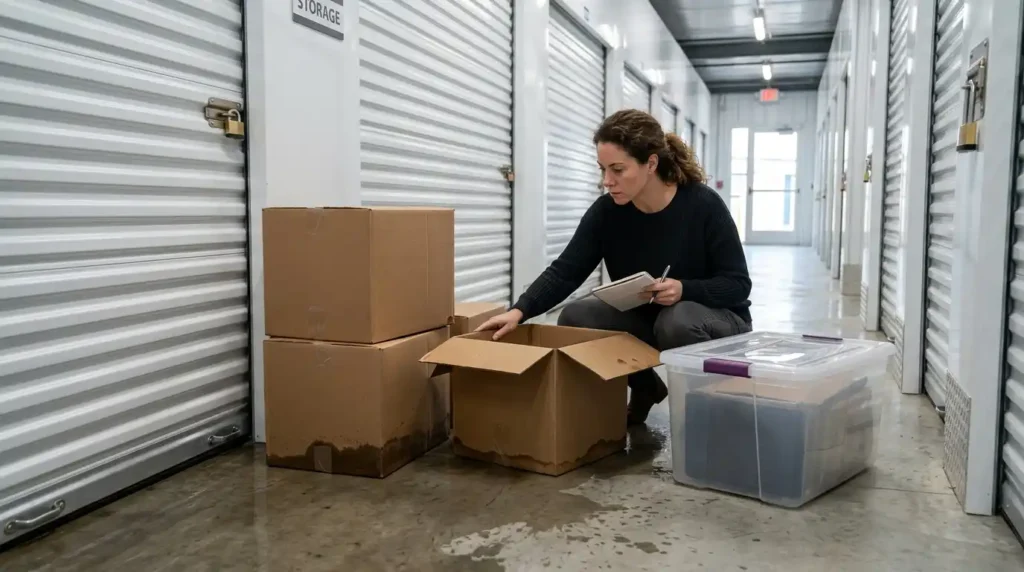
| Mold, mildew, humidity | Likely not | Gradual damage is usually excluded |
| Pests (rodents, insects) | Likely not | Usually excluded as maintenance-related |
| Wear and tear | Not covered | Standard exclusion |
| Vehicles in the unit | Not covered | Cars belong on an auto policy |
| Business inventory | Depends | Often a low sub-limit or excluded |
Notice the flood row. That’s the biggest difference between USAA and most renters insurers. A flooded storage facility is a total loss for many renters. At USAA, NerdWallet reports, flood is part of the base coverage.
Eight Storage Losses, Eight Verdicts
Each case tests what happens when something specific goes wrong. These scenarios are illustrative. They show how standard policy rules usually apply. Your own claim depends on your policy and the facts.
Case 1: The Break-In
What happened: A thief cut the lock on a unit in San Antonio. Furniture and a TV are gone. Total loss: $4,800.
Verdict: Likely covered.
The math:
- Loss: $4,800
- Deductible: $500
- Possible payout: $4,300, if the storage limit allows
What helps: A police report and photos of the cut lock. File both quickly. If you also insure a car in Texas, our guide to Texas car insurance quotes covers the state’s minimums.
Case 2: The Missing Ring
What happened: A $4,000 engagement ring stored in a jewelry box was stolen.
Verdict: Partly covered.
Why: Jewelry often has a theft sub-limit. LegalClarity reports $1,000 for USAA’s standard policy.
- Ring value: $4,000
- Possible sub-limit: $1,000
- Possible gap: $3,000
What helps: USAA’s Valuable Personal Property (VPP) coverage. NerdWallet says it carries no deductible. But honestly? A storage unit isn’t a great place for an engagement ring at all.
Case 3: The Flooded Facility
What happened: A storm floods a ground-floor facility in Houston. Boxes of clothes and books are ruined.
Verdict: Likely covered at USAA.
Why: NerdWallet says USAA includes flood coverage. Most renters’ policies would deny this claim. Florida drivers face similar flood risks on the auto side, as Florida car insurance quotes explain.
What to check: Confirm how flood coverage applies to property away from your home. Ask before storm season. If a flood claim is denied, our Alabama insurance claim lawyer guide explains how disputes work.
Case 4: The Slow Mildew
What happened: After eight months in a non-climate-controlled unit, a couch and paintings grew mildew.
Verdict: Likely not covered.
Why: Gradual damage from humidity or mold is usually excluded. It’s treated as a maintenance issue, not a sudden event.
The lesson: Insurance won’t fix a bad storage choice. Climate control costs more, but it protects what insurance won’t.
Case 5: The Car in the Unit
What happened: A vehicle stored in a drive-up unit was damaged by a falling shelf.
Verdict: Not covered by renters insurance.
Why: Renters policies exclude motor vehicles. Damage to a stored car falls under the car’s comprehensive coverage. If a car is damaged by an uninsured driver instead, our guide to an uninsured motorist lawsuit explains that process.
Case 6: The Overseas PCS Move
What happened: A soldier stores household goods in Germany during a permanent change of station. A fire damages the unit.
Verdict: Likely covered.
Why: NerdWallet reports that USAA covers items in storage overseas. That’s a big deal for military families. Many civilian insurers limit coverage outside the U.S.
What to check: Some policy forms carry war-related exclusions for property outside the continental U.S. Read that section if you’re stationed in a high-risk area.
Case 7: The Roommate’s Boxes
What happened: A shared unit was burglarized. Half the items belong to a roommate who isn’t on the policy.
Verdict: Your items only.
Why: Renters insurance generally covers the named insured and resident relatives. A roommate who isn’t related or listed usually needs their own policy.
Case 8: The Side-Business Inventory
What happened: An Etsy seller stores $6,000 in inventory. It’s stolen.
Verdict: Probably limited.
Why: Business property often has a low sub-limit on renters’ policies. Some policies exclude it outright. If the business also uses a vehicle, our guide to commercial auto insurance explains when you need a business policy.
Does Renters Insurance Cover Storage Units USAA Members Use? How It Compares
Military families moving often ask the same thing: does renters insurance cover storage units that USAA members rent between duty stations? Here’s how USAA appears to compare with the industry norm.
| Feature | Typical Renters Policy | USAA (as reported) |
| Storage coverage | Usually included | Included, U.S. and overseas |
| Storage limit | Often 10% of Coverage C, or a flat cap | Reported as up to policy limit (verify) |
| Flood | Usually excluded | Included (NerdWallet) |
| Earthquake | Usually excluded | Included (NerdWallet) |
| Settlement | Often, actual cash value by default | Replacement cost (NerdWallet) |
| Military uniforms | No special treatment | No deductible on covered claims (NerdWallet) |
What stood out to me when comparing these sources was the flood row. Storage facilities often sit on cheap, low-lying land. That’s exactly where flooding hits. For a renter at a typical insurer, that’s a common uncovered loss. For a USAA member, it may not be.
What It Costs
NerdWallet puts USAA renters insurance at about $160 a year, or roughly $13 a month. The national average in its data is $165 a year. Its sample policy used $30,000 in personal property coverage, $100,000 in liability, and a $500 deductible.
Eligibility is limited. NerdWallet lists active military, veterans, certain federal employees, their families, and descendants of USAA members. Military families often review life coverage too, such as a $2 million life insurance policy.
Storage Facility Plans: Double Coverage or Wasted Money?
Most facilities offer their own “tenant protection plan.” Some require proof of insurance or a plan before you move in.
Insurance.com reports these plans cost about $8 to $25 a month for $2,000 to $5,000 of coverage. Standalone storage insurance with $15,000 or more in limits runs about $35 to $50 a month.
Here’s the comparison. These figures are illustrative.
- Facility plan: $15 a month × 12 = $180 a year for about $5,000 of coverage
- USAA renters policy: about $160 a year for $30,000 of coverage, home and storage combined (NerdWallet’s sample)
So, is USAA coverage good enough to skip the facility plan? Often, yes. Many facilities accept a renter’s policy declarations page as proof of insurance. Ask the facility before you sign.
When the Facility Plan Still Makes Sense
There’s a realistic case for buying both. If USAA’s storage limit turns out to be a percentage cap, and your unit holds more than that cap, a facility plan can fill the gap. It may also make sense if you’ve hit a sub-limit you can’t raise.
Read the Rental Contract, Too
Facility contracts often limit the facility’s own liability for your belongings. That means if your items are damaged, the facility may not pay much. Your own insurance usually does the heavy lifting. Large estates face similar limit questions, as our guide to the cost of a $20 million life insurance policy shows.
PCS Moves, Deployment, and Moving Day
Military families store belongings more than most. A PCS move or deployment can mean months of storage. Here’s where coverage gets tested.
Moving to a New Duty Station
Say you’re moving to Fort Carson in Colorado Springs or Buckley Space Force Base near Denver. Your goods may sit in storage while you find housing. Your car insurance will also need a new garaging address. Our guide to Colorado auto insurance quotes explains the state’s 25/50/15 minimums, MedPay rules, and hail risk.
If you’re landing in the city itself, rates there run higher than the state average. Our walkthrough of Denver car insurance quotes shows how one driver compared four insurers.
The Rental Truck Problem
Many people drive a rental truck to their storage unit. That trip has its own insurance gap. Personal auto policies may not cover large moving trucks. Check before you drive off the lot. Rules vary by state, as New York car insurance quotes show.
If a moving-day crash does injure someone, the costs can climb fast. Our car accident settlement calculator gives an educational sense of how injury claims are valued. It isn’t legal advice. But it shows why the right coverage matters.
Liability at the Storage Facility
Renters insurance also includes personal liability. That can matter if you accidentally damage a neighbor’s unit or injure someone at the facility. The concept works much like car liability limits. Our guide on how to get liability insurance and choose limits explains why low limits can leave you exposed.
Your Car Isn’t Covered by Renters Insurance
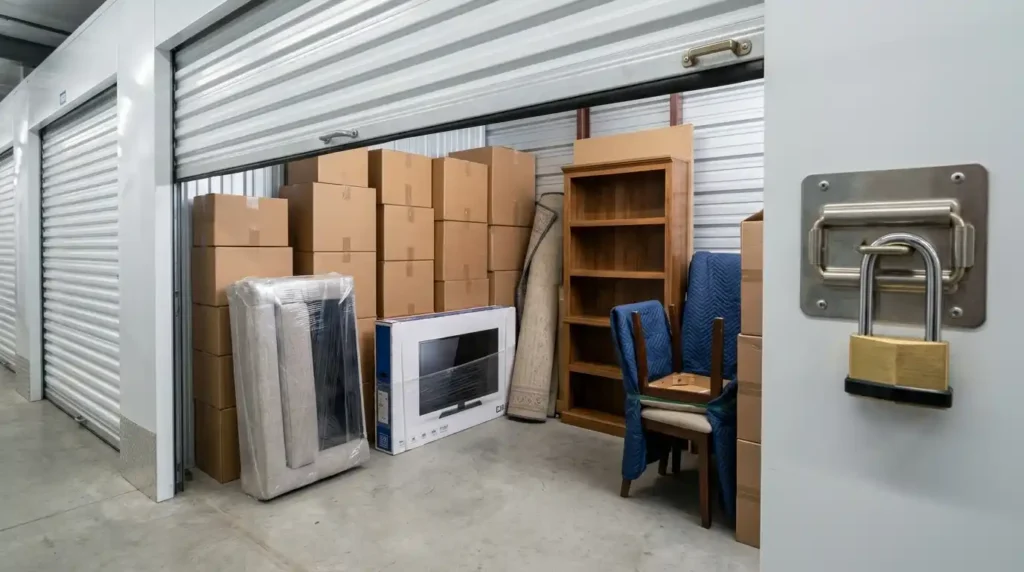
This is the most common storage mistake. Renters insurance doesn’t cover cars, motorcycles, or boats, even inside a unit.
Damage to a stored car usually falls under comprehensive coverage on the car’s own policy. Some owners drop collision while a car sits in storage during a deployment, but keep comprehensive. Ask your insurer whether that’s allowed in your state and what it saves. If an uninsured driver hits you on moving day, our guide to finding a lawyer for a car accident with no insurance explains your options.
Our car insurance calculator can help you estimate how changing coverage affects your premium.
If you’re shopping for a new auto policy after a move, use the same limits on every quote. Our guide on how to compare car insurance quotes side by side shows how to keep the comparison fair.
Bundling Renters and Auto
USAA members often insure renters and auto together. Bundling can lower your total price. But it’s worth checking both sides separately.
A household driver with tickets or an accident can raise the auto side sharply. In that case, the bundle may not be the best deal. Our guide to the cheapest high-risk car insurance companies shows how much prices vary after a violation.
Some drivers also need an SR-22 filing after a serious violation. Confirm your insurer files it in your state before you bundle. Our review of the best SR22 insurance companies explains how those filings work.
Price isn’t everything, either. Claims service matters most after a loss. Our review of how to evaluate the best insurance companies explains how to read complaint records and financial ratings.
If You Own a Home
Homeowners policies have their own off-premises rules, often the same 10% pattern. If you’re shopping for a home policy, our walkthrough of an Allstate homeowners quote shows how to read personal property and settlement terms line by line.
Before a Loss: The 20-Minute Storage Prep
Knowing you’re covered is only half the job. Proof is the other half. Do this before you lock the unit.
- [ ] Photograph every item as you load it. Video works too.
- [ ] Keep receipts for anything valuable.
- [ ] List serial numbers for electronics.
- [ ] Save your storage contract and gate access records.
- [ ] Confirm your storage limit with USAA in writing.
- [ ] Move jewelry and important papers somewhere safer.
- [ ] Choose climate control if you’re storing wood, fabric, or paper long-term.
- [ ] Update your address with USAA if you move.
Here’s the friction point most people hit. Without photos, an adjuster has to rely on your memory. That’s where claims slow down or shrink.
After a Loss: What to Do First
- Report it to the facility. Get a written incident record.
- File a police report for theft or vandalism.
- Photograph the damage before moving anything.
- Contact USAA to start the claim.
- Send your inventory and receipts.
- Keep damaged items until the adjuster says you can discard them.
Replacement cost settlements often pay in stages. You may get an initial payment and then the rest after you replace the item. Ask how USAA handles this for your claim. Families planning ahead may also compare the cost of a $3 million life insurance policy.
Final Verdict
Does USAA renters insurance cover storage units? Yes. It generally covers belongings in storage, at home, or overseas. Reported flood and earthquake coverage makes it broader than many renters’ policies. That can matter a lot for storage facilities.
But “covered” isn’t unlimited. Check three things: your storage limit, your sub-limits for valuables, and the exclusions for mold and pests.
Here’s one feasible next step. Pull up your USAA declarations page today. Find your personal property limit. Then call USAA and ask one question: “What is my coverage limit for property in a storage unit?” Write down the answer, the date, and the representative’s name.
Quick Questions
Does renters insurance cover storage units that USAA members use on base?
Generally, yes, if the storage is part of your covered personal property. Confirm how your policy treats on-base or government-provided storage.
What else does a USAA renters policy cover?
NerdWallet lists personal property at replacement cost, liability, flood, earthquake, and no deductible for military uniforms on covered claims. Optional add-ons include electronics coverage and Valuable Personal Property.
Is storage overseas covered?
NerdWallet reports that it is. Check your policy for any war-related exclusions that may apply outside the continental U.S.
Do I need the storage facility’s insurance if I have USAA?
Often not, but ask. Many facilities accept a renter’s declarations page as proof of coverage. Buy the facility plan only if it fills a real gap.
Does renters insurance cover storage units that USAA members rent for a business?
Usually only partly. Business property often has a low sub-limit or is excluded. A business policy may be needed.
Are moldy stored items covered?
Usually not. Mold and humidity damage are typically excluded as gradual or maintenance-related losses.

Michael Bennett is a U.S. insurance research and consumer education writer at Insurancebasics Hub, an independent resource dedicated to helping consumers understand insurance policies, coverage decisions, claims, and insurance-related consumer protections. His work covers auto, homeowners, renters, life, and other areas of insurance, with a focus on making complex insurance topics easier to understand.
Michael takes a research-focused approach to insurance content, using authoritative government and regulatory resources, state insurance department guidance, applicable insurance rules, policy provisions, and documented industry information. His articles examine important details such as coverage limits, deductibles, exclusions, policy conditions, premiums, claims, denials, cancellations, renewals, and state-specific requirements.
His goal is to provide accurate, transparent, and practical information that helps readers make better-informed insurance decisions. Insurancebasics Hub provides general educational information and does not replace individualized advice from a licensed insurance professional, attorney, financial professional, or other qualified adviser.