
Commercial auto insurance covers vehicles used for business purposes, including liability, collision, and comprehensive protection, usually with higher limits than a personal policy. You generally need it once a vehicle is owned by a business, used to transport goods or passengers for pay, or driven regularly for work beyond a simple commute. A personal auto policy typically excludes business use entirely.
You may have started researching this because your personal insurer denied a claim, or because a client asked for proof of coverage you do not have yet. Either way, the confusion is common, and the stakes are real.
What Is Commercial Auto Insurance?
It is a policy that covers vehicles owned or used by a business, protecting against liability and vehicle damage the same way personal auto insurance does, but built around business risk instead of personal driving. It typically carries higher liability limits, since business use often creates greater financial exposure than personal driving.
Insurers commonly recommend at least $1 million in commercial auto liability coverage as a general benchmark, according to the Insurance Information Institute, though your actual need depends on your industry and risk exposure. You can browse more independent insurance breakdowns like this one on the Insurancebasics Hub.
Is It Different From a Business Auto Policy?
No. The two names are used interchangeably across the industry. The formal policy form many insurers use is called a Business Auto Policy, or BAP, but consumers and marketing materials commonly call the same coverage commercial auto coverage.
What Does It Actually Cover?
It generally covers bodily injury liability, property damage liability, collision, comprehensive, and often uninsured or underinsured motorist coverage for vehicles used in business operations. Medical payments or personal injury protection coverage may also be included depending on your state. Our guide on how to get liability car insurance explains how liability limits work on a personal policy, for comparison.
- Bodily injury liability: pays for injuries you or an employee causes to others while driving for business
- Property damage liability: pays for damage to another person’s vehicle or property
- Collision coverage: pays to repair or replace a business vehicle after an accident
- Comprehensive coverage: pays for theft, vandalism, fire, and other non-collision losses
- Uninsured or underinsured motorist coverage: protects your business if the at-fault driver has no or insufficient insurance
What Does Commercial Vehicle Insurance Not Cover?
Commercial vehicle insurance does not automatically cover tools or cargo left inside the vehicle, employees’ personal vehicles, garage or repair shop risks, or customer vehicles left in your care. Each of these requires a separate policy or a specific endorsement added to your coverage.
Here is the distinction many business owners miss. A general liability policy or a business owner’s policy typically covers tools and equipment, not your commercial auto policy. Treating the two as interchangeable is one of the more expensive assumptions a business can make.
Do You Need Commercial Auto or Just Personal Auto Insurance?
You need commercial coverage once a vehicle is owned by your business, used to transport goods or paying passengers, or driven regularly enough for work that it no longer fits a personal policy’s intended use. A personal policy is generally built around commuting and everyday errands, not business operations.
When Does a Personal Auto Policy Stop Covering Business Driving?
A personal auto policy typically stops covering you the moment your driving crosses from incidental work errands into regular business use, such as making deliveries for pay or transporting clients. Insurers define this line differently, so the safest approach is to ask your insurer directly rather than assuming occasional business use is automatically fine. If a claim is denied over business use, our New York insurance claim attorney guide explains how those disputes work.
This gap matters most at claim time, not at renewal. A denied claim because of undisclosed business use is one of the more painful surprises a driver can face, since it usually surfaces right after an accident, not before one. If you are weighing full coverage on a personal vehicle against a business policy, our full coverage car insurance guide explains what a personal policy actually includes and where its limits sit.
What Is Hired and Non-Owned Auto Insurance, and How Is It Different?
Hired and non-owned auto insurance, known as HNOA, covers liability when your business uses vehicles it does not own, such as a rented van or an employee’s personal car driven for work. It protects the business, not the vehicle itself, since the vehicle’s own physical damage coverage still comes from whoever owns or rents it.
A business that never owns a vehicle but regularly has employees run errands in their own cars still carries real liability exposure. HNOA exists specifically to close that gap, and it is often far cheaper than a full commercial auto policy because it only covers liability, not physical damage to the vehicle.
Commercial vs. Rideshare Insurance: Which Applies to You?
Rideshare insurance is a specific product built for drivers using their personal vehicle through a rideshare or delivery app, while commercial coverage is built for business-owned vehicles or broader commercial operations. A personal policy without a rideshare endorsement typically excludes the period when your app is on but no passenger is in the car, leaving a real coverage gap. Rideshare rules vary by state, as Michigan car insurance quotes show.
Decision Checklist: Personal Auto vs. HNOA vs. Full Commercial Auto Policy
| Your Situation | Coverage That Likely Fits |
| You drive your own car and never use it for business | Personal auto insurance |
| Your business uses employee-owned or rented vehicles, but owns none itself | Hired and non-owned auto insurance |
| Your business owns one or more vehicles used for work | A full commercial auto policy |
| You drive for a rideshare or delivery app using your own car | A rideshare-specific endorsement or policy |
What Does Business Auto Insurance Cost?
Business auto insurance costs vary widely, with published estimates ranging from roughly $150 to $500 or more per month depending on business type, fleet size, and coverage limits. There is no single accurate national number, since the data sources and business profiles behind published averages differ significantly.
What Factors Affect the Cost?
- Industry risk: a delivery business or contractor typically pays more than a low-mileage consulting business
- Vehicle type and class: heavier trucks and specialized vehicles cost more to insure than passenger cars
- Driving records: every listed driver’s history affects the business’s overall rate, not just the owner’s
- Coverage limits and deductible: higher liability limits raise the premium, while a higher deductible can lower it
- Claims history: a business with recent claims generally pays more at renewal
- Location: urban, high-traffic areas tend to cost more than rural operating areas
How Much Does Commercial Truck Insurance Cost Compared to Standard Business Vehicles?
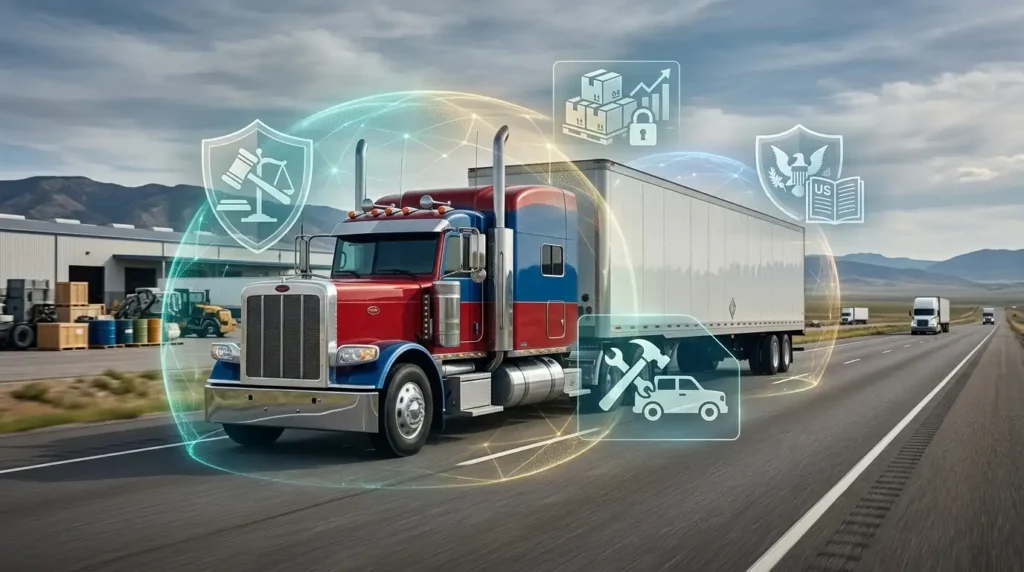
Commercial truck insurance typically costs more than standard business vehicle coverage, since larger trucks carry higher liability exposure, greater repair costs, and often federally mandated minimum coverage levels. An owner-operator hauling general freight will usually see a noticeably higher premium than a contractor insuring a single pickup truck.
Illustrative calculation, not a real quote: a small business insuring one pickup truck for local deliveries might see a monthly premium near $180, while a similar business operating a delivery van across a wider area might see $260 a month for the same liability limits. A single truck operation with a $1 million liability requirement could easily run $800 to $1,200 a month, reflecting the much larger financial exposure involved. Dense markets tend to cost more, as New York car insurance quotes show.
Comparison Table: Typical Cost Drivers by Business Type
| Business Type | Typical Risk Level | Common Cost Driver |
| Consulting or low-mileage service | Lower | Minimal weekly driving, mostly local |
| Contractor or trades business | Moderate | Tools onboard, job site driving, moderate mileage |
| Local delivery or courier | Moderate to high | High daily mileage, frequent stops, package handling |
| Long-haul trucking | High | Interstate mileage, federally mandated minimums, cargo value |
What Is Truck Insurance and How Does It Differ From Standard Commercial Auto Coverage?
Truck insurance is a specialized version of commercial auto coverage built for larger vehicles and freight operations, adding coverage types that a standard business auto policy does not include. Standard commercial auto coverage protects the vehicle and liability exposure, while trucking-specific coverage also protects cargo and addresses unique operating scenarios.
What Additional Coverage Do Trucking Businesses Need?
- Motor truck cargo insurance: covers the freight being hauled, which a standard liability or collision policy does not protect
- Bobtail insurance: covers a truck operating without a trailer attached, a scenario that standard commercial auto coverage often excludes
- Non-trucking liability insurance: covers an owner-operator using the truck for personal reasons while not under dispatch for a carrier
How Do DOT and FMCSA Requirements Affect Coverage for Trucks?
Interstate trucking operations must meet federal minimum insurance requirements set by the Federal Motor Carrier Safety Administration, which are separate from and often higher than a state’s general commercial auto minimum. These federal minimums are laid out in 49 CFR Part 387, the federal regulation governing financial responsibility for motor carriers.
This is a distinction that many general commercial auto articles blur completely. A business operating trucks only within one state may only need to meet that state’s requirements, while a carrier crossing state lines must meet the federal standard as well, regardless of what a single state’s minimum says.
How to Get Quotes
Getting accurate quotes starts with gathering complete information about your vehicles, drivers, and business operations before you contact an insurer. Incomplete information at quote time almost always leads to a higher final premium once underwriting fills in the gaps.
What Information Do You Need for Trucking Insurance Quotes?
Trucking insurance quotes are only as accurate as the details you provide. Have these ready:
- Vehicle details, including VIN, weight class, and intended use
- Driving records for every driver who will operate a covered vehicle
- Business details, including industry type, years in operation, and prior claims history
- Desired coverage limits and deductible for each vehicle
Many of the underlying principles for getting an accurate personal quote apply here too, particularly around providing complete information up front rather than letting an insurer discover gaps later. Our car insurance quotes guide walks through that process in more depth for personal policies, and the same logic carries over to a business application.
How to Compare Commercial Auto Providers Effectively
Compare providers by requesting quotes with identical coverage limits and deductibles, then checking each insurer’s financial strength and complaint history before deciding on price alone. A cheaper quote from a company with a poor claims reputation can cost your business far more the first time you actually need to file. Alabama car insurance quotes show how much prices can vary between insurers for the same driver.
Progressive and Travelers are commonly cited among the largest commercial auto insurers by market share, according to Insurance Information Institute data, though size alone does not determine which company fits your specific business best. Our comparison of top-rated auto insurers explains how to evaluate that kind of track record in more detail.
State and Federal Requirements for Business Vehicles
Requirements come from two separate layers: your state’s general minimum liability rules and, for interstate trucking, federal requirements on top of that. Confusing the two can leave a business technically compliant with one layer while still violating the other.
What Are the Minimum Requirements by State?
State minimum liability requirements for commercial vehicles vary, and most states apply a similar or slightly higher standard than their personal auto minimums. Nearly every state requires some form of liability insurance for business-owned vehicles, with New Hampshire commonly cited as an exception worth verifying directly, since financial responsibility laws can still apply there in practice. Florida, for example, sets unusual personal minimums, as our guide to Florida car insurance quotes explains.
Confirm your own state’s exact commercial minimum through your state Department of Insurance rather than relying on a general figure, since requirements can differ by vehicle weight and business type. The NAIC’s consumer information tool is also a useful starting point for checking an insurer’s licensing and complaint history in your state.
How Do Requirements Differ for Interstate Trucking Operations?
Interstate trucking operations must meet federal minimum financial responsibility levels that generally exceed most state commercial auto minimums, particularly for vehicles hauling hazardous materials or heavier freight. A business operating only within one state’s borders is typically governed by that state’s requirements alone, while any carrier crossing state lines takes on the federal standard as well.
Common Mistakes Businesses Make With Insurance
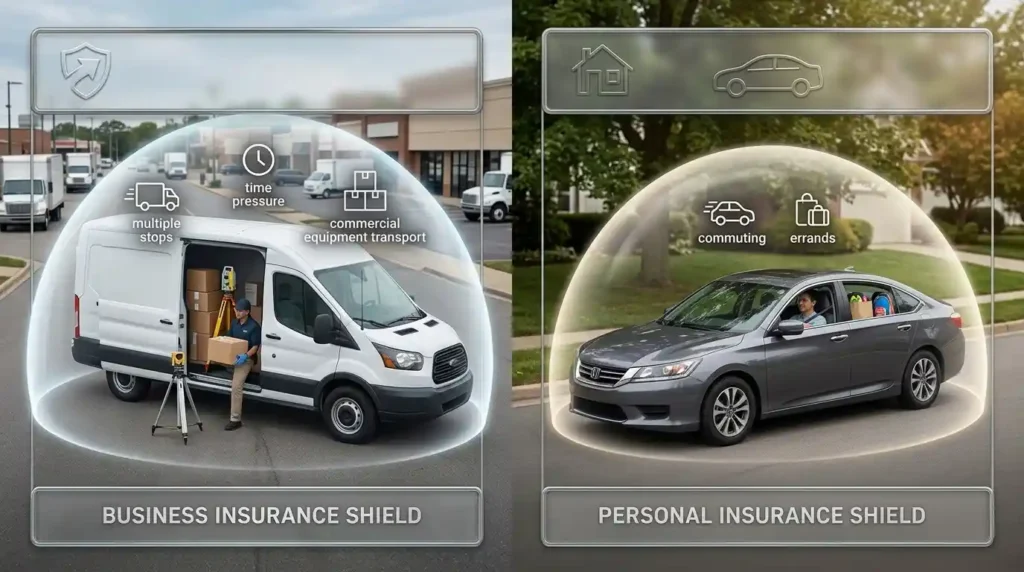
Most mistakes come from treating a personal policy, a general liability policy, or an HNOA policy as interchangeable with full commercial coverage. The three below cause the most expensive surprises.
Assuming Personal Auto Insurance Covers Work-Related Driving
Assuming a personal policy covers work-related driving is one of the most common and costly mistakes a small business owner makes, since most personal insurers exclude business use once it becomes regular rather than occasional. Misclassifying a business vehicle as personal use does not just risk a higher premium later. It can result in a denied claim entirely at the exact moment coverage matters most. If that happens, our Alaska insurance claim lawyer guide shows how claim denials are contested.
Forgetting to Add Newly Purchased or Leased Vehicles to a Policy
Forgetting to add a newly purchased or leased vehicle to an existing commercial policy can leave that specific vehicle with no coverage at all until the insurer is formally notified. Some policies include a short automatic coverage window for new vehicles, but this varies by insurer and should never be assumed without checking your policy language directly. Lapse rules also differ by state, as Maryland car insurance quotes show.
Overlooking Hired and Non-Owned Auto Coverage for Employee-Owned Vehicles
Overlooking hired and non-owned auto coverage leaves a business exposed whenever an employee uses their own vehicle for work, since a standard commercial auto policy covering business-owned vehicles does not automatically extend to employee-owned cars. This gap surfaces most often with small businesses that assume owning no vehicles means carrying no auto-related risk at all. Nevada car insurance quotes show how one state handles uninsured and underinsured drivers.
Final Thoughts
Commercial auto insurance exists because business driving carries different risks than personal driving, and a policy built for one rarely protects you fully in the other. The right setup depends on whether your business owns vehicles, uses vehicles it does not own, or simply has employees running occasional errands, not on a single blanket rule that fits every operation equally.
Before you assume your current policy is enough, walk through how your vehicles are actually used today, not how they were used when you first bought the policy. A business that outgrows its original coverage without updating it is a common way protection quietly falls short, and catching that gap now costs far less than discovering it after a claim. Owners protecting the business may also review life coverage, such as a $2 million dollar life insurance policy.

Michael Bennett is a U.S. insurance research and consumer education writer at Insurancebasics Hub, an independent resource dedicated to helping consumers understand insurance policies, coverage decisions, claims, and insurance-related consumer protections. His work covers auto, homeowners, renters, life, and other areas of insurance, with a focus on making complex insurance topics easier to understand.
Michael takes a research-focused approach to insurance content, using authoritative government and regulatory resources, state insurance department guidance, applicable insurance rules, policy provisions, and documented industry information. His articles examine important details such as coverage limits, deductibles, exclusions, policy conditions, premiums, claims, denials, cancellations, renewals, and state-specific requirements.
His goal is to provide accurate, transparent, and practical information that helps readers make better-informed insurance decisions. Insurancebasics Hub provides general educational information and does not replace individualized advice from a licensed insurance professional, attorney, financial professional, or other qualified adviser.
4 Responses