
If the driver who hit you has no insurance, a lawyer can often help, mainly by finding every policy that might pay, including your own uninsured motorist (UM) coverage. Most car accident lawyers work on a contingency basis, so there’s usually no upfront fee. But a lawyer can’t create money that doesn’t exist. If you have no UM coverage and the driver has no assets, recovery may be limited.
People search “lawyer car accident no insurance” for two very different reasons. Some were hit by an uninsured driver. Others were uninsured themselves when the crash happened.
Both situations deserve an honest answer. So this guide doesn’t sell you on hiring anyone. It gives you a value test, the questions to ask in a free consultation, the fee math, and the cases where you might not need a lawyer at all.
Start Here: The Two Numbers That Decide Your Case
Before you call anyone, find two numbers.
- Your UM limit. It’s on your auto policy’s declarations page. It’s often the biggest source of payment after an uninsured crash.
- Your total loss. Add medical bills, lost wages, and vehicle damage so far.
Why these two? Because a lawyer’s value often depends on the gap between them. A large loss with UM coverage gives a lawyer something to recover. A small loss, or no coverage and no collectible driver, may not. Comparing car insurance quotes is also when most people choose their UM limit.
The Insurance Research Council estimated that 15.4% of U.S. drivers were uninsured in 2023. That’s about one in seven. So this situation isn’t rare, and your own policy is often the main safety net. Our guide on how to get liability car insurance explains how to match UM limits to your liability limits.
The Honest Value Test: Do You Need a Lawyer for Car Accident With No Insurance Claims?
Not every search like this should end with hiring one. Here’s a general guide, not a rule.
| Your Situation | Lawyer Often Helps? | Why |
| Serious injury, hospital stay, or surgery | Usually yes | Large damages, complex medical proof, insurer pushback |
| Injury costs above your UM limit | Usually yes | A lawyer can look for other liable parties and policies |
| Your UM claim was denied or lowballed | Often yes | Policy disputes and bad-faith questions get technical |
| The other driver was working or driving someone else’s car | Often yes | An employer’s or owner’s policy may apply |
| Hit-and-run with injuries | Often yes | UM rules for unidentified drivers can be strict |
| Minor injury, fully treated, UM pays fairly | Maybe not | Fees may outweigh what a lawyer adds |
| Property damage only | Often not | Collision, UMPD, or small claims may be simpler |
| No UM, uninsured driver with no assets | Limited | There may be little money for anyone to recover |
Decision checkpoint: If your injuries are minor and your own insurer is paying fairly, ask yourself what a lawyer would add after fees. If your injuries are serious or your claim is stuck, a consultation usually costs nothing to try. If your UM claim is denied, our New York insurance claim attorney guide explains how bad faith disputes work.
What a Lawyer Can and Can’t Do
This is where expectations of a car accident no insurance lawyer often go wrong. Here’s the split.
| A Lawyer Can | A Lawyer Can’t |
| Review every policy that might apply, including yours, a household member’s, and an employer’s | Create insurance coverage that doesn’t exist |
| Handle your UM claim against your own insurer | Force an uninsured driver with no income to pay |
| Gather police reports, medical records, and wage proof | Guarantee any result or settlement amount |
| Search for the driver’s assets before suing | Undo a deadline you already missed |
| Negotiate medical liens with health insurers or hospitals | Remove no-pay-no-play limits if you were uninsured |
| File a lawsuit and pursue collection | Speed up an insurer beyond what the law allows |
Here’s the part many people miss. In a UM claim, your own insurer sits across the table. It investigates fault and damages much as the other driver’s insurer would. That’s often where a lawyer earns the fee: negotiating with your own carrier. Bad faith rules vary by state, as our Alaska insurance claim lawyer guide explains.
Inside the Free Consultation: 10 Questions to Ask
A free consultation is the cheapest way to test any lawyer. Use that time well. These questions help you judge who’s worth hiring.
1. “How many uninsured motorist cases have you handled?”
Why it matters: UM claims follow policy terms, not just injury law.
Good sign: Specific experience with UM and UIM claims.
Red flag: Vague answers or a focus only on “big verdicts.”
2. “What policies might apply to my crash?”
Why it matters: Coverage can come from your policy, a household relative’s, the car owner’s, or an employer’s. Our guide to commercial auto insurance explains how employer coverage works.
Good sign: They ask about everyone in your household and the other vehicle’s owner.
Red flag: They talk only about suing the driver.
3. “What’s your fee percentage, and does it change if the case goes to trial?”
Why it matters: Many contingency agreements use a lower percentage for early settlement and a higher one for litigation.
Good sign: Clear numbers, in writing.
Red flag: Reluctance to put percentages on paper.
4. “Are case costs deducted before or after your fee?”
Why it matters: This changes your take-home amount.
Good sign: A clear answer and an example.
Red flag: “Don’t worry about that.”
5. “Will I owe costs if we lose?”
Why it matters: Some agreements make clients responsible for expenses either way.
Good sign: A direct answer, written into the agreement.
6. “Is the driver worth suing?”
Why it matters: A judgment is only worth what can be collected.
Good sign: They mention an asset search or collectability.
Red flag: Promising a big lawsuit without asking about the driver’s finances.
7. “What deadlines apply, including my policy’s own deadlines?”
Why it matters: UM policies can have notice and suit deadlines separate from the state statute of limitations.
Good sign: They ask to see your policy.
8. “Should I give my insurer a recorded statement?”
Why it matters: Your policy may require cooperation, but statements can be used to dispute fault or injuries.
Good sign: Guidance on how to cooperate without hurting your claim.
9. “Who will actually handle my case?”
Why it matters: Some firms pass cases to junior staff.
Good sign: A named attorney and a contact person.
10. “What’s a realistic range, and what could lower it?”
Why it matters: Honest lawyers explain risks, not just upside.
Red flag: Guaranteed outcomes. That’s a warning sign, not a promise.
The Rule Behind Fee Agreements
Under the American Bar Association’s Model Rule 1.5(c), which most states use as a template, a contingent fee agreement must be “in a writing signed by the client.” It must state the percentage for “settlement, trial, or appeal” and whether expenses are deducted “before or after the contingent fee is calculated.” Your state’s version may differ slightly.

The Fee Math: What You Might Actually Keep
Almost every lawyer in these cases works on contingency. It sounds simple. The details change the result.
Illustrative example: Your UM claim settles for $60,000. Your lawyer’s fee is one-third. Case costs total $3,000.
| Method | Calculation | You Receive |
| Costs are deducted after the fee | $60,000 − $20,000 fee − $3,000 costs | $37,000 |
| Costs are deducted before the fee | ($60,000 − $3,000) = $57,000; fee = $19,000 | $38,000 |
That’s a $1,000 difference from one sentence in the agreement. Medical liens may also come out of the settlement. Ask how the lawyer handles lien negotiation.
When a Lawyer May Not Be Worth It
Here’s a realistic case. A driver has $2,800 in repair costs and a minor sprain fully treated for $900. Her UM property damage and MedPay cover most of it.
A lawyer taking one-third of any added recovery may leave her with less than handling it herself. For small, clear claims, a direct claim with your insurer or small claims court is often more practical. Even small claims can affect future premiums, as Alabama car insurance quotes show.
Before You Meet a Car Accident No Insurance Lawyer: Your Document Folder
Bring these to any consultation:
- ☐ Police or accident report number
- ☐ The other driver’s name, plate, and any insurance info they gave
- ☐ Photos of the scene, vehicles, and injuries
- ☐ Witness names and phone numbers
- ☐ Your auto policy’s declarations page
- ☐ Any letters or emails from insurers
- ☐ Medical bills and records so far
- ☐ Proof of lost wages
- ☐ Repair estimates or total-loss letters
- ☐ A short timeline of what happened
Don’t forget your other policies. Belongings damaged inside the car are usually a homeowners or renters issue, not an auto one. Our walkthrough of an Allstate homeowners quote shows where personal property limits appear on a typical policy.
Renters often have off-premises coverage for belongings, too. Our guide on whether USAA renters insurance covers storage units explains how off-premises limits usually work.
Recovery Path: What a Car Accident Attorney No Insurance Victims Hire Checks First
A good car accident attorney no insurance victims hire will usually work through sources in an order like this:
- MedPay or PIP for early medical bills, depending on your state
- Health insurance, which may later seek reimbursement
- UM bodily injury for injuries caused by the uninsured driver
- UM property damage or collision for your vehicle
- Other liable parties, such as an employer or vehicle owner
- A lawsuit against the driver, if there are assets to collect
Suing the driver comes last for a reason. Our guide to an uninsured motorist lawsuit explains why judgments against uninsured drivers are often hard to collect, including federal wage garnishment limits.
State Rules Can Change the Value
UM rules differ widely by state. Colorado, for example, requires insurers to offer UM coverage and bars insurers from reducing it by setoffs from other coverage, under C.R.S. § 10-4-609 as published. Our guide to Colorado auto insurance quotes explains how coverage choices shape prices there.
Local pricing also affects how much UM people buy. Our walkthrough of Denver car insurance quotes shows how one driver’s ZIP code shaped her price.
Florida changed its rules recently. Its 2023 tort reform law, HB 837, cut the general negligence deadline from four years to two and barred recovery for plaintiffs found more than 50% at fault. Florida also runs on PIP. Our guide to RV insurance quotes in Florida explains Florida’s PIP and property damage requirements.
Nevada drivers face their own setup. Insurers must offer UM coverage, and drivers can reject it in writing. Our guide to RV insurance in Las Vegas covers Nevada’s 25/50/20 minimums and why rejecting UM is risky.
If You Were the Uninsured One
This is the side most law firm pages skip. Can a lawyer for car accident with no insurance on your side still help you? Sometimes. But some states sharply limit what you can recover. Michigan has its own penalties for uninsured drivers, as Michigan car insurance quotes explain.
These are often called “no pay, no play” laws. Three examples, as published:
| State | Rule | Notable Exceptions |
| California | Prop 213 (Civil Code § 3333.4) generally bars uninsured drivers from recovering noneconomic damages, like pain and suffering | The at-fault driver was convicted of DUI, among others |
| Missouri | RSMo § 303.390: an uninsured motorist “shall waive the ability to have a cause of action or otherwise collect for noneconomic loss” | The at-fault driver was impaired or convicted of certain crimes; passengers keep their rights |
| New Jersey | N.J.S.A. 39:6A-4.5: an uninsured operator has no cause of action for “economic or noneconomic loss” | Very limited |
New Jersey’s rule is the strictest of the three. It can bar even medical bills and lost wages. Neighboring New York uses no-fault PIP instead, as New York car insurance quotes explain.
So should an uninsured driver still talk to a lawyer? Possibly. Exceptions exist. You may also have been a passenger, a pedestrian, or covered under a household member’s policy. A lawyer can check.
You’ll also face consequences for driving uninsured, such as license or registration suspension. Getting coverage back in place quickly matters. Before you share your data with a new agency, verify its license. Our fact-check of JoNa Insurance Agency walks through how to check an agency’s license and reviews.
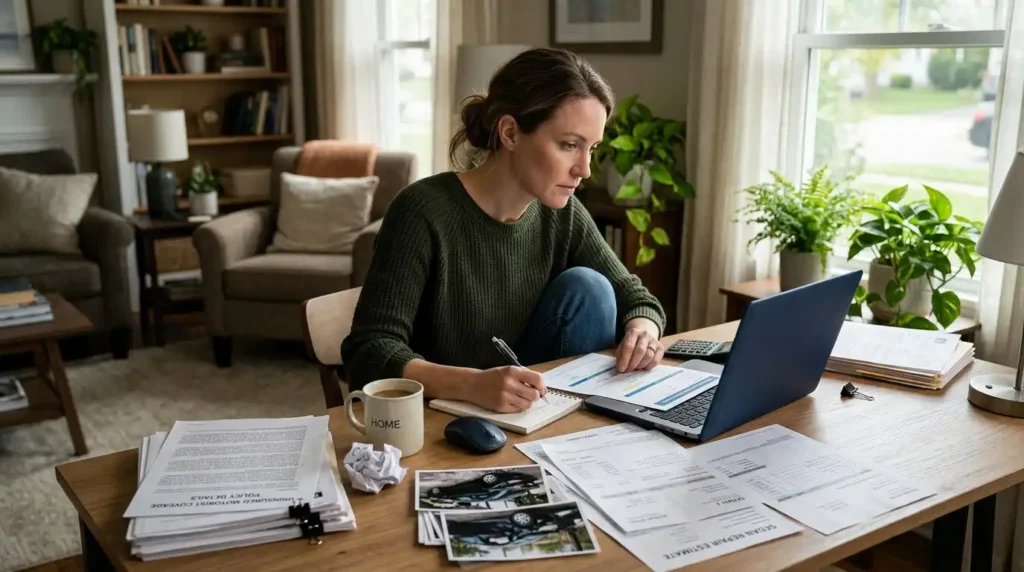
Scenario Cards: Four Common Situations
These scenarios are illustrative. They show how a lawyer’s role changes with the facts.
Card 1: The Hit-and-Run. A driver sideswipes you and flees. You report it to the police that night. Your policy treats the unknown driver as uninsured. A lawyer helps document the crash and handles the UM claim. Prompt reporting matters here.
Card 2: The Work Van. An uninsured delivery driver hits you while on the job. His employer may share liability, and its commercial policy may apply. If you were working when hit, workers’ comp may also come into play. Our guide to employer of record insurance coverage explains who holds workers’ comp in outsourced employment.
Contractor vehicles often sit under specialty commercial programs with their own claims lines. For one example of how such a program separates its agent portal and claims contacts, see our guide to the US Assure agent login.
Card 3: The Minimum-Limit Driver. The other driver has insurance, but only state minimums. Your injuries exceed it. This becomes an underinsured case, not a pure uninsured case. A lawyer collects the at-fault limit, then pursues your UIM coverage for the gap. Families facing large losses may also review life coverage, such as a $2 million dollar life insurance policy.
Card 4: Both Drivers Uninsured. Neither driver had coverage. You were not at fault. Your recovery depends heavily on your state’s no-pay-no-play rules and the other driver’s assets. A lawyer can clarify whether any path exists.
Red Flags in Lawyer Advertising
Some ads aimed at crash victims promise far too much. Watch for these signs:
- Guaranteed settlement amounts
- Pressure to sign at the first meeting
- No written fee agreement
- Unsolicited contact right after the crash
- Vague answers about who handles your case
- Promises to “make the driver pay” without discussing collectability
Most states regulate lawyer advertising and solicitation. If something feels off, you can check the lawyer’s standing with your state bar. Maryland car insurance quotes show how UM coverage works in a contributory-negligence state.
How to Avoid This Next Time
The best way to avoid needing a lawyer is your own coverage. Florida car insurance quotes show how PIP and UM fit together. Consider:
- UM and UIM limits that match your liability limits
- Stacking, if your state and insurer allow it
- MedPay or PIP for fast medical payments
- An umbrella policy, if your insurer offers UM coverage with it
Our guide to home insurance quotes in Rhode Island explains how umbrella policies sit above home and auto limits.
Looking Ahead
The IRC found that 33.4% of drivers were either uninsured or underinsured in 2023, up 10 percentage points since 2017. If that trend continues, more crash victims may depend on their own UM coverage. That’s a reasonable expectation, not a confirmed forecast. Reviewing your UM limits at each renewal is the practical response. Nevada car insurance quotes show how UM choices shape prices in one state.
The Bottom Line on Lawyer Car Accident No Insurance Cases
Searching for a lawyer car accident no insurance situations can feel urgent. Start with your own policy. Your UM limit and your total loss decide much of what’s possible. A lawyer adds the most value when injuries are serious, the claim is disputed, or another party may be liable. For small, clear claims, you may not need one.
Your one pragmatic next step: find your declarations page today and write down your UM limit. Then, if your injuries are serious, use the 10 questions above in a free consultation.
Frequently Asked Questions
Do I need a lawyer if the other driver has no insurance?
Not always. A lawyer often helps with serious injuries, denied UM claims, or cases with other liable parties. For small, clear claims, you may handle it directly with your insurer.
How much does a lawyer cost in these cases?
Most work is on contingency, often around one-third of the recovery, with case costs handled as the written agreement states. There’s usually no upfront fee.
Can a lawyer help if I was uninsured?
Sometimes. Some states limit what uninsured drivers can recover. A lawyer can check exceptions and other coverage, like a household member’s policy.
Can a lawyer collect from a driver with no money?
Not if there’s nothing to collect. A lawyer can search for assets, but a judgment against a driver with no income or property may go unpaid.
Will my own insurer fight my UM claim?
It may dispute fault or damages. In a UM claim, your insurer evaluates the claim much like the other driver’s insurer would.
Is a free consultation really free?
Usually, yes. Ask before the meeting whether any charge applies.
Does my lawyer have to be local?
Generally, yes. Lawyers must be licensed in the state where they practice, and state law shapes your claim.

Michael Bennett is a U.S. insurance research and consumer education writer at Insurancebasics Hub, an independent resource dedicated to helping consumers understand insurance policies, coverage decisions, claims, and insurance-related consumer protections. His work covers auto, homeowners, renters, life, and other areas of insurance, with a focus on making complex insurance topics easier to understand.
Michael takes a research-focused approach to insurance content, using authoritative government and regulatory resources, state insurance department guidance, applicable insurance rules, policy provisions, and documented industry information. His articles examine important details such as coverage limits, deductibles, exclusions, policy conditions, premiums, claims, denials, cancellations, renewals, and state-specific requirements.
His goal is to provide accurate, transparent, and practical information that helps readers make better-informed insurance decisions. Insurancebasics Hub provides general educational information and does not replace individualized advice from a licensed insurance professional, attorney, financial professional, or other qualified adviser.