
RV insurance quotes Florida drivers receive usually start around $125 a year for liability-only coverage and can pass $3,000 for a full-time Class A. Florida requires $10,000 in PIP and $10,000 in property damage liability for motorhomes. Towable trailers have no state requirements. Your price depends on RV type, value, use, storage, and hurricane exposure.
Every RV quote form asks the same handful of questions. Most people rush through them. But each answer moves the price, and some change what you’d get paid after a hurricane.
So this guide is built around the form itself. It walks through each field you’ll fill in, explains why the insurer asks, and shows how your answer shifts the cost. Along the way, you’ll find real Florida rules, cost ranges, and a hurricane-season timeline.
Before the Form: The Florida Rules in 60 Seconds
| RV Type | What Florida Requires | Source |
| Motorhome (Class A, B, C) | $10,000 PIP + $10,000 property damage liability | FLHSMV |
| Travel trailer, fifth wheel, pop-up | No state insurance requirement | Progressive, Good Sam |
| Tow vehicle | Must meet Florida’s PIP and PDL minimum | FLHSMV |
Three details catch people off guard:
- Coverage must be continuous. The Florida Highway Safety and Motor Vehicles Department (FLHSMV) says coverage must stay in force “even if the vehicle is not being driven or is inoperable.” That includes a motorhome parked for the summer.
- Surrender the plate first. FLHSMV says to surrender your license plate before canceling insurance. Otherwise, penalties can apply.
- Bodily injury liability isn’t on the list. Florida’s minimum doesn’t require it for most drivers. But that doesn’t make it optional in practice. More on that below.
Field 1: “What Type of RV Do You Own?”
This is the biggest price driver. A Class A motorhome is a house on a truck chassis. A pop-up camper is a tent on wheels. Insurers price them very differently.
What RV Insurance Quotes Florida Owners See by Type
Trusted Choice’s InsuredBetter guide (updated September 2026) gives these national annual ranges. We’ve added the monthly equivalent, which most pages leave out.
| RV Type | Annual Range | Monthly Equivalent |
| Class A motorhome | 600–3,000 | 50–250 |
| Class C motorhome | 540–1,500 | 45–125 |
| Class B (camper van) | 480–1,000 | 40–83 |
| Travel trailer / camper | 180–1,000 | 15–83 |
| Pop-up camper | 200–550 | 17–46 |
For Florida specifically, Progressive reported 2024 averages of $1,386.04 a year for a motorhome and $841.16 a year for a travel trailer. That’s about $116 and $70 a month. Those figures are a few years old now, so treat them as a reference point, not today’s price.
Why the wide ranges? A $40,000 Class C and a $400,000 diesel pusher are both “motorhomes.” The value of the coach drives the physical damage cost more than anything else. RV pricing in other states follows the same pattern, as our guide to RV insurance in Las Vegas shows.
Field 2: “How Do You Use It?”
Your answer here can swing your quote by hundreds of dollars. Insurers usually sort RVers into three groups. Your answer changes both price and coverage.
| Use | What It Usually Means | Price Effect |
| Recreational | Weekends and vacations | Lowest |
| Snowbird / extended stays | Months at a time, often in Florida for winter | Middle |
| Full-timer | The RV is your primary home | Highest |
InsuredBetter reports that full-time RV coverage costs about 20% to 40% more than recreational coverage. That’s because a full-timer policy adds home-like coverage, such as liability while parked. If you work remotely while traveling, our guide to employer of record insurance coverage explains whose coverage applies on the job.
Here’s an illustrative example. These figures aren’t quotes.
- Recreational Class C policy: $1,200 a year
- Same coach, full-timer at +30%: $1,200 × 1.30 = $1,560 a year
- Difference: $360 a year
Don’t understate your use to save money. If you live in the RV and the policy says “recreational,” a claim could be disputed.
Snowbirds With Out-of-State RVs
Many Florida RVers don’t live in Florida. They winter here. In that case, your policy usually follows your home state’s rules, not Florida’s. Texas snowbirds, for example, follow Texas rules, covered in our guide to Texas car insurance quotes.
Say your motorhome is registered in Colorado and you drive south each November. Colorado requires 25/50/15 liability, which Florida doesn’t. Our guide to Colorado auto insurance quotes covers those rules.
If your home base is the Denver metro, our walkthrough of Denver car insurance quotes shows how local pricing works there too.
The catch? FLHSMV says some nonresidents, such as those working or enrolled in school in Florida, must register and insure the vehicle in Florida. Check your situation before winter. Northeast snowbirds should check their home rules too, as New Jersey car insurance quotes show.
Field 3: “Where Is the RV Stored?”
Storage matters more in Florida than almost anywhere else. Why? Hurricanes. Georgia car insurance quotes show how much location shapes price just north of the state line.
| Storage Setup | Hurricane Exposure | What Insurers Like |
| Enclosed, inland garage | Lowest | Best rates |
| Covered carport | Moderate | Better than open lot |
| Open lot near the coast | Highest | May raise price or limit options |
Some policies also offer a “storage” or “layup” option. It lowers your premium while the RV sits unused, usually by suspending collision. Good Sam lists a storage option among its Florida features.
But here’s the warning. If you drive during layup, collision coverage may not apply. Lift the layup before any trip.
Your Belongings Inside the RV
Personal effects coverage protects clothes, electronics, and gear inside the RV. Some owners assume a renters or homeowners policy covers those items instead. Sometimes it does, often with limits. Our guide on whether USAA renters insurance covers storage units explains how off-premises limits usually work.
Field 4: “How Much Liability Do You Want?”
Here’s where Florida gets tricky. The state minimum for a motorhome is $10,000 PIP and $10,000 property damage liability. That’s it. No bodily injury liability is required for most drivers.
Now picture a motorhome crash. A 30-foot Class A weighs many tons. If it hits another car, injuries can be serious.
Here’s an illustrative example. These figures aren’t quotes.
| Loss | Amount | Minimum Policy Pays | You May Owe |
| Other driver’s injuries | $60,000 | $0 (no BI coverage) | $60,000 |
| Other driver’s car | $28,000 | $10,000 | $18,000 |
| Total | $88,000 | $10,000 | $78,000 |
That’s the gap. A legal policy left the owner exposed to $78,000. Our guide on how to get liability insurance and choose limits explains how bodily injury limits work and why many drivers choose more.
If you ever want a rough sense of how injury claims are valued after a crash, our car accident settlement calculator gives an educational estimate. It isn’t legal advice.
Uninsured Drivers Raise the Stakes
The Insurance Research Council estimates that 20.6% of Florida drivers were uninsured in 2023. That ranked seventh-highest in the nation. Uninsured motorist coverage protects you if one of them hits your RV. If you need legal help after that kind of crash, our guide to finding a lawyer for a car accident with no insurance explains when it’s worth it.
Decision checkpoint: If a crash could reach your savings or home equity, the Florida minimum likely isn’t enough. Ask each insurer to quote at least one bodily injury liability level.
Field 5: “Agreed Value or Actual Cash Value?”
This field decides what you get after a total loss. Many people skip right past it.
- Actual cash value (ACV) pays what the RV is worth after depreciation.
- Agreed value pays an amount you and the insurer set in advance.
- Total loss replacement may buy a new RV if a newer model is totaled, often within its first few model years.
Here’s an illustrative total loss. These figures aren’t quotes.
- Class C bought new for $120,000
- Four years later, ACV: $78,000
- Agreed value on the policy: $110,000
- Deductible: $1,000
| Settlement Type | Payout |
| Actual cash value | $78,000 − $1,000 = $77,000 |
| Agreed value | $110,000 − $1,000 = $109,000 |
That’s a $32,000 difference after a hurricane. RVs lose value fast. The settlement type often matters more than the premium. If a settlement is disputed, our Arkansas insurance claim lawyer guide shows how disputes work.
Lenders Have a Say
If you financed the RV, your lender will likely require comprehensive and collision. If you owe more than ACV, gap coverage can matter too. Specialty coverages like builders risk run through separate programs, as our US Assure agent login guide explains.
Field 6: “Which Optional Coverages?”
Progressive’s Florida page lists these optional coverages. They don’t all fit every owner. Glass damage from road debris is usually a comprehensive claim, as our guide to a cracked windshield from a rock explains.
| Coverage | What It Does | Who It Fits |
| Total loss replacement | Replaces a newer RV after a total loss | Owners of newer coaches |
| Personal effects | Covers belongings inside | Anyone carrying gear |
| Emergency expense | Pays lodging and travel if the RV breaks down far from home (Progressive lists up to $1,000) | Long-distance travelers |
| Vacation liability | Liability while parked at a campsite | Recreational users |
| Roadside assistance | Towing and service calls | Nearly everyone |
| Pet injury | Vet bills after a covered crash (Progressive lists up to $1,000) | Pet owners |
| Pest damage protection | Damage from rodents or insects | Long-term storage |
Here’s an honest take. Roadside assistance for a big motorhome is usually worth it. A heavy-duty tow can cost far more than a car tow. But vacation liability may overlap with a full-timer policy. Don’t pay twice. Full-timers comparing renters-style coverage can look at USAA renters insurance for context.
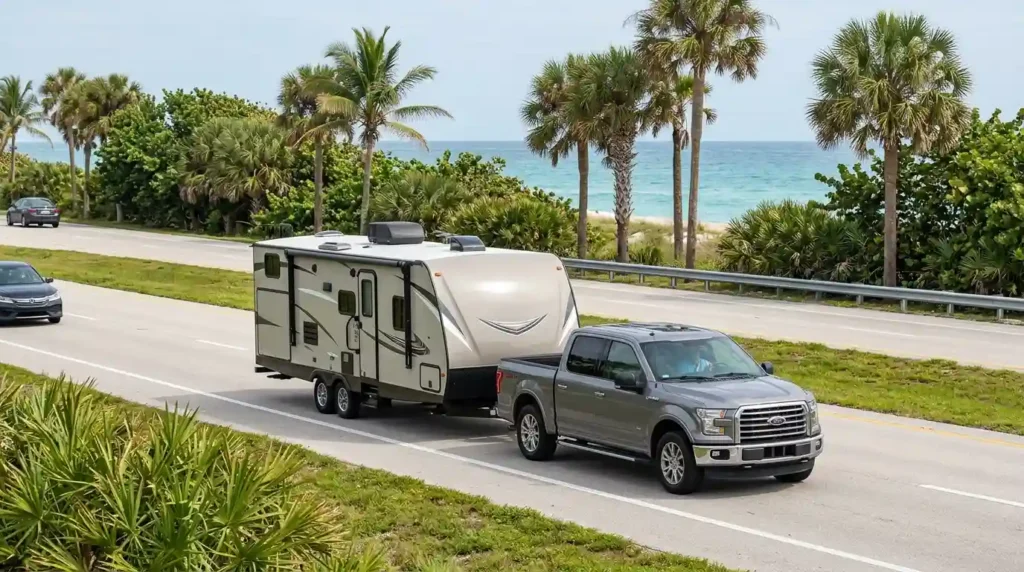
The Towable Gap: Hitched vs. Unhitched
Travel trailers confuse more owners than any other RV. Your tow vehicle’s policy does some of the work. Not all of it.
| Situation | Liability | Damage to the Trailer |
| Trailer hitched, driving | Usually extends from the tow vehicle’s policy | Not covered unless the trailer has its own policy |
| Trailer unhitched at a campsite | Usually not covered by the tow vehicle | Not covered unless insured |
| Trailer in storage | Not covered by the tow vehicle | Not covered unless insured |
Florida doesn’t require towable insurance. But a hurricane doesn’t care. If the trailer isn’t insured, a storm loss is yours alone.
If you want a rough idea of what adding or changing coverage on your tow vehicle might cost, our car insurance calculator gives an estimate.
Hurricane Season: A Florida RV Owner’s Calendar
NOAA’s Atlantic hurricane season runs from June 1 to November 30. Storms affect which policies insurers will issue, in a way most guides miss.
The binding restriction problem. When a storm threatens, many insurers stop issuing new policies or changing coverage in affected areas. Insurify reports that one insurer’s rule says: “No new homeowners or auto policies may be bound in Florida counties under a hurricane warning.” In Florida, that can mean you can’t add comprehensive coverage once a storm is on the map.
| When | What to Do |
| March–May | Shop quotes from several insurers. Confirm the comprehensive and settlement type. |
| May | Photograph the RV inside and out. Save your declarations page offline. |
| June 1 | The season begins. Know your evacuation route and storage plan. |
| Storm forms | Don’t count on changing coverage. Binding restrictions may apply. |
| Watch or warning | Move the RV inland if safe, or secure it. Remove valuables. |
| After the storm | Photograph damage before moving anything. Report the claim quickly. |
| December | Review the policy. Re-shop if your price jumped. |
What stood out to me when comparing Florida RV pages was how few mention binding restrictions at all. Yet for a coastal RV owner, that’s the single biggest timing risk. Shopping in spring isn’t just about price. It’s about being covered before you need it. If a storm claim is later denied, our Arizona insurance claim lawyer guide explains your options.
Florida RV Insurance Rates: What Moves Them
Beyond the form fields, a few other factors shape Florida RV insurance rates.
- Location. Coastal and South Florida ZIP codes often cost more.
- Driving record. Tickets and accidents raise RV premiums, just like car premiums.
- Coach age and value. Newer, pricier coaches cost more to cover.
- Deductibles. Higher deductibles lower premiums.
- Credit. Florida allows credit-based insurance scores.
Driving Record Effects
A ticket or accident on your record can raise RV premiums sharply. Some insurers react more than others. Our guide to the cheapest high-risk car insurance companies shows how much prices vary after a violation.
Florida uses an FR-44 filing after certain DUI convictions, with higher required limits. Other violations may require an SR-22. Our review of the best SR22 insurance companies explains how both filings work.
Cheap RV Insurance Florida Owners Can Actually Find
Cheap RV insurance Florida owners can find usually comes from matching coverage to real use, not from cutting protection.
Here’s how:
- Use layup or storage coverage in the off-season, but lift it before trips.
- Bundle RV with auto or home. Good Sam says customers can save up to 21% by combining RV and auto on one policy. Its footnote says that the figure is based on National General Group policies as of November 2024, and individual savings vary.
- Raise deductibles on comprehensive and collision if you could pay them after a storm.
- Pay in full if your insurer offers a discount for it.
- Store inland or under cover if you can.
Good Sam’s Florida page lists paid-in-full, multi-policy, multi-product, and homeowner discounts. Good Sam also says it works with carriers including National General, an Allstate company, and Progressive. If you also insure a house, our homeowners insurance quote guide shows how to compare the home side.
If you’re bundling with a home policy, our walkthrough of an Allstate homeowners quote shows how advertised bundle savings compare with typical ones.
When “Cheap” Costs More
Here’s the realistic case where the cheapest option backfires. A liability-only policy on a $90,000 travel trailer might cost very little. But Florida doesn’t require towable coverage, and a hurricane can total a trailer in one night. Saving a few hundred dollars a year isn’t much help after a $90,000 loss. If a storm claim is underpaid, our California insurance claim lawyer guide explains dispute options.
For an older, low-value pop-up stored inland, though? Liability-only, or no separate trailer policy at all, may be perfectly reasonable.
Decision checkpoint: A cheap policy should still cover a hurricane loss you couldn’t absorb. If losing the RV would hurt financially, keep comprehensive.
Getting a Quote Florida Insurers Can Price Accurately
Have these ready before your first call or online form:
- [ ] VIN, year, make, model, and length
- [ ] Purchase price and current value
- [ ] Storage address and setup (garage, carport, open lot)
- [ ] How many days a year do you use it
- [ ] Whether you live in it full time
- [ ] Driver’s license numbers for every driver
- [ ] Any tickets or accidents in the past five years
- [ ] Tow vehicle policy details, if you tow
Then compare at least three. Use the same limits, deductibles, and settlement type on each. Our guide on how to compare insurance quotes side by side explains why mismatched quotes mislead.
Price isn’t the whole story. Claims handling matters most after a storm. Our review of how to evaluate the best insurance companies explains how to read complaint records and financial ratings.
The Good Sam RV Insurance Quote Florida Phone Number
Many readers search for the Good Sam RV insurance quote Florida phone number. Good Sam’s official Florida RV insurance page lists 1-888-514-1116. We took that number directly from goodsamrvinsurance.com on October 3, 2026. Check the site before calling, since numbers can change.
A few things to know before you call:
- Good Sam Insurance Agency is an agency, not the insurer. It places policies with carriers such as National General and Progressive.
- Have your checklist ready. Phone quotes go faster with the VIN and storage details in hand.
- Ask which carrier the quote comes from. That’s the company that will handle your claim.
We’re not affiliated with Good Sam. Listing the number here isn’t an endorsement. Compare its quote with at least two others. If you’d rather use a local agency, our review of JoNa Insurance Agency shows how to vet one.
Three Florida RVers, Three Quotes
These scenarios are illustrative. They show how the form fields change outcomes.
The Retired Snowbird in The Villages
She owns a $95,000 Class C registered in Ohio and winters in Central Florida. Her policy follows Ohio rules. She adds layup coverage for summer, when the coach sits in an inland storage barn. Her price drops in the off-season. Retirees planning estates can also compare the cost of a $20 million life insurance policy.
The Full-Timer on the Gulf Coast
He lives in a $210,000 Class A near Fort Myers. He chose full-time coverage and agreed value. His premium sits near the top of the range. But after a storm, his payout won’t be cut by years of depreciation. If he runs a business from the RV, he should also check whether an LLC needs commercial insurance.
The Weekend Camper in Gainesville
She tows a $28,000 travel trailer twice a month. Her tow vehicle’s liability extends while hitched. She adds a separate trailer policy with comprehensive coverage because her storage lot is open to the weather. Young families who camp often may also compare the cost of a $3 million life insurance policy.
Your Next Step
RV insurance quotes Florida owners receive depend on six form fields more than on the company name. Type, use, storage, liability, settlement, and add-ons drive the price and the payout.
The biggest Florida-specific risks are thin minimum liability, uninsured towables, and hurricane timing. Check all three before you buy.
Here’s one practical next step. Before June 1, gather the checklist above. Request three quotes using identical limits and settlement type. Then confirm, in writing, how each policy handles a named-storm loss.
Quick Questions
Are Florida RV quotes free?
Yes. Getting a quote is generally free. The price only becomes binding after you buy the policy.
What does Florida RV insurance usually cost per month?
Rough ranges run from about $15 to $83 a month for trailers and $45 to $250 for motorhomes, based on InsuredBetter’s annual figures. Your rate depends on value, use, and storage.
Is a travel trailer required to have insurance in Florida?
No. Florida doesn’t require insurance on towables. But your tow vehicle must meet the state minimum, and a lender may require coverage.
What is Good Sam’s Florida RV quote line?
Good Sam’s official Florida page lists 1-888-514-1116 as of October 3, 2026. Confirm on its website before calling.
Can I get cheap RV insurance in Florida during hurricane season?
You can shop anytime. But once a storm threatens, binding restrictions may stop new policies or coverage changes. Shop before June if you can.
Does my auto policy cover my motorhome?
Usually not. A motorhome needs its own RV policy. A tow vehicle’s policy may extend liability to a hitched trailer, but not physical damage.

Michael Bennett is a U.S. insurance research and consumer education writer at Insurancebasics Hub, an independent resource dedicated to helping consumers understand insurance policies, coverage decisions, claims, and insurance-related consumer protections. His work covers auto, homeowners, renters, life, and other areas of insurance, with a focus on making complex insurance topics easier to understand.
Michael takes a research-focused approach to insurance content, using authoritative government and regulatory resources, state insurance department guidance, applicable insurance rules, policy provisions, and documented industry information. His articles examine important details such as coverage limits, deductibles, exclusions, policy conditions, premiums, claims, denials, cancellations, renewals, and state-specific requirements.
His goal is to provide accurate, transparent, and practical information that helps readers make better-informed insurance decisions. Insurancebasics Hub provides general educational information and does not replace individualized advice from a licensed insurance professional, attorney, financial professional, or other qualified adviser.