
Short answer: Does an LLC need commercial insurance? The LLC itself doesn’t trigger a legal requirement. Your activities do. Employees usually bring workers’ comp. Business vehicles need auto coverage. Leases, client contracts, and licenses often demand proof of insurance. When none of those apply, insurance is optional, but a single claim can still cost more than years of premiums.
LLC insurance follows a few simple rules. But every rule has an exception.
This guide lays out nine rules. Each one comes with the reason behind it and the exception that trips owners up. Learn the rules, and you’ll know what your LLC needs.
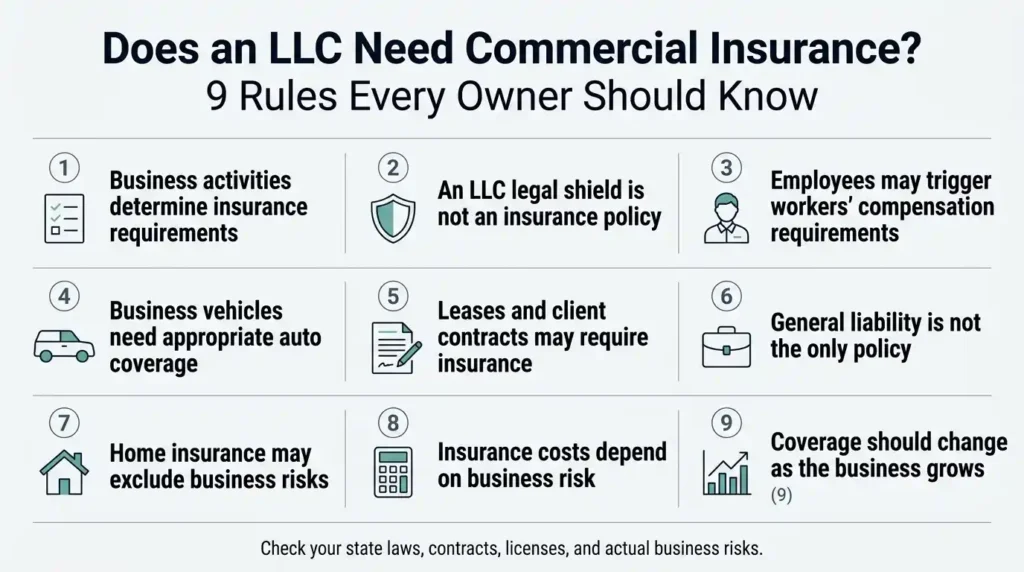
The Rules at a Glance
| # | Rule | The exception to watch |
| 1 | Activities create requirements, not the LLC | Licenses can require coverage before you open |
| 2 | An LLC is a shield, not a policy | Personal guarantees and your own negligence |
| 3 | Employees bring workers’ comp | Texas lets private employers opt out |
| 4 | Vehicles need their own coverage | Personal cars used for business |
| 5 | Leases and contracts set your minimum | Additional insured and higher limits |
| 6 | GL isn’t the only liability policy | Service businesses may need E&O first |
| 7 | Your home policy isn’t a business policy | Small home-business add-ons |
| 8 | Price follows risk, not the LLC label | Minimum premiums and audits |
| 9 | Coverage should grow with the business | Owner deaths and buy-sell plans |
Rule 1: Your Activities Create Requirements, Not the LLC
The rule: No federal law requires insurance just because you form an LLC. Most states don’t either.
Why it exists: An LLC is a legal structure. It’s paperwork filed with your state. Insurance laws focus on what you do: hiring, driving, building, or serving the public.
So can you run an LLC without insurance? Often yes, legally, at the very start. But the answer changes once you hire, buy a vehicle, lease space, or sign certain contracts.
The exception: Some licenses require insurance or a bond before you can work at all. Contractors and some health or trade professions are common examples. Check your licensing board before your first job. For licensed trades, the license itself can set your requirements. Contractors may also need builders risk coverage, as our US Assure agent login guide explains.
The SBA’s test: Insure against losses you couldn’t pay for on your own. That’s a practical standard for any LLC.
Rule 2: An LLC Is a Shield, Not a Policy
The rule: An LLC can separate business debts from your personal assets. Insurance pays claims. They are different tools.
Why it exists: If a customer is hurt, they can still sue your business. The LLC doesn’t pay its medical bills. It doesn’t pay your legal fees. A liability policy can. Relying on the shield alone is risky.
The exception: The shield itself has holes.
- Your own negligence. If you personally cause harm, you can be personally liable.
- Personal guarantees. Signing a lease or loan personally puts your assets on the line.
- Mixing funds. Paying personal bills from business accounts can weaken the shield in court.
So is insurance still needed if the LLC already protects you? In most active businesses, yes. The shield and the policy work together. If a claim against you is disputed, our Arizona insurance claim lawyer guide explains your options.
Rule 3: Employees Bring Workers’ Comp
The rule: Hiring is the biggest legal trigger. Ask the coverage question again after your first hire, and the answer usually flips to yes.
What type of insurance is required for an LLC with employees? The SBA says businesses with employees must carry workers’ compensation, unemployment, and disability insurance. In practice, each state sets the details. Unemployment insurance usually runs through state payroll taxes. Only a few states, such as California, New York, and New Jersey, require short-term disability coverage.
Why it exists: Workers’ comp pays for job-related injuries. General liability doesn’t cover your own employees. If you hire through an outside firm, our guide to employer of record insurance coverage explains who carries workers’ comp.
The exception: According to the Texas Department of Insurance, private employers in Texas can choose whether to carry workers’ comp. Employers who don’t must report their non-coverage status and work-related injuries. Failing to report can bring administrative penalties.
Some states also set thresholds based on employee count or industry.
Do I need commercial insurance for my LLC once I hire? In most states, yes. Check your state’s workers’ comp rules before your first payday.
Rule 4: Vehicles Need Their Own Coverage
The rule: If your LLC owns a vehicle, you’ll generally need commercial auto coverage that meets your state’s minimums. That’s a clear rule for LLCs with company vehicles.
Skipping coverage on business vehicles isn’t an option. State auto laws still apply to business-owned vehicles.
Why it exists: Business driving carries different risks. Insurers price it differently. State minimums also differ, as New Jersey car insurance quotes show.
The exception: Many owners drive personal cars for work. Personal auto policies often limit business use. Some can add it. Others can’t. Tell your insurer how you really use the car. Do you need business coverage if you drive your own car? Maybe, if your personal policy excludes business use.
Small claims can expose the problem. A cracked windshield from a rock during a client visit seems routine. But if the car was used in a way the policy doesn’t allow, the claim can get complicated.
The same goes for road damage. Here’s how auto policies treat pothole damage. Your policy type should match how the car is actually used.
Some carriers focus mainly on personal auto. Direct General, for example, is known for personal policies, including for drivers with past violations. A personal policy like that isn’t built for business-owned vehicles.
Skipping proper coverage can be expensive. See what happens when someone needs a lawyer after a car accident with no insurance. For a business, the bill can reach the LLC and sometimes you.
Trucking is its own world, with federal minimums and much higher premiums. Our guide to commercial truck insurance cost breaks it down.
Rule 5: Leases and Contracts Set Your Minimum
The rule: The people you do business with often decide your coverage.
Why it exists: Landlords and clients don’t want to pay for your mistakes. So they require proof that you’re insured. Signing a commercial lease without coverage is rare.
If you lease space, do you need coverage? Your landlord will almost certainly say yes. Most commercial leases require general liability. Many also require property coverage.
What a typical lease asks for:
- $1 million per occurrence and $2 million aggregate in GL
- Coverage for your equipment and improvements
- The landlord named as an “additional insured”
The exception: Some contracts ask for more than the standard. A client might want $2 million per occurrence or a specific endorsement. Endorsements can add cost.
Proof: A certificate of insurance (COI) is a one-page summary of your coverage. Ask your insurer for one once coverage starts. If you use a local agency, our review of JoNa Insurance Agency shows how to vet one.
What does a contract require? Whatever it says. Read the insurance section before you sign.
Rule 6: GL Isn’t the Only Liability Policy
The rule: General liability covers injury and property damage to others. It doesn’t cover professional mistakes.
| Policy | Covers | Commonly needed by |
| General liability (GL) | Injury or property damage to others; advertising injury | Businesses with clients, visitors, or job sites |
| Professional liability (E&O) | Errors or advice that cost a client money | Consultants, designers, IT, accountants |
| Business owner’s policy (BOP) | GL plus property, often with business interruption | Businesses with equipment or space |
| Workers’ comp | Employee injuries | Businesses with employees |
| Commercial auto | Business vehicles | LLCs that own or rely on vehicles |
| Cyber liability | Data breaches | Businesses handling client data |
The exception (and a contrarian point): Many new owners buy GL first because it’s the best-known policy. But for a solo writer, designer, or consultant, E&O may matter more. Their real risk is a client claiming a costly mistake, not someone slipping in an office. E&O prices vary by profession, so quote both. If a client claim turns into a dispute, our Arkansas insurance claim lawyer guide shows how disputes work.
If a client contract asks for E&O and you want the work, you’ll need it.
Rule 7: Your Home Policy Isn’t a Business Policy
The rule: Homeowners and renters policies usually limit or exclude business activity.
Why it exists: Personal policies are priced for personal risk. A client visiting your home office adds business risk.
When you compare a homeowners insurance quote, ask how business use is handled. Inventory and business equipment may have low limits.
Renters face the same gap. A renters policy protects personal belongings. Look at how USAA renters insurance treats your things, then ask any insurer about business property and liability.
The exception: Some insurers offer small home-business add-ons. They can work for very low-risk businesses. But they often have tight limits. If you store inventory off-site, see whether USAA renters insurance covers storage units.
Bundling home and auto insurance can simplify household bills. Still, a personal bundle isn’t business coverage. A small GL policy or BOP is often cleaner.
If clients visit your home office, you hold inventory, or you sell products, it’s worth a close look.
Rule 8: How Much Does Liability Insurance for an LLC Cost? Price Follows Risk
The rule: Insurers price your work, revenue, location, limits, and claims history. Being an LLC doesn’t change the rate.
How much does liability insurance for an LLC cost? For many small LLCs, published figures land around $45 to $80 a month for general liability.
| Source | Published GL figure | What it measures |
| Insureon (updated Mar 30, 2026) | $45/month median | ~100,000 small business customers |
| The Hartford (updated May 20, 2026) | ~68/month,~810/year | Hartford small business customers |
| Progressive Commercial (2025 data) | $55/month median, $79/month average | New Progressive Commercial customers |
| NerdWallet/Coverdash (Jan 2026) | 700–3,000/year | Businesses with ≤$1M revenue |
Industry is the biggest driver. Insureon shows a home-office IT consultant at about $32 a month. An appliance contractor pays $85 to $90.
Sources disagree because each measures a different group. Some report medians. Others report averages.
For the formula insurers use, see our full guide to general liability insurance cost for an LLC.
The exception: Two things can push your real cost above the quote. Many insurers set a minimum premium. And auditable policies can add premium at year-end if revenue or payroll grew. If an audit or claim dispute escalates, our California insurance claim lawyer guide explains your options.
So what will your business pay? Only a quote with your details can say.
Rule 9: Coverage Should Grow With the Business
The rule: The right coverage on day one won’t be right in year three.
Why it exists: New employees, vehicles, locations, and contracts each add risk. Your policies should keep up. Even recreational vehicles need their own policies, as our guide to RV insurance in Las Vegas shows.
Does your coverage need to change as you grow? Usually. Review coverage when:
- You hire your first employee
- You buy or lease a vehicle
- You move or add a location
- You sign a large contract
- Your revenue jumps
The exception that surprises owners: Some of the biggest risks aren’t commercial insurance at all. If you co-own an LLC, what happens when a partner dies?
Many co-owners use a buy-sell agreement, often funded with life insurance. Large shares can call for large policies. Our guide to a $2 million dollar life insurance policy explains who qualifies at that level.
For bigger buyouts, compare rates in our breakdown of $3 million life insurance cost. An attorney should draft the agreement itself.
Can You Run an LLC Without Insurance? When the Rules Say “Not Yet”
Here’s a realistic case where buying a full package may not make financial sense.
Hypothetical: A solo freelance writer works from a rented apartment. No employees. No vehicles used for business. No lease. No client contracts requiring coverage.
A full BOP with property coverage may not be practical here. There’s little property to insure. A small E&O policy, or none until a client requires it, may fit better.
Is going uninsured legal here? Yes. But one contract can change that within days. Some policies can be bought quickly online, but don’t count on same-day approval.
A low-risk solo owner like this often pays near the low end of published ranges.
Does an LLC Need Commercial Insurance? Three Hypothetical Profiles
| Profile | What the rules point to | Main rules involved |
| Solo online consultant | E&O, maybe GL | Rules 5, 6 |
| Contractor with two employees | GL, workers’ comp, commercial auto, tools coverage | Rules 1, 3, 4 |
| Small café with a lease | BOP, workers’ comp, liquor liability if serving alcohol | Rules 3, 5, 7 |
So does every LLC need coverage? No. But most active LLCs trigger at least one rule.

What Type of Insurance Is Required for an LLC in Your State?
Requirements vary by state. There’s no single national list.
- Workers’ comp: Your state workers’ compensation board or labor department
- Auto minimums: Your state DMV or Department of Insurance
- Disability: Your state labor department, if your state requires it
- Licenses: Your licensing board for insurance or bond rules
Your state Department of Insurance can also confirm that an insurer is licensed.
Do I Need Commercial Insurance for My LLC? Your Launch Kit
- [ ] List your triggers: employees, vehicles, lease, contracts, licenses
- [ ] Read every insurance clause in your lease and contracts
- [ ] Check your state’s workers’ comp rules
- [ ] Ask your personal insurers about business use at home and on the road
- [ ] Compare three quotes with the same limits and deductible
- [ ] Ask about minimum premiums and audits
- [ ] Request a COI when coverage starts
- [ ] Review coverage whenever your business changes
Putting the Rules to Work
Does an LLC need commercial insurance? Not because it’s an LLC. The rules point to your activities: employees, vehicles, leases, contracts, and licenses.
Learn the exceptions, too. They’re where most coverage gaps hide.
Start with Rule 1 and work down the list. Then compare three quotes with identical limits. That’s the practical way to answer the question for your own business.
FAQ
Does a single-member LLC need insurance?
Usually not by law, unless a trigger applies. But a single-member LLC can still be sued or face contract demands. Many solo owners start with GL or E&O. Pick the policy that matches your real risk.
What coverage does an LLC with no employees need?
Often none by law, unless you own business vehicles or hold a license that requires coverage. Leases and contracts can still require it. Read each document you sign.
Do I need insurance if my LLC is dormant?
A dormant LLC with no activity, staff, or contracts has little exposure. Many owners wait until business starts. Confirm that no lease or license requires coverage in the meantime.
What does liability insurance cost an LLC per year?
Published figures put many small LLCs around $540 to $950 a year for GL. Insureon’s yearly range runs from $265 to $3,030. Higher-risk trades often pay more.
Should I buy coverage before I earn revenue?
Not always. But buy coverage before you sign a lease, hire help, or meet clients in person. Claims can happen before your first sale.
What does liability cost inside a BOP?
It depends on your business. A BOP adds property coverage, so it usually costs more than GL alone. But it can cost less than separate policies. Ask for both and compare.

Michael Bennett is a U.S. insurance research and consumer education writer at Insurancebasics Hub, an independent resource dedicated to helping consumers understand insurance policies, coverage decisions, claims, and insurance-related consumer protections. His work covers auto, homeowners, renters, life, and other areas of insurance, with a focus on making complex insurance topics easier to understand.
Michael takes a research-focused approach to insurance content, using authoritative government and regulatory resources, state insurance department guidance, applicable insurance rules, policy provisions, and documented industry information. His articles examine important details such as coverage limits, deductibles, exclusions, policy conditions, premiums, claims, denials, cancellations, renewals, and state-specific requirements.
His goal is to provide accurate, transparent, and practical information that helps readers make better-informed insurance decisions. Insurancebasics Hub provides general educational information and does not replace individualized advice from a licensed insurance professional, attorney, financial professional, or other qualified adviser.