
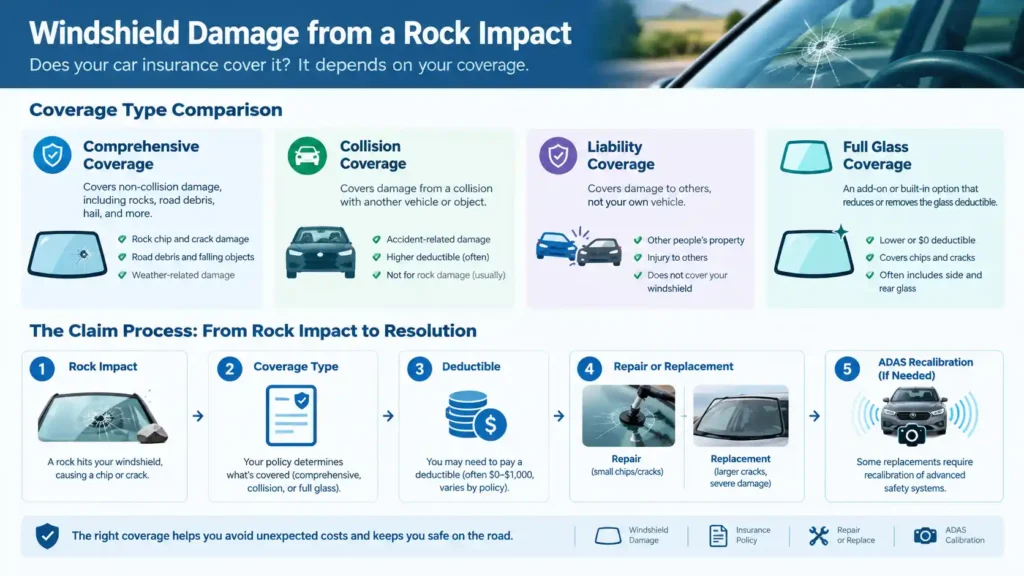
Does car insurance cover a cracked windshield from a rock? Usually yes, but only if you carry comprehensive coverage. A rock strike is a non-collision loss, so comprehensive pays, minus your deductible. Liability-only policies don’t pay for your own glass. In some states, the deductible doesn’t apply at all. Florida, Kentucky, and South Carolina have laws waiving it for windshield or glass damage when you have comprehensive.
A rock hits your windshield on the highway. Now you have a chip, or worse, a spreading crack. Will your policy pay in your situation? That depends on a few answers.
Most articles give one long answer. This one works like a decision tree. Answer one question at each branch. Each answer sends you to the next step, until you reach your outcome.
The Tree at a Glance
| Branch | The Question | Why It Matters |
| 1 | Do you have comprehensive coverage? | No comprehensive usually means no glass coverage |
| 2 | Which state do you live in? | Some states waive the glass deductible |
| 3 | Is it a chip or a crack? | Repair and replacement are treated differently |
| 4 | Does your car have windshield cameras? | Recalibration can raise the cost |
| 5 | Is the cost above your deductible? | Decides whether a claim makes sense |
| 6 | Will a claim affect your rates? | Usually minor, but it varies |
Let’s walk through each branch. Together, they turn the coverage question into a clear yes, no, or partly.
Branch 1: Do You Have Comprehensive Coverage?
Start here. This branch settles most of the coverage question. Pull your declarations page and look for “comprehensive” or “other than collision.”
If Yes → Go to Branch 2
Comprehensive covers damage that isn’t from a crash. That includes falling objects, hail, vandalism, theft, and flying rocks. It’s also why chips are usually covered.
Progressive puts it simply: for a rock strike, “your comprehensive coverage should cover this type of damage.”
If No → Outcome A: You Likely Pay Out of Pocket
A liability-only policy pays for damage you cause to others. It doesn’t pay to fix your own car, including the glass.
Wait, What About Collision?
Collision applies when the glass breaks in a crash with another vehicle or object. A rock flying off a truck is generally treated as a comprehensive loss, not a collision. If a crash also causes injuries, our car accident settlement calculator gives a rough estimate of what’s at stake.
If the windshield breaks in a crash with an uninsured driver, the rules change. Our guide to an uninsured motorist lawsuit explains how claims work when the other driver has no insurance.
What About Your Home or Renters Policy?
They don’t cover car glass. A homeowners policy covers the house and belongings, not the vehicle. Our homeowners insurance quote guide explains what a home policy actually covers.
Renters coverage works the same way. It may cover belongings inside the car, but not the car itself. Our guide to USAA renters insurance shows where renters coverage starts and stops.
Decision checkpoint: If your car is financed or leased, your lender likely requires comprehensive. Check before assuming you don’t have it.
Branch 2: Which State Do You Live In?
This branch can save you the entire deductible. People often search for “states with zero deductible windshield replacement” for exactly this reason.
States With Zero Deductible Windshield Replacement Laws
| State | Rule | Source |
| Florida | The deductible “shall not be applicable to damage to the windshield” when you have comprehensive | Fla. Stat. § 627.7288 |
| Kentucky | Comprehensive must cover safety glass “without regard to any deductible” | KRS 304.20-060 |
| South Carolina | Deductibles do “not apply to automobile safety glass” | S.C. Code § 38-77-280(B) |
Florida’s law applies to the windshield. Kentucky’s definition of safety glass includes the windshield, door, and window glass. South Carolina’s covers “automobile safety glass.”
States With Optional Zero-Deductible Glass
Other states let you choose low or no-deductible glass coverage. Arizona’s law, A.R.S. § 20-264, requires insurers writing comprehensive to offer optional glass coverage “without regard to a deductible.”
CarInsurance.com, updated June 15, 2026, also lists Connecticut, Massachusetts, Minnesota, and New York as states where you can add zero-deductible or low-deductible glass coverage.
The South Carolina Change to Watch
Here’s a development most guides miss. South Carolina’s House Bill 4817 proposed changing the state’s glass rule starting January 1, 2027.
A Senate committee version, dated April 30, 2026, would cap replacement deductibles at $100. Repairs would stay deductible-free, and insurers would have to offer a $0 option. As of the legislature’s website this month, the bill shows no final passage. Check its status before relying on either rule.
So, zero-deductible states aren’t a fixed list. Laws change. Always confirm with your state insurance department.
Everywhere Else
In other states, your regular comprehensive deductible usually applies, unless you bought full glass coverage. Some insurers sell it as an add-on. Progressive, for example, says it offers a “$0 deductible option” for glass-only claims in some states. Glass options in large states vary by insurer, as our guide to Texas car insurance quotes explains.
Branch 3: Is It a Chip or a Crack?
This branch decides how much the fix costs. It also shapes your deductible.
Does Comprehensive Cover Windshield Chips? Usually, Through Repair
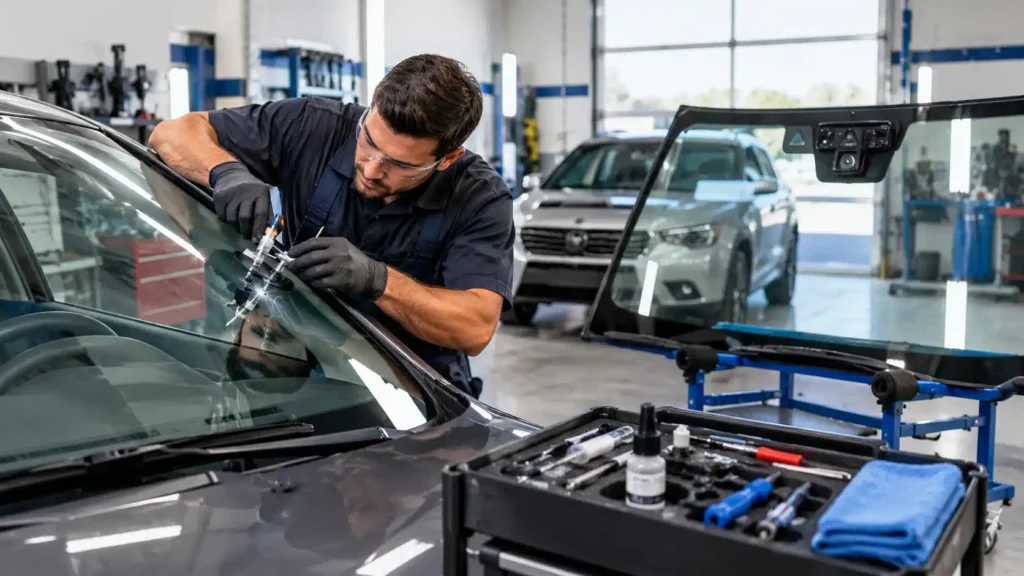
Small chips, like star breaks and bullseyes, can often be filled with resin. Repairs are usually quick and cheaper.
So, does comprehensive cover windshield chips? Generally yes, if you have comprehensive. And many insurers waive the deductible for repairs. Progressive says that “if your glass can be repaired instead of replaced, then you won’t have to pay anything in most cases.”
Crack → Often Replacement
Long cracks, edge cracks, and damage in the driver’s line of sight often require a new windshield. Replacement costs more and usually triggers your deductible, unless your state or policy waives it.
Windshield Repair vs Replacement Insurance Claim: Key Differences
Here’s how a windshield repair vs replacement insurance claim usually differs:
| Factor | Repair | Replacement |
| Typical damage | Small chips and short cracks | Long cracks, edge cracks, line-of-sight damage |
| Cost | Lower | Higher |
| Deductible | Often waived by many insurers | Usually applies, unless state law or glass coverage waives it |
| Factory seal | Preserved | Replaced |
| Recalibration | Usually not needed | May be needed for camera-equipped cars |
The size limits for repair vary by shop and insurer. Ask the shop to measure the damage before you file.
Why Speed Matters
Here’s the friction point. Chips spread. Temperature swings, potholes, and car washes can turn a small chip into a long crack. That can turn a free repair into a paid replacement.
Mountain and winter driving make this worse. Gravel and sanded roads send more rocks into windshields. Our guide to Colorado auto insurance quotes explains how weather and road conditions push comprehensive costs higher there.
Decision checkpoint: If the chip is small, schedule a repair quickly. A fast repair decision can be the difference between paying nothing and paying your full deductible.
Branch 4: Does Your Car Have Windshield Cameras?
Many newer cars have cameras or sensors mounted behind the windshield. They power features like lane-keeping and automatic emergency braking.
If Yes → Ask About Recalibration
After a replacement, these systems may need recalibration. That adds cost and time. Recalibration is one of the biggest cost differences between repair and replacement.
Ask the shop three questions:
- Does my car need recalibration after replacement?
- Will you perform it, or send me to a dealer?
- Is recalibration included in the insurance claim?
If No → Go to Branch 5
Without sensors, a replacement is usually simpler and cheaper.
Larger Vehicles Cost More
RV and motorhome windshields are much larger and often harder to source. Our guide to RV insurance in Las Vegas explains how desert heat stresses RV glass and seals.
Florida’s windshield law also matters for RV owners there. Our guide to RV insurance quotes in Florida covers how RV policies work in that state.
Branch 5: Is the Cost Above Your Deductible?
This branch decides whether a claim makes sense at all.
The Deductible Math Grid
Illustrative example: These costs are round numbers to show the logic, not price quotes.
| Your Deductible | $100 Chip Repair | $500 Replacement | $1,200 Replacement With Recalibration |
| $0 (state law or glass coverage) | You pay $0 | You pay $0 | You pay $0 |
| $250 | Often $0 if repair is waived | You pay $250; insurer pays $250 | You pay $250; insurer pays $950 |
| $500 | Often $0 if repair is waived | You pay $500; insurer pays $0 | You pay $500; insurer pays $700 |
| $1,000 | Often $0 if repair is waived | You pay $500; no claim needed | You pay $1,000; insurer pays $200 |
The Rule of Thumb
Chips are the cheapest case. Since many insurers waive repair deductibles, chips often come with a $0 bill.
If the replacement costs less than or close to your deductible, a claim adds little. Paying directly may be simpler.
If the replacement is far above your deductible, especially with recalibration, a claim usually makes sense.
When a Claim Isn’t Worth It
Here’s a realistic case. A driver with a $1,000 deductible gets a $550 replacement quote for an older car without cameras. Filing a claim would pay nothing. Paying directly is the only practical option.
Here’s the contrarian point. A high comprehensive deductible saves premium, but it can make glass damage almost entirely out of pocket. If you drive a lot on highways, low-deductible glass coverage may be worth the extra cost.
Branch 6: Will a Windshield Claim Raise My Rates?
This is the question that stops many people from filing. Will a windshield claim raise my rates? Usually not by much, but it depends.
CarInsurance.com, updated June 15, 2026, says filing a windshield claim under comprehensive typically doesn’t raise rates. It notes that most insurers treat glass claims as non-chargeable. Progressive’s answer is more cautious: “This varies between car insurance companies. Talk to your insurer for more details.” If a glass claim is denied and turns into a dispute, our Alabama insurance claim lawyer guide explains how disputes work.
Why the Answer Varies
- A glass claim is generally a comprehensive claim, not an at-fault accident.
- But it may still appear in your claims history.
- Several claims in a short period can affect renewal pricing or eligibility.
- A claims-free discount could be affected at some insurers.
So, for one claim, often not. For several claims, possibly. Ask your insurer directly before filing.
Ask These Questions First
Before you decide, call your insurer and ask how a glass claim would affect your rates with that company specifically.
- Is a glass-only claim chargeable with your company?
- Will it affect my claims-free discount?
- Is my repair deductible waived?
- Can I choose my own glass shop?
The Outcomes
Here’s where the tree typically ends, and what each path usually means.
| Outcome | Situation | What Usually Happens |
| A | No comprehensive | You pay out of pocket |
| B | Comprehensive + zero-deductible state | Insurer usually pays the full covered cost |
| C | Comprehensive + chip repair | Often $0 at many insurers |
| D | Comprehensive + replacement + deductible | You pay the deductible; insurer pays the rest |
| E | Replacement cost below deductible | Paying directly is usually simpler |
| F | Camera-equipped car | Ask about recalibration before approving work |
Who Pays If a Truck Threw the Rock?
This is a common question. Can you make the truck’s insurer pay?
Usually, it’s very hard. Rocks and road debris are generally treated as road hazards. Proving that a specific driver was negligent, like hauling an unsecured load, is difficult. Trucks carry commercial auto insurance, but debris claims against it rarely succeed.
Commercial vehicles and construction projects carry their own insurance. For an example of how one specialty program separates its agent portal from its claims lines, see our guide to the US Assure agent login.
Pursuing another driver for minor glass damage rarely makes sense. Our guide on whether to hire a lawyer for a car accident with no insurance explains when legal help is worth the cost, and when it isn’t.
If a company car is damaged, your employer’s commercial policy usually responds, not your personal policy. Our guide to employer of record insurance coverage explains who holds coverage when you’re hired through an outside firm.
How to File a Glass Claim: Step by Step
- Photograph the damage with a coin or ruler for scale.
- Note the date, time, and location of the rock strike.
- Check your declarations page for comprehensive and any glass deductible.
- Call your insurer or file online. Many insurers route glass claims to a glass partner.
- Ask whether repair or replacement is recommended. This shapes your claim.
- Confirm recalibration if your car has windshield cameras.
- Keep the invoice and claim number.
Some insurers partner with large glass networks. Our review of Direct General insurance notes that Direct Auto handles glass repairs with Safelite.
Common Mistakes
These mistakes cost drivers money even when comprehensive coverage applies. If an insurer wrongly denies a glass claim, our California insurance claim lawyer guide explains your options.
- Waiting too long. A chip can spread into a crack.
- Assuming liability covers glass. It doesn’t.
- Filing for damage below the deductible. You may get nothing.
- Skipping recalibration questions. Safety systems may not work properly.
- Not knowing your state’s rule. You might owe nothing.
- Never asking about chip coverage. Many drivers pay for repairs themselves without checking.
Hail, Storms, and Other Glass Damage
Rocks aren’t the only threat. Hail and falling branches also crack windshields. These are generally comprehensive claims too, and hail chips are usually handled the same way as rock chips.
When one storm damages both your home and car, bundling may help. Our guide to home and auto insurance explains how some insurers offer a single deductible when one event damages both.
Coastal storms add another layer. Our guide to home insurance quotes in Rhode Island explains how hurricane deductibles work on the home side.
Home policies follow their own rules for glass in the house. Our walkthrough of an Allstate homeowners quote shows how home coverage lines are structured.
Choosing or Changing Your Coverage
If you’re moving, check whether your new state waives the glass deductible. If you’re shopping for comprehensive or glass coverage, compare insurers by glass deductible, repair waiver, and claim treatment, not just price. Drivers reviewing coverage often check life insurance too, such as the cost of a $3 million life insurance policy.
Location affects comprehensive pricing too. Our walkthrough of Denver car insurance quotes shows how one driver’s ZIP code shaped her price.
If you work with a local agency, verify its license first. Our fact-check of JoNa Insurance Agency shows how to check an agency’s license and carrier list.
Storing belongings in your car? Remember that personal items follow different coverage rules. Our guide on whether USAA renters insurance covers storage units explains how off-premises limits usually work.
Looking Ahead
Windshields keep getting more complex, with cameras, sensors, and heated or acoustic glass. That may push replacement costs higher over time. At the same time, the list of zero-deductible states may change, as South Carolina’s debate shows. These are reasonable trends to watch, not confirmed changes. Review your glass deductible each renewal. Long-term planners may also compare the cost of a $20 million life insurance policy.
The Bottom Line: Does Car Insurance Cover a Cracked Windshield From a Rock?
So, does car insurance cover a cracked windshield from a rock? Yes, if you have comprehensive coverage. Your state, the size of the damage, your deductible, and your car’s sensors decide what you’ll actually pay.
Your one practical next step: check your declarations page today for comprehensive and any glass deductible. Then, if you have a chip, get it repaired before it spreads.
FAQs
Is rock damage to a windshield covered?
Usually, if you have comprehensive coverage. A rock strike is a non-collision loss. You may owe your deductible, unless your state or policy waives it.
Are windshield chips covered?
Yes, generally. Many insurers waive the deductible for chip repairs, though rules vary by insurer and state.
Will my rates go up after a glass claim?
Often not for a single glass claim. Many insurers treat glass claims as non-chargeable. Multiple claims can still affect pricing.
Which states waive the windshield deductible?
Florida, Kentucky, and South Carolina have laws waiving the deductible for windshield or glass damage with comprehensive. Laws can change, so confirm with your state.
How do repair and replacement claims differ?
Repairs are usually cheaper and often deductible-free. Replacements cost more, usually trigger the deductible, and may need recalibration.
Does liability insurance cover a cracked windshield?
No. Liability pays for damage you cause to others, not your own car.
Can I drive with a cracked windshield?
It depends on the crack and your state’s rules. Damage in the driver’s view can be unsafe and may violate local laws. Get it checked soon.

Michael Bennett is a U.S. insurance research and consumer education writer at Insurancebasics Hub, an independent resource dedicated to helping consumers understand insurance policies, coverage decisions, claims, and insurance-related consumer protections. His work covers auto, homeowners, renters, life, and other areas of insurance, with a focus on making complex insurance topics easier to understand.
Michael takes a research-focused approach to insurance content, using authoritative government and regulatory resources, state insurance department guidance, applicable insurance rules, policy provisions, and documented industry information. His articles examine important details such as coverage limits, deductibles, exclusions, policy conditions, premiums, claims, denials, cancellations, renewals, and state-specific requirements.
His goal is to provide accurate, transparent, and practical information that helps readers make better-informed insurance decisions. Insurancebasics Hub provides general educational information and does not replace individualized advice from a licensed insurance professional, attorney, financial professional, or other qualified adviser.