
Ohio RV insurance is required only in part. A motorhome needs at least 25/50/25 liability. A travel trailer generally relies on its tow vehicle’s liability. Lenders usually require collision and comprehensive on financed units. One insurer’s 2024 Ohio averages were $773.63 a year for a motorhome and $450.55 for a travel trailer.
Maybe a dealer asked for proof of coverage. You weren’t sure what to hand over. Or your truck’s insurer said the camper “should be fine.”
That one sentence causes many expensive surprises. The state’s legal floor is narrow. Your lender and your own choices decide the rest.
This guide separates those three. It uses only figures tied to a source. Every example is labeled illustrative. It is general education, not advice about your policy.
Motorhome or Trailer? This Decides Everything
Ohio’s rules depend on whether your RV drives itself. A motorhome is a motor vehicle, so liability insurance applies. A trailer is towed, so the requirement attaches to the vehicle pulling it.
| Your RV | What Ohio requires | Who usually requires more |
| Class A, B or C motorhome | Liability of at least 25/50/25 | Lenders, for collision and comprehensive |
| Travel trailer, fifth wheel, toy hauler | No standalone trailer policy; liability follows the tow vehicle | Lenders, for physical-damage coverage |
| Financed or leased unit | Same as above | The loan agreement sets the minimum |
“Not required” does not mean “not exposed.” A trailer with no policy has nothing behind it after a fire or theft. Hail damage is the same story. That loss is yours.
Where 25/50/25 Runs Out
Ohio’s minimum liability limits are $25,000 per person and $50,000 per accident for bodily injury. Property damage is $25,000. These come from Ohio Revised Code Chapter 4509. They reached this level in December 2013.
Check today’s numbers with the Ohio Department of Insurance. Limits can change.
Ohio is an at-fault state. The driver who causes a crash pays for the other party’s losses. The state also uses modified comparative negligence. A driver who is mostly at fault may be barred from recovering their own damages.
Here is an illustrative case. A Class C driver near Columbus causes a crash. One person has $60,000 in medical bills. Property damage is $32,000.
Bodily injury pays $25,000 and leaves $35,000. Property damage pays $25,000 and leaves $7,000. That is $42,000 the driver could owe personally.
A minimum is a floor. It is not a forecast of what a serious crash costs. Ask whether your declarations page limits match what you could absorb.
One side note. If you have ever needed an SR-22 filing, tell every insurer up front. It affects which companies will write your policy.
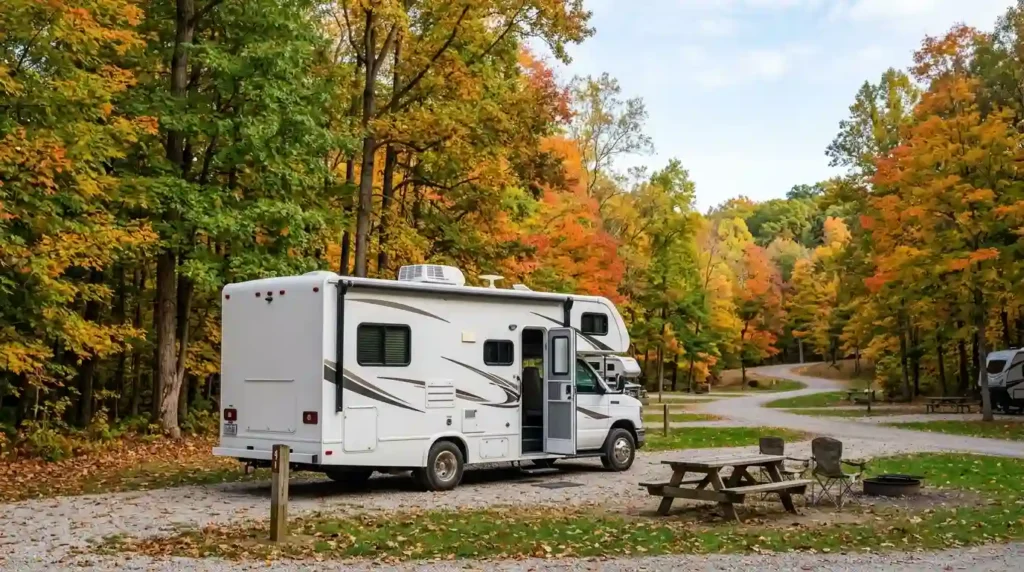
Ohio Motorhome Insurance: Part Auto, Part Home
Motorhome insurance does two jobs. It covers you as a driver. It also covers a costly unit that doubles as living space. That is why it usually costs more than coverage for a towable.
Class A, B, and C units differ in value and repair cost. A diesel pusher can cost far more to fix than a camper van. Parts and labor drive that gap.
Your driving record matters more here than with a trailer. You are the one behind the wheel. Insurers rate that directly.
If You Live in It
Full-timer coverage is its own product. It is not a bonus feature. If the RV is your home for much of the year, a standard recreational policy may not respond as expected.
Some insurers call more than six months a year full-time use. Others count nights. Definitions vary, so ask for the written one.
Full-timer policies generally add personal liability around a parked RV. They may add medical payments for visitors. Answer the usage question honestly. A mismatch can be raised at claim time.
Ohio Travel Trailer Insurance and the Truck-Policy Trap
Travel trailer insurance in Ohio covers what your truck’s policy leaves out. The truck’s liability generally responds to harm the rig causes while hitched. It typically does not repair or replace the trailer.
Unhitching changes the risk. A guest trips over a hose. An awning collapses in wind. That is campsite liability, not road liability.
Vacation liability is an optional coverage built for this. Limits vary by insurer.
Toy haulers and fifth wheels add wrinkles. Motorcycles or ATVs in the garage area are not automatically covered. Ask whether your personal effects limit includes them.
If different companies insure the truck and trailer, get answers in writing. Ask which policy responds to what.
How the Policy Values Your RV
After a total loss, the valuation method sets your payout. Actual cash value (ACV) subtracts depreciation. Agreed value fixes the amount in advance. Stated value is usually capped at market value. Replacement cost pays for a similar newer unit, often with an age limit.
| Method | Payout basis | Worth checking |
| Actual cash value | Market value minus depreciation | Which comparable units the insurer uses |
| Agreed value | The amount written on the policy | Whether an inspection is required first |
| Stated value | Often the lesser of stated or market value | Whether the number binds the insurer |
| Replacement cost | A similar new unit | The age cutoff on the RV |
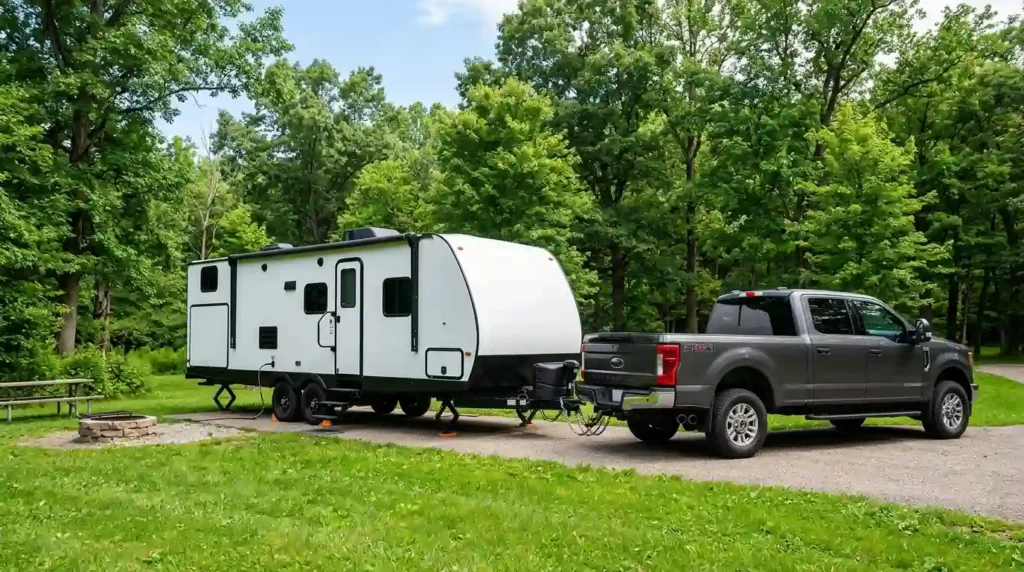
Take an illustrative owner in Cincinnati. They financed a 2020 Class C with a $38,000 loan balance. The policy values it at $31,000 ACV with a $1,000 deductible.
The insurer pays $30,000. The owner still owes $8,000. With a $36,000 agreed value, the payout would be $35,000. The shortfall drops to $3,000.
Gap coverage exists for some vehicles. Do not assume your RV insurer offers it. Compare your loan balance with the valuation method first.
What RV Coverage Costs in Ohio
One insurer’s published 2024 Ohio averages were $773.63 a year for a motorhome and $450.55 for a travel trailer. That is roughly $64.47 and $37.55 a month. These are one company’s customers. They are not a statewide average.
I’m leaving out the $800 to $2,000 ranges on third-party sites. I can’t trace them to a source.
RV insurance is priced one household at a time. Ohio motorhome insurance usually costs more than Ohio travel trailer insurance. These averages blend classes, so a large new unit can sit well above them.
The factors that move price most:
- Class and value: more value means more physical-damage exposure.
- Driver record: this matters most on motorhomes.
- Usage and storage: a locked storage lot rates differently from a driveway.
- Deductible and limits: higher deductibles usually lower the premium.
- Credit-based insurance score: many insurers use it where state rules allow.
What stood out to me, comparing Ohio’s liability rules with carrier guidance, is how little the law settles. Hail, theft, and fire coverage are contract choices. I also could not verify one statewide RV premium average for Ohio. Treat the one-insurer figures as a starting point.
Cheap RV Insurance in Ohio: Where Savings Are Real
Real savings come from deductibles, storage, accurate usage, and paying in full. Cutting liability limits looks like a saving. It only moves the cost to the day of a crash.
Discounts depend on the insurer. Many lists copy auto discounts that do not exist on RV policies. Ask for the RV-specific list. Common ones include multi-policy, claims-free, paid-in-full, and storage discounts.
Here is an illustrative deductible example. A Columbus owner has $7,200 of covered hail damage to the roof and awning. A $500 deductible leaves $6,700 payable. A $1,000 deductible leaves $6,200. A $2,500 deductible leaves $4,700.
Suppose moving from $500 to $1,000 saves $60 a year. The extra 500ofrisktakesabout8.3yearstoearnback(500 ÷ $60. A higher deductible is not wrong. It just has a price.
Choose it only if you could pay it within a week without borrowing.
Hail, Floods and Frozen Pipes: Ohio’s Weather Problem
Ohio’s weather risk varies by region. The same policy can feel fine in one county and thin in another. Hail and tornado season reaches much of the state. Lake-effect snow hits the shoreline. River flooding concerns the south and east.
Near Sandusky and Cleveland, snow load and road salt matter for storage. Along the Ohio River, flood is the bigger worry. Coverage depends on how your comprehensive policy treats flood damage. Ask before storm season, not after.
In the Hocking Hills, falling branches over campsites are a common comprehensive claim.
Winter brings its own friction. Freeze damage from poor winterization can be excluded as neglect. Your policy’s maintenance conditions matter as much as the coverage list.
Freeze-thaw potholes can also hurt your tow vehicle. Whether that is covered is a separate question. This guide explains whether car insurance covers pothole damage.
Taking the RV Out of Ohio
Coverage generally follows you across the U.S. Rules and risks change at the state line. Many Ohio owners winter in the South or road-trip west.
If Florida is your winter stop, read Florida RV insurance for storm-season issues. Georgia is a common stop on the way. RV insurance in Georgia explains how it treats motorhomes and towables.
Heading west? Compare Washington RV insurance and confirm the covered territory in writing. Canada, Mexico, and long stays away from Ohio can be treated differently. A long absence may also change how the insurer rates your storage and use.
Getting Quotes You Can Compare
Quotes only line up when every insurer prices the same limits, deductibles, and valuation method. Otherwise, the cheapest number belongs to the thinnest policy. It is easy to sort five prices and miss that the winner has a $2,500 deductible. It may also carry half the personal effects limit.
Have these ready before you ask for a price:
- VIN, year, class, and purchase price or current value
- Storage address, yearly usage days, and whether anyone lives in the unit
- Every driver’s license details and recent claims
- Lienholder details, if the unit is financed
Then record the same items for every quote. Write down liability limits, deductibles, and valuation method. Add the personal effects limit, roadside help, and vacation liability. Note which company actually underwrites the policy.
An independent agent can price several carriers. A captive agent sells one company’s products. A direct insurer quotes only its own. Ask any agent which carriers they really compare.
Ohio RV insurance quotes also change after you apply. Insurers verify your driving record, the unit’s value, and the storage address. Any of these can move the final price.
If you also carry home and auto policies, bundling might lower the total. This guide to the homeowners and car insurance quote shows how to test a bundle against separate prices. The overview of home and auto insurance shows where an RV policy fits beside them.
What RV Policies Usually Leave Out
Standard policies exclude wear and tear and mechanical breakdown. They also exclude rental or business use unless you add coverage. Neglect damage, such as pests or freezing, can be excluded too. So can items not attached to the unit.
If you rent your RV out, tell the insurer first. A personal policy may not cover a renter’s accident. People tend to learn that at the worst moment.
Personal effects are capped in dollars. Items kept outside often carry lower limits.
Solar panels, upgraded awnings, and satellite systems may need an endorsement. Photograph and list them now. Good records often separate a quick settlement from a dispute.
When the RV Earns Money or Your Needs Grow
Personal RV policies assume personal use. A food stand, a work trailer, or a craft business run from the camper can fall outside them.
If you operate through a company, start with whether an LLC needs commercial insurance.
RV, home, and auto policies protect property and liability. They do not replace your family’s income. To see how large protection amounts scale, read what $20 million life insurance costs. Most households won’t need that figure. Treat it as a cost reference, not a recommendation.
What Happens When You File a Claim
An RV claim follows a fairly predictable order. What you gather early often shapes how smoothly it goes. Make the unit safe first. Photograph the damage before moving anything.
Report the loss to your insurer. Report theft or a collision to the police too. Keep receipts for emergency repairs, towing, and temporary lodging.
When the adjuster’s estimate arrives, compare it with your declarations page and valuation method. If any part is denied or reduced, ask for the reason in writing.
A denial alone does not say why. The loss may be excluded. Documents may be missing. A limit may be exceeded. The letter and the provision it cites tell you which.
Timelines differ by insurer. I won’t promise one.
A Few Mistakes Worth Dodging
Most costly mistakes start with assumptions. People assume the truck’s policy covers the trailer. They compare mismatched quotes. They never read the valuation clause.
Others are quieter. Some trim liability to hit a premium target. Some ignore the loan balance. Some leave a household driver off the application.
Canceling the old policy before the new one is bound is another trap. So is letting a winter lapse without asking how it affects your rate. Cheap RV insurance in Ohio gets expensive the day a claim exposes a cut limit.
Who Regulates Ohio Insurers
The Ohio Department of Insurance regulates insurers and takes consumer complaints. The Ohio BMV enforces proof of financial responsibility for registered vehicles. Use both to verify a rule or check an insurer’s license before you buy.
Limits and rules change. Rely on the department’s own pages for current numbers, not any article, this one included.
Before You Sign: Three Documents to Compare
Ohio RV insurance comes down to three documents. They are the state’s liability rules, the declarations page of any policy you consider, and your lender’s requirements. The law fixes the first. You control the other two. That is where most expensive surprises start.
Your next step is simple. Pull each quote’s declarations page. Write the liability limits, deductibles, and valuation method side by side. Then confirm the current Ohio minimums with the Ohio Department of Insurance before you commit.
FAQ’s
Is RV coverage required in Ohio?
For a motorhome, yes, at least 25/50/25 liability. A travel trailer has no standalone state requirement. Lenders usually require physical-damage coverage on financed units.
Does my truck’s policy cover my travel trailer?
Its liability generally follows the trailer while hitched. Damage to the trailer itself is typically not covered. Ask about a separate policy.
What are Ohio’s minimum liability limits?
They are $25,000 per person and $50,000 per accident for bodily injury, plus $25,000 for property damage. Confirm current limits with the Ohio Department of Insurance.
How much does RV coverage cost in Ohio?
One insurer’s 2024 Ohio averages were $773.63 for a motorhome and $450.55 for a travel trailer. Your price depends on class, value, usage, storage, and driving record.
Can I insure my RV only for camping season?
Some insurers offer seasonal or storage rates. Availability varies. Ask whether comprehensive coverage stays in place during winter storage.
Does homeowners insurance cover an RV in my driveway?
Homeowners policies commonly exclude motor vehicles. They also limit belongings kept in an RV. Read the exclusions before assuming anything is covered.
What happens if my RV is totaled?
The insurer pays based on your valuation method, minus the deductible. With a loan, any gap between the payout and the balance is yours unless gap coverage applies.
How do I file a complaint in Ohio?
Start with the Ohio Department of Insurance. It handles complaints against licensed insurers. Keep your policy, claim letters, and dates ready.