
Does car insurance cover pothole damage? Usually yes, but only if you carry collision coverage. The Insurance Information Institute (Triple-I) says pothole damage “is usually covered, provided you have collision coverage.” You’ll pay your deductible first, often $500 or $1,000. Comprehensive doesn’t usually apply, and liability-only policies don’t pay for your own car. In some places, the city or state may also reimburse part of the cost.
You hit a pothole. There’s a loud bang. Now the car pulls left, or a tire is going flat. The first question: will insurance pay for this at all?
Most guides answer in one block of text. This one does it differently. Part 1 maps the damage from the ground up: tire, rim, alignment, suspension, and beyond. Part 2 shows the two doors to payment: your insurer and the government that owns the road.
First, the Coverage Question in One Table
Here’s the quick answer by policy type.
| Your Policy | Does It Pay to Fix Your Car After a Pothole? |
| Liability only | No. Liability pays for the damage you cause to others |
| Liability + comprehensive | Usually no. Comprehensive covers non-collision events |
| Liability + collision | Usually yes, minus your deductible |
| “Full coverage” (collision + comprehensive) | Usually, yes, through collision |
Is Pothole Damage Collision or Comprehensive?
This is the most common confusion. So, is pothole damage collision or comprehensive? It’s a collision.
Progressive states it directly: “Comprehensive coverage doesn’t cover pothole damage to your car.” Hitting a pothole is treated as your car colliding with the road.
Comprehensive covers different events, like hail, theft, falling objects, and animal strikes. Our guide to Colorado auto insurance quotes explains how hail drives comprehensive costs, a good contrast with collision claims.
Why does that answer matter so much? Because it decides which deductible applies, and whether the claim may count as at-fault.
Is It an At-Fault Accident?
Usually, yes. Progressive says hitting a pothole is a single-vehicle accident, and “your insurer will usually deem you at fault for the incident.” That matters for your rates, which we cover in Part 2. Fault rules and pricing vary by state, as Georgia car insurance quotes show.
Part 1: The Damage Map, From the Ground Up
Potholes damage cars from the bottom up. AAA reported that U.S. drivers paid about $26.5 billion for pothole-related repairs in 2021, with an average repair cost close to $600. About one in ten drivers needed a repair after hitting a pothole that year. Northern states see the most damage, as New Jersey car insurance quotes reflect.
Here’s what typically breaks and how insurance usually treats each part. This is where the coverage answer gets specific.
Level 1: Tires
What happens: Sidewall bulges, cuts, or sudden flats.
Signs: A bubble on the sidewall, fast air loss, or a thumping sound.
Insurance treatment: Progressive says collision “will pay for rim damage, as well as damage to your tires, caused by a pothole.” But some insurers treat tire-only damage differently, and worn tires can complicate a claim.
The reality: A single tire often costs less than your deductible. That’s why pothole tire and rim damage insurance claims for one tire rarely pay anything.
Level 2: Rims and Wheels
What happens: Bent or cracked rims.
Signs: Slow leaks, vibration at highway speed, or a visible dent in the wheel lip.
Insurance treatment: Collision usually covers rim damage. Custom or aftermarket wheels may need separate custom parts coverage.
The reality: Rim claims make more sense when two wheels are damaged or when expensive wheels are involved.
Level 3: Alignment
What happens: The impact knocks the wheels out of alignment.
Signs: The car pulls to one side, the steering wheel sits off-center, or tires wear unevenly.
Insurance treatment: Alignment caused by a covered pothole impact is usually part of the collision claim.
The reality: Alignment alone rarely exceeds a deductible. But skipping it can ruin new tires quickly. Alignment is often bundled into tire-and-rim damage claims.
Level 4: Suspension
What happens: Damaged struts, shocks, control arms, ball joints, or bushings.
Signs: Clunking over bumps, a bouncy ride, or the car leaning in turns.
Insurance treatment: Collision usually covers suspension damage from the impact. Insurers may question it if parts were already worn.
The reality: This is where repair bills climb. Suspension damage often pushes a claim above the deductible.
Level 5: Steering, Exhaust, and Undercarriage
What happens: Bent tie rods, damaged exhaust, or scraped undercarriage parts.
Signs: Loose steering, new rattles, or warning lights.
Insurance treatment: Usually covered under collision when caused by the impact.
The reality: These are the hidden-damage cases. Symptoms may appear days or weeks later. Flying debris that cracks glass is a different story, as our guide to a cracked windshield from a rock explains.
Pothole Tire and Rim Damage Insurance: The Damage Map Summary
| Level | Part | Usually Covered by Collision? | Likely Above a $500 Deductible? |
| 1 | One tire | Often, but it varies by insurer | Usually not |
| 2 | Rim | Yes, custom rims may need extra coverage | Sometimes |
| 3 | Alignment | Yes, when caused by the impact | Rarely alone |
| 4 | Suspension | Yes, if not pre-existing wear | Often |
| 5 | Steering and undercarriage | Yes | Often |
Most of these questions come down to that last column.
Decision checkpoint: Get a written repair estimate before filing. The total, not the scariest single part, decides whether a claim pays you anything.
Bigger Vehicles, Bigger Bills
RVs and motorhomes carry heavy loads on large tires. A pothole can damage tires, wheels, and leveling systems. Our guide to RV insurance in Las Vegas explains how RV collision and roadside coverage work.
RV policies differ by state, too. Our guide to RV insurance quotes in Florida covers how RV coverage is built there.
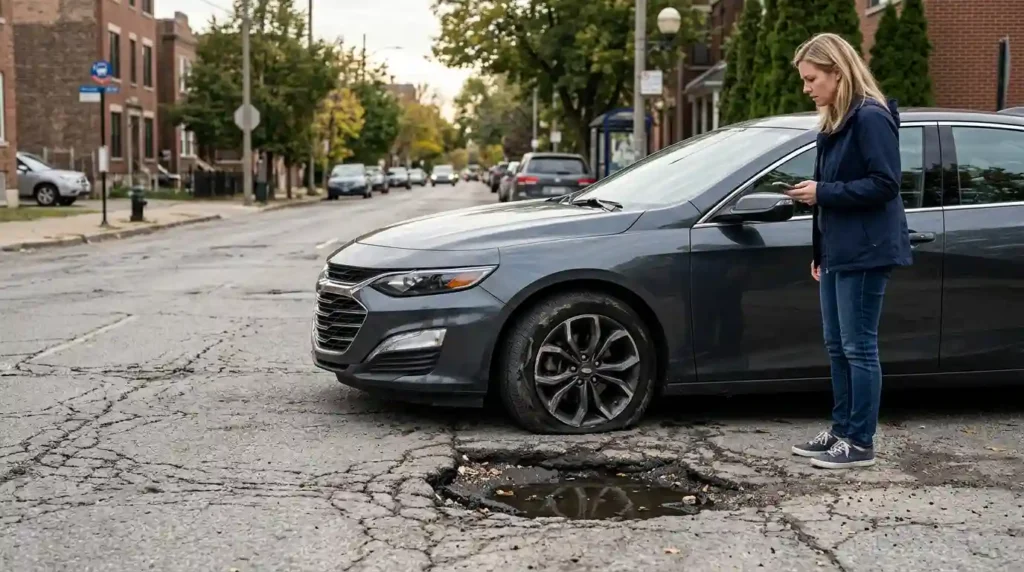
Part 2: Two Doors to Payment
The coverage answer is usually yes. But that doesn’t settle who should pay. Once you know the damage, you have two doors to choose from. Door 1 is your own insurer. Door 2 is the government that owns the road.
| Factor | Door 1: Your Insurer | Door 2: The City or State |
| What you need | Collision coverage | Proof the agency knew about the pothole |
| Who pays the deductible | You | No deductible, but payouts may be partial |
| Speed | Usually faster | Often slow |
| Approval odds | High if covered | Often low |
| Rate impact | Possible | None |
| Deadline | Prompt notice under your policy | Short local deadlines are common |
Door 1: Your Insurer
Is It Worth Filing a Claim for Pothole Damage?
This is the core decision. Is it worth filing a claim for pothole damage? It depends on three numbers: the repair cost, your deductible, and the possible rate increase.
The Break-Even Worksheet
Use this grid to run the numbers.
Illustrative example: These costs are round numbers to show the logic.
| Scenario | Repair Cost | Deductible | Insurer Pays | Worth Filing? |
| One tire | $250 | $500 | $0 | No |
| Tire + rim + alignment | $900 | $500 | $400 | Maybe, after the rate impact |
| Two rims + suspension | $2,500 | $500 | $2,000 | Often yes |
| Same damage, $1,000 deductible | $2,500 | $1,000 | $1,500 | Often yes |
The Hidden Third Number: Your Rates
Triple-I notes deductibles are typically $500 or $1,000. But there’s another cost. Progressive warns that after a pothole claim, “you may see an increase in your insurance rates at renewal time.”
So, should you file when the insurer pays $400? Maybe not. If your premium rises at renewal, the extra cost over time could exceed $400.
Here’s the contrarian point. A pothole claim may cost more than the repair itself, once you count future premiums. For mid-sized damage, paying out of pocket is often the smarter long-term move.
When Filing Clearly Makes Sense
Here’s when filing is more likely worth it:
- Damage is far above your deductible
- Safety systems or suspension need major repair
- Your insurer offers accident forgiveness, and you’re eligible
- The car is financed or leased, and repairs must be done properly
If you’re unsure, ask your insurer whether a pothole claim would be chargeable before filing.
Steps to File With Your Insurer
- Get to safety and check for injuries.
- Photograph the pothole, your car, and the location.
- Get a repair estimate from a trusted shop.
- Compare the estimate to your deductible.
- Report the claim online, by app, or by phone if it’s worth filing.
- Keep all receipts, including towing and alignment.
What If the Pothole Caused a Crash?
If you swerve and hit another car, liability coverage pays for their damage. Triple-I notes that a driver who hits another car because of a pothole “will be covered by liability insurance.” If someone is hurt, our car accident settlement calculator gives a rough estimate of what an injury claim could involve.
If the other driver is uninsured and at fault in a related crash, different rules apply. Our guide to an uninsured motorist lawsuit explains how claims work when the other driver has no insurance.
Door 2: The City or State
Can You File a Claim With the City for Pothole Damage?
Often, yes. Can you file a claim with the city for pothole damage? Many cities, counties, and states accept claims. But approval is far from guaranteed.
Triple-I notes that “some jurisdictions, like Chicago and New York State, may pay for pothole damage in certain cases.”
Why Government Claims Are Hard
Governments generally aren’t liable just because a pothole exists. Most rules require proof that the agency knew, or should have known, about the pothole and didn’t fix it in a reasonable time. That’s why reporting matters. If your claim turns into a dispute, our Arizona insurance claim lawyer guide explains your options.
Example: Chicago
According to an ABC7 Chicago report, drivers file claims with the City Clerk for damage under $2,500. They need a receipt or two, written estimates, and a police report.
The same report says that if a claim is approved, the city pays up to half the cost. In the year it described, the average payout was $333. Of nearly 1,400 claims, 46% were approved, and 37% were denied. Denied claims can’t be appealed; the next step is court. If an insurer denies your claim instead, our California insurance claim lawyer guide explains how disputes work there.
Example: New York State
A WHEC report from April 2026 says drivers can pursue damages on state roads only between May 1 and November 15. A pothole generally must have been reported at least 15 days earlier.
The same report describes a bill by State Sen. Jeremy Cooney to make the state liable year-round. As of the report, it was a proposal, not a law. If your own insurer denies a pothole claim, our Arkansas insurance claim lawyer guide shows how claims are contested.
The Government Claim Checklist
Before filing a government claim, start with this checklist:
- ☐ Find out who owns the road: city, county, or state
- ☐ Check the agency’s claim deadline, which can be short
- ☐ Photograph the pothole with something for scale
- ☐ Note the exact location, date, and time
- ☐ Get written repair estimates or receipts
- ☐ File a police or non-emergency report if required
- ☐ Keep copies of everything you submit
Should You Try Both Doors?
Sometimes. You can claim with your insurer and also file with the city. If the city pays later, your insurer may seek reimbursement for what it paid. Tell your insurer if you’ve filed a government claim.
So, can you claim both at the same time? Generally, yes, but disclose both, and don’t expect to be paid twice.
When Suing Isn’t Worth It
Here’s a realistic case. A driver’s city claim for $700 is denied. Suing the city means court fees, time off work, and a hard burden of proof.
For most drivers, a lawsuit over a few hundred dollars doesn’t make financial sense. Our guide on hiring a lawyer for a car accident with no insurance explains when legal help is worth the cost and when it isn’t.
Who Else Might Be Responsible?
Potholes in active construction zones can raise questions about the contractor’s responsibility. Contractors carry their own commercial and project insurance. For an example of how one specialty construction program separates its agent portal from its claims lines, see our guide to the US Assure agent login.
If you hit a pothole in a company vehicle, your employer’s commercial policy usually responds. Our guide to employer of record insurance coverage explains who holds coverage when you’re employed through an outside firm.
What Your Other Policies Won’t Cover
Your home policy doesn’t cover your car. Our homeowners insurance quote guide explains what a home policy actually covers.
A pothole in your own driveway is a property maintenance issue, not a car claim. Our walkthrough of an Allstate homeowners quote shows how home coverage lines are structured.
Renters coverage doesn’t cover your car either. It may cover belongings inside it. Our guide to USAA renters insurance shows where renters coverage starts and stops.
Personal items have their own limits away from home. Our guide on whether USAA renters insurance covers storage units explains how off-premises limits usually work.
Pothole Season and Your Coverage
Potholes often multiply after winter, when water freezes and thaws inside pavement cracks. Northern and mountain states see this most.
Winter storms are also a home insurance issue in those regions. Our guide to home insurance quotes in Rhode Island covers how inland towns handle winter storm and tree damage risks.
City driving adds more exposure. Our walkthrough of Denver car insurance quotes shows how one driver’s ZIP code shaped her price.
Should You Add Collision?
Remember: pothole damage falls under collision. If you don’t have collision, a pothole is fully your cost. Whether a collision is worth it depends on your car’s value and your savings.
For an older car worth a few thousand dollars, collision may cost more than it would ever pay. For a newer or financed car, it usually makes sense, and lenders often require it. Business owners should also check whether an LLC needs commercial insurance for work vehicles.
Bundling can lower the cost of adding collision. Our guide to home and auto insurance explains how bundle discounts work and when they don’t.
High-risk drivers sometimes carry only minimum liability. Our review of Direct General Insurance explains how one high-risk auto brand prices minimum and full coverage.
If you work with a local agency, verify its license first. Our fact-check of JoNa Insurance Agency shows how to check an agency’s license and carrier list.
Common Mistakes After Hitting a Pothole
These mistakes cost drivers money even when collision coverage applies.
- Not photographing the pothole. Cities may fill it within days.
- Ignoring small symptoms. A slight pull can mean damaged suspension.
- Filing before getting an estimate. You may file for less than your deductible.
- Skipping the alignment. New tires can wear out fast.
- Missing the city’s deadline. Some are short.
- Assuming the city always owns the road. Many roads belong to the county or state.
- Driving on a damaged tire. A sidewall bulge can fail at speed.
Looking Ahead
Pothole claims track road conditions and weather. More frequent freeze-thaw cycles in some regions may keep pothole damage common. Some states, like New York, are also debating changes to when governments must pay. These are reasonable trends to watch, not confirmed changes. Know your collision deductible before pothole season starts. Business owners face similar road risks, as our guide to general liability insurance cost for an LLC explains.
The Bottom Line: Does Car Insurance Cover Pothole Damage?
So, does car insurance cover pothole damage? Yes, if you have collision coverage. But coverage is only the first question. The repair estimate, your deductible, your rate risk, and the city’s rules decide what you’ll actually recover.
Your one practical next step: after hitting a pothole, photograph it, get a written estimate, and compare it to your deductible before filing anything.
FAQs
Will my policy pay for pothole damage?
Usually, if you have collision coverage. You’ll pay your deductible first. Liability-only and comprehensive-only policies usually won’t pay for your car.
Which coverage handles pothole damage?
Collision. Progressive and Triple-I both point to collision coverage for pothole damage to your car.
Does full coverage cover pothole damage?
Usually, because full coverage includes collision. Check the collision line on your declarations page to confirm.
When is a pothole claim worth filing?
It depends on the repair cost, your deductible, and the possible rate increase. Small claims near the deductible often aren’t worth it.
Can the city pay for pothole damage?
Often, yes. But many governments require proof they knew about the pothole, and some pay only part of the cost.
Does collision cover custom wheels?
Standard collision covers factory wheels. Custom or aftermarket wheels may need extra custom parts coverage.
Does insurance cover a flat tire from a pothole?
Often, under collision. But one tire usually costs less than the deductible. Claims make more sense when several parts are damaged.
Will my rates go up after a pothole claim?
They may. Insurers usually treat pothole claims as at-fault single-vehicle accidents. Ask your insurer before filing.

Michael Bennett is a U.S. insurance research and consumer education writer at Insurancebasics Hub, an independent resource dedicated to helping consumers understand insurance policies, coverage decisions, claims, and insurance-related consumer protections. His work covers auto, homeowners, renters, life, and other areas of insurance, with a focus on making complex insurance topics easier to understand.
Michael takes a research-focused approach to insurance content, using authoritative government and regulatory resources, state insurance department guidance, applicable insurance rules, policy provisions, and documented industry information. His articles examine important details such as coverage limits, deductibles, exclusions, policy conditions, premiums, claims, denials, cancellations, renewals, and state-specific requirements.
His goal is to provide accurate, transparent, and practical information that helps readers make better-informed insurance decisions. Insurancebasics Hub provides general educational information and does not replace individualized advice from a licensed insurance professional, attorney, financial professional, or other qualified adviser.