
FL RV insurance works differently for motorhomes and towables. A Florida motorhome is registered like a car, so it generally carries $10,000 in personal injury protection and $10,000 in property damage liability under no-fault rules. A towable has no state-mandated policy, yet lenders and hurricane exposure make physical damage coverage a practical question.
Most Florida owners reach this topic after hearing two confident answers that contradict each other. One agency page says RV coverage “is not optional.” Another says no law requires it for a trailer. Both can be right, depending on what you own.
This guide is organized around where the RV sits, because that is what changes the answer: on the road, at a campsite, in storage, or in the path of a storm. Cost figures come from Progressive’s published Florida data and are labeled as one carrier’s numbers, not a market average.
The Short Answer by RV Type
Your RV’s classification decides your legal baseline. A motorhome is treated as a registered motor vehicle, while a towable follows the vehicle pulling it. Everything beyond that baseline comes from a lender, a campground, or your own tolerance for loss.
| Factors | Motorhome (Class A, B, C) | Towable (travel trailer, fifth wheel, pop-up) |
| State-mandated coverage | PIP and property damage liability, as with a car | No standalone state mandate |
| Liability while moving | Its own policy | Tow vehicle’s liability, while hitched |
| Physical damage (theft, storm, collision) | Optional by law, typically required by a lender | Same |
| When parked or unhitched | Comprehensive keeps working if carried | Tow vehicle’s liability stops applying |
The “legal” row is the only one government sets. The rest is contract and risk.
Motorhome or Towable? Where Florida Law Draws the Line
Florida treats a motorhome like any other four-wheeled vehicle registered in the state, which brings in the no-fault system. A towable is not self-propelled, so the law looks to the vehicle towing it. That single distinction explains most of the confusion online, and neighboring states draw the line differently, as our guide to RV insurance in Georgia shows.
Florida minimums for motorhomes
Agency pages consistently report $10,000 PIP and $10,000 property damage liability for motorhomes. These figures trace to Florida’s no-fault statutes, and you should confirm the current numbers on the Florida DHSMV site before relying on them.
Bodily injury liability is not part of that baseline, although Florida’s financial responsibility rules can require higher coverage after certain accidents or violations. PIP pays your own medical costs and part of lost income regardless of fault. Property damage liability pays for what you damage.
What a towable needs
Per Progressive, Florida has no state requirement to insure a travel trailer. Your tow vehicle’s liability coverage is what responds if the trailer injures someone or damages property while hitched. Insurance.com adds the other half: that coverage does not repair the trailer itself.
If you financed the trailer, a lender typically requires comprehensive and collision. That is a loan term, not a law. For the smallest towables, our breakdown of pop-up camper insurance requirements covers the same questions at a lower price point.
When you unhitch, liability changes
Once the trailer is parked and unhooked, the tow vehicle’s liability has little reason to respond to what happens around it. A guest tripping over a stabilizer jack at your site is a different kind of claim, which is why a separate coverage called vacation liability exists (more below).
Decision checkpoint: If your RV is a towable, the question is not “does Florida require a policy?” It is “who pays if the trailer is damaged, or someone is hurt while it is parked?” If the answer is “I would,” read your tow vehicle’s declarations page and your loan agreement before assuming otherwise.
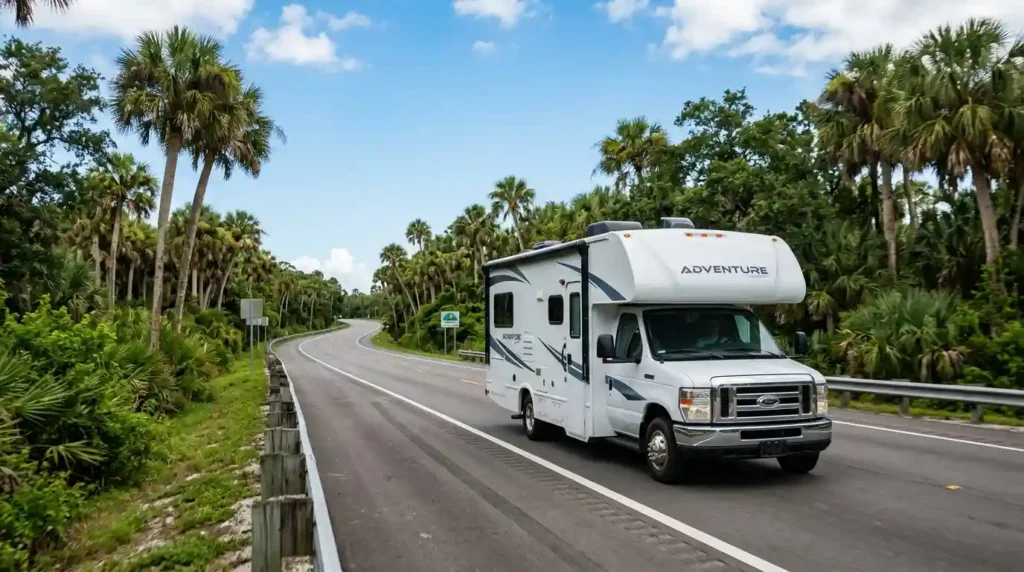
Full-time RV insurance in Florida
An RV faces different risks on the road, at the campsite, in storage, and during a storm. Each moment typically requires a different coverage, which is why a single “do I need insurance” answer often falls short.
On the road
On the road, liability, PIP, and collision matter most. A motorhome’s minimums are low: if you cause an accident that damages two cars for $38,000 total, a $10,000 property damage limit leaves $28,000 unpaid by the policy (illustrative scenario in Orlando traffic). That gap lands on you.
This is the situation where people look at coverage limits above the minimum, and at an umbrella policy on top.
One number you will see repeated: some Florida pages cite an uninsured-driver share of 15 to 20 percent, but I could not trace that figure to a primary source, so I am not relying on it. Uninsured/underinsured motorist coverage is worth understanding regardless, because it covers your injuries when the other driver has little or nothing. If you want to see what happens when that coverage is disputed, read how an uninsured motorist lawsuit works.
At the campsite
At the campsite, vacation liability and personal effects coverage are the relevant pieces. Vacation liability typically applies while the RV is parked and used as a temporary residence, covering injuries to guests at your site. It is commonly part of an RV policy rather than an auto policy.
Take a guest at a Pensacola-area campground who breaks an ankle, with $14,000 in medical bills (illustrative). Without vacation liability, you may be handling it from your own funds or hoping another policy responds. Whether homeowners liability extends to a camper at a campsite depends on the policy wording.
A sub-limit limits personal effects. If $3,200 of gear is stolen and the sub-limit is $2,000 (illustrative), the policy caps at $2,000, leaving at least $1,200 unreimbursed.
In storage
In storage, comprehensive coverage is what continues to protect the RV, covering theft, fire, vandalism, and rodent damage. Some carriers offer storage-only coverage that suspends driving-related coverage to lower the cost.
The catch: if you drive a stored RV and the driving coverages are suspended, you may have no liability protection. Confirm exactly what your carrier suspends before you move the vehicle.
Storage location matters for rating, too. Coastal storage generally prices higher than inland, and a secured facility may be viewed differently from a driveway. Homeowners policies rarely fill the gap, because they are built around the dwelling, not a vehicle parked beside it.
During a hurricane
During hurricane season, wind damage typically falls under comprehensive coverage, but three details decide whether you are actually protected. Here is the sequence worth thinking through:
- Before the season: Read your comprehensive section and your deductible. Photograph the RV inside and out, and keep an inventory of contents.
- When a storm is named: Many carriers restrict new policies and coverage changes once a storm is named, per agency guidance. Do not plan to add coverage at the last minute.
- During the storm: Follow official evacuation guidance from county emergency management and the National Hurricane Center’s advisories.
- After the storm: Document damage before moving anything, and report the claim promptly. Delays in documentation are a common friction point.
Wind, flood, and named-storm deductibles
Three terms matter here, and they are where RV policies diverge by carrier:
- Wind is generally a comprehensive loss.
- Flood and storm surge are treated inconsistently. One agency page says comprehensive covers flooding; another says standard RV policies exclude it. I’m treating both as unverified, so check the policy language itself.
- Named-storm deductibles may apply as a percentage rather than a flat amount on some policies.
Suppose a $90,000 motorhome sits in a Fort Myers storage lot and the policy applies a 2 percent named-storm deductible (illustrative; many policies use flat deductibles). That deductible is $1,800, versus a $500 flat deductible, a $1,300 difference before the claim even begins.
What FL RV Insurance Covers
A full recreational policy is built from a handful of coverages. Knowing what each one actually pays is more useful than any headline premium, because “full coverage” does not mean every loss is covered.
Liability, PIP, and uninsured motorist. Liability pays for harm you cause to others. PIP pays your own injury costs under Florida’s no-fault system. UM/UIM covers you when the other driver is uninsured or underinsured, and it is optional.
Comprehensive and collision. Comprehensive covers non-collision losses such as theft, wind, fire, and falling objects. Collision covers accident damage. The deductible works the same way on an RV as on a car: it is the first portion of a covered loss that you pay. Damage from road hazards is a gray area worth understanding, and whether car insurance covers pothole damage shows how that question is usually decided.
Contents, emergency expense, roadside. Contents are capped by a sub-limit. Emergency expense covers lodging and travel when a covered loss strands you. Roadside needs to be RV-capable, since a standard tow truck cannot always handle a large rig.
Agreed value and total loss replacement. Actual cash value subtracts depreciation. Agreed value fixes the payout in advance. Total loss replacement pays for a new unit but is typically limited to newer RVs; Progressive requires the RV to be under five years old.
Here is an illustrative comparison: an RV with an ACV of $62,000 and an agreed value of $75,000, with a $1,000 deductible, pays $61,000 under ACV and $74,000 under agreed value. That $13,000 gap is why the valuation method matters as much as the premium.
Here is the detail most readers miss: attached awnings and accessories are often excluded from base coverage, and mold or leak damage from poor maintenance may be excluded. Read the exclusions page, not just the coverage list.
In practice, a claim also depends on paperwork. Insurers commonly ask for the VIN, proof of ownership, photographs, and receipts for contents. An owner who bought privately and never kept the bill of sale can spend weeks rebuilding that record while repairs wait.
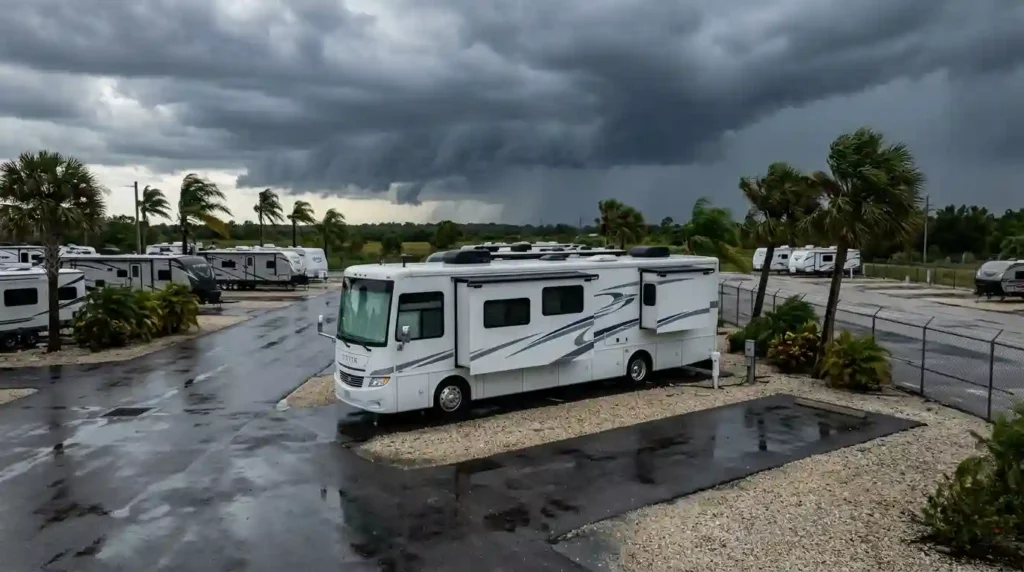
What Does It Cost in Florida?
Progressive’s 2024 Florida averages are $1,386.04 per year for a motorhome and $841.16 for a travel trailer. Those are one carrier’s averages, not a statewide market figure. Florida RV insurance quotes online can land well away from them depending on class, value, storage, and use.
| Factor | Progressive Florida 2024 | Progressive countrywide 2024 | Florida difference |
| Motorhome | $1,386.04 / yr (about $115.50 / mo) | $1,052 / yr | +$334.04 (about 31.8%) |
| Travel trailer | $841.16 / yr (about $70.10 / mo) | $594 / yr | +$247.16 (about 41.6%) |
Progressive’s countrywide data also shows liability-only policies starting around $125 a year, though that line should be verified at the source, since Progressive says its travel trailer policies must include comprehensive and collision.
Why the numbers differ
Other sources give wildly different Florida ranges. Agency estimates for full-timers run higher still, and each local page quotes its own. Nobody reconciles them, and here is why they conflict: they measure different things. An insurer average blends all its policies, while an agency range reflects the cases that agency sees, and neither is a market average. I would not treat any single range as “the” price.
What I can say with confidence is the direction. According to Progressive’s own data, Florida costs more than the national average, which is consistent with hurricane exposure, though Progressive does not publish its reasons in the figures I reviewed.
Deductible example (hypothetical)
Say a $520 annual premium comes with a $500 deductible, while a $430 premium comes with a $2,000 deductible. The cheaper policy saves $90 a year but adds $1,500 of exposure per claim. At $90 a year, it takes about 16.7 years without a claim to recover that difference.
Decision checkpoint: If a higher deductible lowers your premium, the relevant question is whether you could comfortably absorb that deductible after a covered loss, especially in a storm, when many claims arrive at once.
Affordable RV Insurance in Florida: What to Trim and What to Keep
Cutting costs is easiest where the premium buys the least exposure: a higher deductible you can actually afford, bundling with your auto or home policy, secure storage, and seasonal or storage-only pricing during months you are not driving. Discounts vary by carrier. If bundling is on the table, a homeowners and car insurance quote comparison explains how that pairing is priced.
What backfires: dropping liability to the minimum, skipping comprehensive in a hurricane region, or choosing a lower-priced policy with a contents sub-limit too small for your gear.
Consider a $9,000 older travel trailer stored inland in Ocala. At Progressive’s $841.16 average, a year of coverage equals about 9.3 percent of its value. For that owner, relying on the tow vehicle’s liability and carrying less physical damage coverage may be a defensible choice, though lenders and some carriers may not allow it. This is the opposite case from a financed newer unit, where dropping coverage would break the loan terms.
Full-Time RV Insurance in Florida
Full-time coverage is a different policy form, not a bigger version of the recreational one. If the RV is your primary residence, the carrier treats it more like a home: higher liability, higher contents limits, and often a higher premium.
How carriers define full-time
The threshold varies. One agency page references 150 nights; another references more than six months. Both are agency pages, and the actual definition sits in your carrier’s policy. Check it against your real usage, because a recreational policy on a full-time RV can create a problem at claim time.
Snowbirds and out-of-state RVs
A snowbird spending several winter months in Florida raises two questions: whether your policy still fits that usage, and what Florida registration rules apply to an out-of-state RV. Verify the second with Florida DHSMV; I have not confirmed the current requirements.
Geography matters inside the state, too. Gulf Coast and Keys storage carries storm-surge and wind exposure that inland Central Florida storage does not, and the Panhandle faces its own landfall history.
Florida RV Insurance Quotes Online: What to Have Ready
An online quote is only as accurate as the inputs, and the inputs most often wrong are usage days and storage address. Have these ready: VIN, year, make, model, purchase price, title, storage ZIP code, annual mileage or nights used, and a list of attached equipment.
Step-by-step process
- Gather the details above and your current declarations page.
- Decide whether you are comparing like-for-like: same deductible, same limits, same valuation method.
- Request quotes from at least two carrier types (specialty RV, standard auto carrier, independent agent).
- Compare the quote’s sub-limits, exclusions, and named-storm terms, not just the price.
- Confirm the effective date and send proof to your lender.
Quote traps
The common ones are an understated usage estimate, a storage ZIP different from the actual one, and compared quotes with different deductibles. A low quote built on the wrong assumptions can be reclassified later. Reading how another market handles the same questions, such as RV insurance in Las Vegas, can help you spot which quote inputs matter most.
Best RV Insurance Companies in Florida: How to Judge Them
No source I could verify supports a universal ranking, so I won’t give one. Lists of the best RV insurance companies in Florida rarely state their criteria, and some include homeowners carriers that may not write RV policies at all. Judge a carrier by what it offers and how it behaves.
How to judge a carrier
Five measurable criteria apply:
- Financial strength: a published AM Best rating.
- Complaints: the NAIC complaint index and Florida DFS Division of Consumer Services records.
- Coverage forms: agreed value, total loss replacement, full-timer, and flood treatment.
- Storm terms: named-storm deductible and mid-season change rules.
- Claims practice: documentation requirements and process.
Carrier types compared
| Carrier type | Typical strength | What to check |
| Specialty RV carrier | RV-specific forms and class pricing | Storm and full-timer terms |
| Standard auto carrier | Bundling with auto and home | Whether the RV form is limited |
| Independent agent | Compares several carriers | Which carriers they actually place with |
| Homeowners carrier listed for RV | Appears in some local lists | Whether it writes RV at all |
Regulators are the neutral place to verify. The Florida Office of Insurance Regulation oversees insurers, and the DFS Division of Consumer Services takes consumer complaints.
Questions to ask an agent
- Is the valuation agreed value or actual cash value?
- How does flood or storm-surge loss get treated?
- Is there a named-storm deductible, and how is it calculated?
- What is the full-timer threshold in nights?
- What is the contents limit, and are awnings covered?
- Does rental use affect the policy? Rental income can also raise a separate commercial-insurance question, so ask the carrier how it treats an RV you rent out.
What stood out to me while comparing Progressive’s Florida data with agency estimates is how rarely the sources define their terms. A price without a stated deductible, valuation method, and usage assumption is not really a price.
Common Mistakes
Most Florida mistakes come from assumption rather than carelessness. Assuming the tow vehicle covers the trailer’s physical damage is the most common. Chasing affordable RV insurance in Florida by trimming liability or the storm deductible is another, since the savings show up monthly while the loss shows up in a single bad week.
Others: adding coverage after a storm is named, understating nights used, driving a storage-policy RV, skipping photos before hurricane season, and forgetting to send proof of coverage to the lender, which can lead to force-placed insurance billed at your expense.
A forward-looking opinion, labeled as one: I expect hurricane exposure to keep shaping how Florida RV policies handle storm terms, deductibles, and mid-season changes. That is my read of the market, not a confirmed regulatory change.
Final Thoughts: Where Your RV Sits Decides the Cover
So what does FL RV insurance actually come down to? For a motorhome, Florida’s no-fault minimums are the legal baseline. For a towable, the law points to your tow vehicle, and everything else comes from your lender, your risk, and where the RV sits when a storm arrives.
The most useful next step is concrete: pull your declarations page, find the comprehensive deductible and any named-storm terms, and confirm the minimums with Florida DHSMV and the Office of Insurance Regulation.
FAQs
Is RV insurance required in Florida?
Motorhomes carry PIP and property damage liability like cars. Towables have no state-mandated policy, but lenders typically require physical damage coverage.
What do Florida motorhome minimums look like?
Agency pages report $10,000 PIP and $10,000 property damage liability. Confirm current figures with Florida DHSMV.
Do travel trailers need insurance in Florida?
Not by state law, per Progressive. Your tow vehicle’s liability responds while hitched.
Does RV insurance cover hurricane damage in Florida?
Wind is generally a comprehensive loss. Flood treatment varies by carrier, so read the policy.
What is full-time RV insurance in Florida?
It is a policy form for RVs used as a primary residence, with higher liability and contents limits. Carriers set their own night thresholds.
Do snowbirds need Florida coverage?
Your policy must match your actual usage and storage. Verify registration rules with Florida DHSMV.
Can I drive an RV on a storage policy?
Often not. Driving coverages may be suspended, so confirm with your carrier first.
Does rental use change my policy?
It can, because personal-use policies may exclude rentals. Check carrier language.