
Here is how to get car insurance: gather your driver’s license, address, and vehicle VIN, check your state’s minimum liability limits, and choose your coverage. Then compare quotes, apply, and pay your first premium. Coverage can start the same day. Forty-nine states and D.C. require liability insurance; New Hampshire is the exception, according to the Insurance Research Council.
Maybe you just bought a car. Maybe you’re about to. Or maybe you’re moving off a parent’s policy for the first time. Either way, you want to get covered without making a costly mistake.
The good news: the process is simple. Most people can finish it in under an hour. The part that trips people up is timing. When does coverage start? What if you drive the car home before the policy is active? And why does the final price sometimes differ from the quote?
This guide answers those questions in order. You’ll see the steps, the documents, and the edge cases most guides skip.
Quick Answer: How to Get Car Insurance in 7 Steps
Getting car insurance takes seven basic steps. Most can be done online in one sitting.
- Gather your information. License, address, VIN, and driving history.
- Check your state’s requirements. Minimum liability limits vary by state.
- Choose your coverage. Decide on limits, deductibles, and optional coverage.
- Compare quotes. Use the same limits and deductibles on every quote.
- Apply and review the final price. Underwriting may adjust your quote.
- Pay and get proof of insurance. Coverage starts on the effective date.
- Cancel or update your old policy. Only after the new one is active.
What You Need Before You Start
You need three kinds of information: about you, about every driver in your home, and about the car. The full checklist is in the next section.
Can You Get Car Insurance Today?
Yes, usually. Many insurers can activate a policy the moment you make your first payment. You’ll often get a digital ID card right away. Some situations take longer, though. A high-risk record, a lapse in coverage, or an unusual vehicle may need manual review.
What Do You Need to Get Car Insurance?
What do you need to get car insurance? It comes down to identity, driving history, and vehicle details. Having it ready speeds things up. It also makes your quote more accurate.
Personal and Driver Information
Insurers rate each driver on the policy. So they need details on you and anyone else who regularly drives the car.
Driver’s License and Driving History
Have your license number ready. Insurers will pull your motor vehicle record anyway. But listing your tickets and accidents up front prevents surprises later. Be honest here. Leaving something out doesn’t hide it. It just delays the price change.
Address and Garaging Location
Your garaging address is where the car is parked overnight. It affects your rate because insurers price local theft, traffic, and claim rates. Use the real address. A wrong garage address can cause problems if you file a claim. Denver car insurance quotes show how much location can move a price.
Vehicle Information
The car matters as much as the driver. Insurers need to know exactly what they’re covering.
VIN, Make, Model, and Year
The VIN is a 17-character code. You’ll find it on the driver-side dashboard, the door jamb, the title, or the sales paperwork. It tells the insurer the exact trim and safety features.
Mileage and Ownership Status
Estimate your annual mileage honestly. Also note whether you own, finance, or lease the car. If there’s a loan or lease, the lender will likely be listed on your policy.
Printable Checklist
| Required | Helpful to Have |
| Driver’s license number for every driver | Current or prior insurance declarations page |
| Home and garage address | Dates of past tickets or accidents |
| VIN, make, model, year | Estimated annual mileage |
| Date of birth for each driver | Lender or lessor name and address |
| Ownership status (own, finance, lease) | Safety and anti-theft features |
The Detail That Changes Your Quote Most
Many people focus on the car. But every household driver matters too. If a teen or roommate regularly drives the car and isn’t listed, the insurer may treat that as a misrepresentation. Ask your insurer how it handles household drivers before you apply. If a claim is ever disputed, our Florida insurance claim lawyer guide explains your options.
Should You Get Car Insurance Before or After Buying the Car?
Get it before you drive the car anywhere. If you already have a policy, a grace period may cover the new car briefly. If you don’t, there is no grace period at all.
This is the part many first-time buyers miss.
Buying From a Dealer
Most dealers won’t let you leave without proof of insurance. If you’re insured already, call your insurer before signing. Ask two things: how long the grace period lasts and what coverage carries over.
Grace periods commonly run 7 to 30 days, depending on the insurer. During that window, the new car usually gets the same coverage your current policy has.
Here’s the catch. “Same coverage” means exactly that. Take this illustrative scenario. A driver in Houston has liability-only coverage on an older car. He buys a newer financed car and drives it home under the grace period. Three days later, he backs into a pole. His liability coverage protects other people. It doesn’t pay for his own car. With no collision coverage, the repair is his to cover.
What stood out to me when I compared the major how-to guides was how rarely they explain this. Most say “you’re covered automatically.” Few add that you’re only covered the way your old car was.
Private Sale Purchases
Private sales need more planning. Get the VIN from the seller before you meet. Then buy a policy with an effective date of the purchase day. If you have no current policy, you have no grace period to fall back on.
Temporary Plates and Proof of Coverage
A temporary tag does not replace insurance. Most states want proof of coverage before you register the car. Keep your ID card on your phone or in the car. Save a PDF copy too, in case your signal drops.
Decision checkpoint: If your current policy is liability-only and the new car is financed, don’t rely on the grace period. Add collision and comprehensive before you drive off. Your lender will likely require it anyway.
Getting Car Insurance Online
Getting car insurance online is the fastest route for most drivers. You fill out a form, see a price, choose coverage, and pay. Many insurers issue proof of insurance within minutes.
Getting an Online Quote Step by Step
The process looks similar on most sites:
- Enter your ZIP code and basic details.
- Add every driver and vehicle.
- Choose limits and deductibles.
- Review the discounts the site applies.
- See your estimate and adjust coverage.
The key is to keep your choices identical across sites. When you compare car insurance quotes from several insurers, use the same limits, deductibles, and optional coverage every time. Otherwise, the cheapest quote may simply be the thinnest one.
Protecting Your Personal Information
Online quotes need real data. Expect to share your license number and date of birth. Some comparison sites share your details with multiple insurers or agents. That can mean follow-up calls and emails. Read the privacy terms before you submit. Look for a clear statement on who receives your data.
Online vs. Agent vs. Comparison Site
| Method | Best For | Trade-Off |
| Direct from an insurer online | Speed and simple profiles | One company’s price at a time |
| Captive agent | Advice on one company’s products | Limited to that company |
| Independent agent or broker | Complex needs or several quotes at once | Depends on which insurers the agent works with |
| Comparison site | Quick side-by-side estimates | Follow-up contact; results may be sponsored |
No method is automatically cheaper. The right one depends on how complex your situation is and how much guidance you want.
Why Online Estimates Move
An online price is an estimate. It’s built on what you typed. After you apply, the insurer checks your records. That’s where the number can shift. We’ll cover why in the application section below. Colorado car insurance quotes show how much estimates can vary.
How to Buy Car Insurance Once You’ve Chosen a Policy
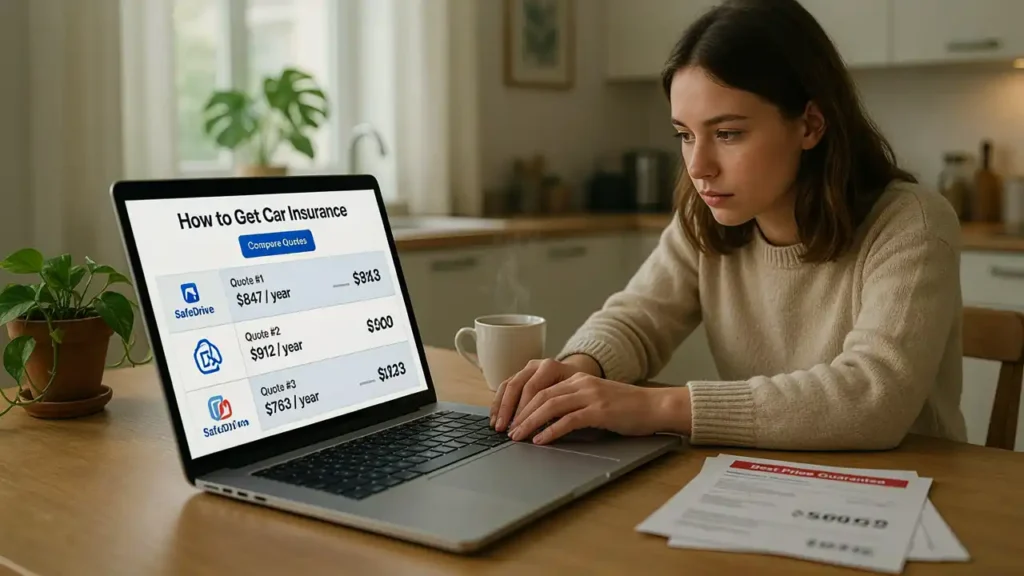
How to buy car insurance, once you’ve picked a quote, comes down to three things: confirm the details, choose how to pay, and get proof. Don’t rush this part. It’s where small errors become real problems.
Reviewing the Final Quote
Read the summary before you pay. Check every driver, the VIN, the garaging address, and each coverage line. Price isn’t the only thing to judge, either. Claims service and financial strength matter when you actually need the policy. Our guide on how to evaluate the best car insurance companies walks through what to look at beyond price.
Paying: In Full vs. Monthly
Paying in full is often cheaper. Many insurers offer a pay-in-full discount. Monthly plans may add installment fees.
Here’s an illustrative example. These figures are not a quote:
- Six-month premium: $1,200
- Monthly plan: $200 down, then five payments of $200
- Installment fee: $6 per payment × 5 = $30 extra
- Paying monthly for a full year: $30 × 2 terms = $60 more per year
That’s not huge. But it adds up, and a pay-in-full discount can widen the gap. Ask your insurer for both totals side by side.
Getting Proof of Insurance
Your insurer will issue an ID card, usually digital at first. It shows your policy number, effective dates, and insured vehicle. You’ll also get a declarations page. Keep it. It’s the one-page summary of what you actually bought.
How to Apply for Car Insurance
How to apply for car insurance is simple on paper. You submit your details, the insurer verifies them, and the policy is issued. The verification step is called underwriting.
Application and Underwriting
During underwriting, the insurer checks your motor vehicle record. It may also review your claims history. In most states, it may check a credit-based insurance score too. Four states ban that: California, Hawaii, Massachusetts, and Michigan.
Why a Final Quote Can Differ From an Estimate
A quote can change after underwriting. This is normal. It’s not a bait-and-switch.
Here’s an illustrative scenario. A renter in Seattle gets an online quote of $140 a month. On the application, she lists her roommate as a regular driver. The roommate has an at-fault accident on record. The final price comes back higher. Nothing was hidden. The quote simply didn’t include that driver yet.
Credit can shift your price too, where allowed. Washington is one of the milder states on this. ValuePenguin found that it has the smallest poor-credit penalty among states that permit credit rating, at 42%. If you live there, reviewing how Washington car insurance quotes are priced can help set realistic expectations.
How Long Approval Takes
Most standard applications are approved within minutes. Some take longer. A recent DUI, an SR-22 filing, a long lapse, or a modified vehicle may need manual review. In those cases, plan ahead. Don’t wait until the day you need to drive. Our list of the cheapest high-risk car insurance companies can help in those cases.
Coverage Types to Consider When You Get Car Insurance
The coverage you choose decides what your policy actually pays. Liability protects other people. Collision and comprehensive protect your own car. The rest fills specific gaps.
This is where the premium alone doesn’t tell the whole story.
State Minimums vs. Real Protection
A state minimum is a legal floor. It isn’t a safety net. If you cause a crash that costs more than your limits, you may owe the rest.
Uninsured drivers make this worse. The Insurance Research Council estimates that 15.4% of U.S. drivers were uninsured in 2023. It also found that one in three drivers was either uninsured or underinsured. The rate ranged from 5.7% in Maine to 28.2% in Mississippi. Uninsured rates vary widely by state, as Alaska car insurance quotes show.
Coverage Types at a Glance
| Coverage | What It Pays For | Usually Required? |
| Bodily injury liability | Injuries you cause to others | Yes, in nearly all states |
| Property damage liability | Damage you cause to others’ property | Yes, in nearly all states |
| Collision | Your car’s repairs after a crash | Often required by lenders |
| Comprehensive | Theft, hail, fire, flood, and animal strikes | Often required by lenders |
| Uninsured/underinsured motorist | Your losses caused by an uninsured driver | Required in 20 states and D.C. |
| Personal injury protection (PIP) | Medical costs regardless of fault | Required in no-fault states |
| Medical payments (MedPay) | Medical costs for you and passengers | Usually optional |
How a Deductible Works
Collision and comprehensive coverage come with a deductible. It’s the amount you pay before the insurer pays. Here’s how it plays out, step by step:
- A covered hailstorm causes $3,800 in damage.
- Your comprehensive deductible is $500.
- You pay the first $500.
- The insurer pays about $3,300, subject to your policy terms.
A higher deductible lowers your premium. But only choose an amount you could pay tomorrow without strain. Home policies use the same logic, as our guide to home insurance quotes in Rhode Island explains.
What Lenders and Lessors Require
If you finance or lease, the lender usually requires collision and comprehensive coverage. Many also limit how high your deductible can be. Check your loan or lease contract. If you’re unsure what that combination includes, our guide to full coverage car insurance really breaks it down.
State Requirements: What to Check Before You Buy Car Insurance

State law sets the minimum coverage you must carry. It also decides which extra coverages are required. So the answer to “what do I need?” depends on where you live.
State Minimum Liability Limits
Limits are written as three numbers. For example, 25/50/25 means $25,000 per injured person, $50,000 per accident, and $25,000 for property damage. Arizona car insurance quotes show how one state applies these limits.
| State | Minimum Liability | Also Required |
| Georgia | 25/50/25 | None beyond liability |
| Maryland | 30/60/15 | Uninsured motorist coverage |
| New Jersey | 35/70/25 | PIP and UM/UIM |
| Texas | 30/60/25 | None beyond liability |
| Washington | 25/50/10 | None beyond liability |
Georgia uses the most common minimum in the country. It’s a clean baseline. But $25,000 in property damage can run out fast in a crash with a newer vehicle. That’s worth weighing when you compare Georgia car insurance quotes at minimum limits.
Maryland asks for more than liability. Drivers must also carry uninsured motorist coverage. Maryland also restricts how insurers use credit. They may use it to price a new policy, but not to raise your premium at renewal. That’s a useful detail if you’re reviewing Maryland car insurance quotes for the first time.
Texas keeps its requirement for liability. But prices there have climbed sharply. ValuePenguin found Texas had the largest five-year increase in the country, with rates up 60.97% between 2020 and 2025. First-time buyers should expect that when they look at how Texas car insurance quotes have changed.
No-Fault States and PIP
In no-fault states, your own policy pays your injury costs first, regardless of what caused the crash. That’s why these states require PIP. New Jersey is one of them. It also raised its minimum liability limits to 35/70/25 on January 1, 2026, under Bill S3157. If you’re buying there, see New Jersey car insurance quotes now.
Old Guides, Outdated Rules
Here’s one more thing that catches readers. Many older articles say Virginia lets drivers skip insurance by paying a fee. That’s no longer true. Virginia eliminated its $500 uninsured motor vehicle fee on July 1, 2024. Every vehicle registered there now needs liability coverage. If a guide still lists that option, check how old it is.
What Affects the Price When You Get Car Insurance?
Your price depends mostly on your driving record, age, location, vehicle, and coverage. Credit matters too, where state law allows it.
Driving Record, Age, and Location
A clean record usually earns the best rates. Tickets and accidents typically affect pricing for three to five years. Young drivers pay the most. Location matters because insurers price local claim costs. For national context, Experian’s August 2026 data puts full coverage at about $243 a month and minimum coverage at about $132. State guides like Arkansas car insurance quotes show these factors locally.
Credit-Based Insurance Scores Where Allowed
In most states, a better credit history can lower your price. California, Hawaii, Massachusetts, and Michigan ban its use in auto rating. Getting a quote typically triggers only a soft credit check. It doesn’t hurt your credit score. Colorado auto insurance quotes show how one state handles these factors.
Discounts to Ask About
Discounts vary by insurer and state. Bundling with a home policy, such as an Allstate homeowners quote, is a common one. Others include:
- Good student for young drivers with strong grades
- Multi-policy for bundling auto with renters or home
- Pay-in-full and paperless billing discounts
- Safety features such as anti-theft devices
Ask directly. Not every discount is applied automatically. See our full list of car insurance discounts to ask about.
Getting Car Insurance in Special Situations
Most guides assume you own a car and have a license. Real life is messier. Here’s how to get covered when your situation doesn’t fit the standard form.
With No Car (Non-Owner Policies)
A non-owner policy gives you liability coverage when you drive cars you don’t own. It’s often used by people who borrow cars regularly or need an SR-22 without owning a vehicle. It doesn’t cover damage to the car you’re driving. Some insurers only quote these by phone.
With No License or a Learner’s Permit
Permit holders are often covered under a parent’s or guardian’s policy. Rules vary by insurer, so call and ask. Some insurers want the permit driver listed. Others don’t until the full license is issued. If you own a car but can’t drive, you may still insure it by listing a licensed primary driver.
As a First-Time Buyer or New Driver
Expect a higher price at first. You have no insurance history yet. Staying on a family policy can be cheaper if you still live there and the car is titled correctly. Once you move out or title a car only in your name, you’ll usually need your own policy. Budget carriers like Direct General Insurance may also be worth a quote.
If You Use Your Car for Work
This is the gap many new drivers never hear about. Personal auto policies are built for personal use. The Insurance Information Institute notes that this exclusion covers business use beyond ridesharing, such as deliveries. Many personal policies also carry a public or livery conveyance exclusion. That can leave you uncovered while a rideshare app is on and you’re waiting for a request. Truck owners can start with our guide to cheap commercial truck insurance.
Commuting to one fixed workplace is usually still personal use. But delivery, rideshare, or driving to job sites may not be. Some insurers offer a rideshare endorsement. If you drive for a business, look into when you need commercial auto insurance instead.
Scenario Summary
| Situation | Key Step | Common Pitfall |
| Buying from a dealer, already insured | Confirm grace period length | Liability-only coverage carries over as-is |
| Private sale, no current policy | Buy a policy dated the purchase day | No grace period exists |
| No car of your own | Ask about a non-owner policy | Doesn’t cover the borrowed car’s damage |
| Learner’s permit | Check your family insurer’s listing rules | Assuming coverage without asking |
| Rideshare or delivery driving | Add an endorsement or commercial policy | Personal policy excludes the gap |
| Financed or leased car | Add collision and comprehensive | Deductible above lender’s limit |
Decision checkpoint: Before you buy, ask how you’ll really use the car. Weekend errands and a commute fit a personal policy. Paid deliveries don’t. Fitting the policy to your real use matters more than shaving a few dollars off the premium. Truck owners should also review commercial truck insurance requirements.
Common Mistakes When You Apply for Car Insurance
The most costly mistakes are about timing and accuracy, not price. They’re also easy to avoid.
Coverage Lapses When Switching
Never cancel your old policy first. Start the new one, confirm it’s active, then cancel. Even a one-day gap can raise your future rates. It can also leave you legally uninsured.
Comparing Quotes With Different Limits
A quote with 25/50/25 isn’t comparable to one with 100/300/100. Line them up with identical limits and deductibles. Otherwise, you’re comparing two different products.
A few more to avoid:
- Guessing at your application. Tickets and accidents will show up in underwriting.
- Leaving out household drivers. This can cause claim disputes later.
- Forgetting to add a new car. Grace periods end. Coverage can lapse quietly.
- Assuming personal coverage covers work driving. Check for business-use exclusions.
What Changes Next Year
Rates rarely stay flat. Insurify projects that national full-coverage prices will end 2026 about 1% higher than a year earlier. Your renewal could move either way. Review your declarations page each time it renews. Business owners can also track commercial truck insurance cost trends.
Your Next Step Before You Get Car Insurance
Knowing how to get car insurance is mostly about order. Gather your details. Check your state’s rules. Pick coverage that matches how you drive. Compare quotes with identical limits. Then pay, save your proof, and only then cancel your old policy.
Here’s one feasible next step. Before you request a single quote, write down the limits and deductibles you want. Use those exact numbers everywhere. It’s the simplest way to make sure you’re comparing real prices, not different policies.
Frequently Asked Questions
What documents are required for car insurance?
You need a driver’s license number, address, date of birth, and vehicle details, including the VIN. List every regular driver in your household, too.
Can I get car insurance the same day?
Often, yes. Many insurers activate coverage once you pay the first premium and issue a digital ID card right away.
Do I need insurance before buying a car?
You need it before you drive. Existing policyholders may get a 7- to 30-day grace period. First-time buyers don’t get one.
Can I get car insurance without a car?
Yes. A non-owner policy provides liability coverage when you drive cars you don’t own. It doesn’t cover the other car’s damage.
Is it cheaper to get car insurance online?
Not always. Online is faster. Price depends on the insurer and your profile, not only on how you buy.
Does my personal policy cover delivery or rideshare driving?
Usually not. Most personal policies exclude it. You may need a rideshare endorsement or a commercial policy.

Michael Bennett is a U.S. insurance research and consumer education writer at Insurancebasics Hub, an independent resource dedicated to helping consumers understand insurance policies, coverage decisions, claims, and insurance-related consumer protections. His work covers auto, homeowners, renters, life, and other areas of insurance, with a focus on making complex insurance topics easier to understand.
Michael takes a research-focused approach to insurance content, using authoritative government and regulatory resources, state insurance department guidance, applicable insurance rules, policy provisions, and documented industry information. His articles examine important details such as coverage limits, deductibles, exclusions, policy conditions, premiums, claims, denials, cancellations, renewals, and state-specific requirements.
His goal is to provide accurate, transparent, and practical information that helps readers make better-informed insurance decisions. Insurancebasics Hub provides general educational information and does not replace individualized advice from a licensed insurance professional, attorney, financial professional, or other qualified adviser.