
Cheap commercial truck insurance is the lowest premium that still meets FMCSA filing rules, your state’s limits, and your broker contracts. In 2026, leased owner-operators often pay about $250 to $500 a month. Own-authority truckers commonly pay $9,000 to $30,000 a year. Box trucks often run $2,772 to $11,400 a year.
If you run a truck, insurance is probably your most painful fixed cost after the truck payment. You need coverage that’s cheap enough to protect your margins. But it also has to pass a broker’s certificate check, satisfy federal filings, and actually pay if something goes wrong.
That’s the tension behind every search for low-cost coverage. The lowest quote isn’t always the cheapest policy. A quote that skips cargo coverage or comes in below a broker’s required limit can cost you loads, not just dollars.
This guide starts with realistic 2026 price ranges. Then it explains the minimums you can’t skip, the coverage gaps by operating structure, and a quote template for comparing offers fairly. You’ll also find a “too cheap” red-flag checklist and a first-year playbook for new authorities.
The 2026 Price Snapshot
Commercial truck insurance prices vary more based on how you operate than on which company you choose. Here’s what 2026 industry sources report.
| Operating Setup | Typical 2026 Cost | Source |
| Leased-on owner-operator | 250–500/month | LogRock (2026) |
| Leased-on package (physical damage, NTL/bobtail, occ. accident) | 3,000–7,000/year | Truck Writers (2026) |
| Own authority, established | 9,000–30,000+/year | LogRock (2026) |
| Own authority, first year | 18,000–25,000/year for most | OOIHub (2026) |
| Box truck, established | 2,772–11,400/year | Insurify |
| 26-ft box truck, new venture | 18,000–31,000/year | FreightWaves Checkpoint (2026) |
Progressive reported national average monthly costs for for-hire trucks ranging from $734 to $926 in 2025, depending on the trucking segment. That’s one insurer’s book of business, not a market average. But it lands inside the same broad bands.
Why the Ranges Are So Wide
A $9,000 policy and a $30,000 policy can both be “normal.” The difference usually comes from four things: authority age, liability limits, garaging location, and what you haul. A new authority in a high-litigation metro area sits at the top. An established local operator with clean loss runs sits near the bottom. Our full breakdown of commercial truck insurance cost goes deeper into each factor.
What the Per-Mile Data Shows
The American Transportation Research Institute (ATRI) tracks insurance as a cost per mile. Its 2026 report found insurance premiums averaged $0.106 per mile in 2025, up 3.9% from the year before. In the first quarter of 2026, per-mile insurance costs rose another 6.4% compared with 2025.
Here’s what that means in dollars. This is illustrative:
- Annual miles: 100,000
- ATRI 2025 average: $0.106 per mile
- Estimated insurance cost: 100,000 × $0.106 = $10,600 per year
ATRI’s figure includes larger fleets, which often get better pricing. A single-truck operator may pay more per mile. But the math gives you a useful sanity check against any quote.
What “Cheap” Actually Means in Trucking
Cheap commercial trucking insurance means the lowest price that still keeps you legal and loadable. If a policy fails either test, it isn’t cheap. It’s a liability. Business owners should also confirm whether an LLC needs commercial insurance.
Three tests decide whether a low quote is usable:
- Legal test. Does it meet federal and state minimum liability and filing requirements?
- Contract test. Does it meet your brokers’ and shippers’ required limits for liability and cargo?
- Survival test. Could you absorb the deductibles and gaps if a claim happened tomorrow?
A quote that fails the contract test is common. Many brokers require $1 million in liability, even though the federal minimum for general freight is $750,000. A $750,000 policy is legal. It just may not get you loads.
What Is Commercial Truck Insurance?
Commercial truck insurance is a bundle of separate coverages, each with its own job. Most truckers carry several. If you’re new to business vehicle coverage in general, our guide to how commercial auto insurance works for business vehicles covers the basics.
The Core Coverages
| Coverage | What It Pays For | Who Usually Requires It |
| Primary liability | Injuries and damage you cause to others | FMCSA and states (if you have authority) |
| Physical damage | Your truck (collision and comprehensive) | Your lender, if financed |
| Motor truck cargo | Freight you’re hauling | Brokers and shippers |
| Non-trucking liability (NTL) | Liability when driving off-dispatch for personal use | Carrier you’re leased to |
| Bobtail | Liability when driving without a trailer | Carrier you’re leased to, in some setups |
| General liability | Non-driving accidents, like damage at a loading dock | Shippers and facilities |
| Trailer interchange | A trailer you don’t own while in your care | Interchange agreements |
NTL vs. Bobtail, Plainly
These two get confused constantly. Non-trucking liability covers you when you’re not under dispatch, such as driving the tractor to a personal errand. Bobtail generally covers you when you’re operating without a trailer, which can include business trips. Policy wording differs by insurer, so read the definitions in your policy.
Liability vs. Physical Damage: A First-Principles Look
Liability pays other people. It never pays to repair your own truck. Physical damage pays for your truck, minus your deductible. If you want a plain-English refresher on how limits and deductibles work, our guide on how car insurance works from premium to payout walks through the mechanics.
Physical damage is usually priced as a percentage of your truck’s stated value. 2026 industry estimates put it around 4% to 6.5% per year. Road damage is handled differently, as our guide on whether car insurance covers pothole damage explains. Here’s an illustrative example:
- Truck’s stated value: $120,000
- Rate: 5%
- Physical damage premium: $120,000 × 0.05 = $6,000 per year
That single line can be half your premium on a newer truck. It’s also a lever. A lower stated value or a higher deductible changes it directly. Glass claims usually fall here too, as our guide to a cracked windshield from a rock explains.
Insurance Requirements You Can’t Skip
The cheapest legal policy is defined by federal rules, state rules, and contracts. Here’s what applies. Our guide to commercial truck insurance requirements covers each rule in more detail.
Federal FMCSA Minimums
Under 49 CFR 387.9, minimum public liability depends on what you haul:
| Operation | Minimum Liability |
| For-hire, interstate, nonhazardous property, GVWR 10,001+ lbs | $750,000 |
| Oil and certain hazardous materials (interstate or intrastate in bulk), 10,001+ lbs | $1,000,000 |
| Certain hazardous substances in bulk and other high-hazard materials | $5,000,000 |
Your insurer files proof of coverage with FMCSA, typically on a BMC-91X form, before your authority can be activated. Many policies also carry an MCS-90 endorsement, which guarantees payment to the public up to the required minimum.
State Intrastate Rules: Texas Example
If you never cross state lines, state rules may apply instead. Texas is a clear example. Under 43 Texas Administrative Code §218.16(a), intrastate carriers operating vehicles over 26,000 pounds hauling general freight generally need at least $500,000 combined single limit. Texas also requires Form E filings with the Texas Department of Motor Vehicles (TxDMV).
That lower state minimum can look like a savings opportunity. But it only works if every load stays inside Texas. One trip into Oklahoma puts you under federal rules.
Broker and Shipper Requirements
Contracts often set the real floor. Many brokers require $1 million in liability and $100,000 in cargo. Some loads, like refrigerated or high-value freight, require more.
Decision checkpoint: Before buying, ask your top three brokers for their insurance requirements in writing. Buy to the highest of those numbers, not the federal minimum. A policy that’s $80 a month cheaper but disqualifies you from your best broker isn’t a savings.
Who Needs a Personal Policy Instead?
Not every pickup or van needs commercial coverage. If you use a vehicle only for personal driving, a personal policy may fit. Our guide on how to get car insurance for personal vehicles covers that path. But once a vehicle carries paid freight or operates under authority, personal coverage usually won’t apply.
Who Pays for What: The Coverage-Gap Map
Your operating structure decides which coverages you buy and which someone else provides. Many expensive mistakes come from misunderstanding this.
| Coverage | Leased-On Owner-Operator | Own Authority | Private Carrier (Own Goods) |
| Primary liability | Usually, the carrier provides on dispatch | You buy | You buy |
| Physical damage | You buy (if financed, required) | You buy | You buy |
| Cargo | Often carrier; confirm | You buy | Usually not needed for own goods |
| NTL or bobtail | You buy (often required) | Usually not needed | Usually not needed |
| General liability | Sometimes | Often required by shippers | Often useful |
| FMCSA filing | Carrier files | Your insurer files | Depends on operation |
This is the biggest reason leased-on drivers pay less. They’re not buying primary liability, which is usually the largest line on the bill.
The Gap Most Leased Drivers Miss
When you’re leased on, the carrier’s primary liability typically covers you while you’re under dispatch. Off-dispatch, it may not. That’s the gap NTL fills. Drivers who skip NTL to save money can end up personally exposed on a weekend trip in their own tractor. If a claim is ever denied, our Florida insurance claim lawyer guide explains your options.
What Affects the Price You Pay?
Several factors move commercial truck premiums. Some you control. Some you don’t.
Factors You Can Influence
- Driver record. Clean MVRs and solid CDL experience lower rates.
- Limits and deductibles. Higher deductibles lower premiums but raise out-of-pocket risk.
- Radius. Local operations usually cost less than long-haul.
- Truck value. A lower stated value means lower physical damage premiums.
- Safety technology. Telematics, ELD data, and dashcams can help.
- Payment plan. Paying in full can avoid installment fees.
Factors You Mostly Can’t
- Authority age. New authorities pay a “new venture” surcharge.
- Garaging location. Dense metros and high-litigation states cost more.
- Commodity. Hazmat, high-value, or refrigerated loads cost more.
Many of these rating factors mirror how personal auto insurance works, just at a larger scale. Our guide to what drives car insurance cost explains the logic insurers use.
Location Matters More Than Most Think
Geography can double a premium. LogRock reports that for-hire owner-operators in New York often see $14,000 to $28,000 a year statewide, while New York City and downstate operations commonly run $25,000 to $35,000+. Geotab notes that Mississippi is often cited among the lowest-cost states for local operations. Same truck. Very different bills. State pricing gaps show up in personal auto too, as New Jersey car insurance quotes show.
Drivers With Violations
A driver with tickets, accidents, or a DUI can reshape your entire premium. Some insurers decline outright. Others surcharge heavily. The same principles that apply to personal policies apply here: violation type matters, and surcharges vary by insurer. Our guide to the cheapest high-risk car insurance companies explains how insurers price bad records.
If a driver also needs an SR-22 filing for a personal license, that’s a separate requirement from your FMCSA filing. Our review of the best SR22 insurance companies covers how those filings work.
How to Get Cheap Commercial Truck Insurance Step by Step
Getting a good price comes down to preparation. Insurers’ price uncertainty. The more complete and accurate your submission, the better your price tends to be.
Step 1: Define Your Operation
Write down exactly how you’ll run. Fleets with employed drivers should also review employer-of-record insurance coverage.
- Interstate or intrastate?
- Own authority or leased on?
- Average radius and typical lanes?
- Commodities you’ll haul?
- Number of trucks and drivers?
Step 2: Gather Your Documents
Have these ready before requesting quotes:
| Document | Why Insurers Want It |
| USDOT and MC numbers | Confirms your authority status |
| CDL and MVR for every driver | Driving record drives price |
| Vehicle VINs, year, make, model | Rates the truck and physical damage |
| Stated value of each truck | Sets physical damage premium |
| Prior insurance and loss runs | Proves history and lowers new-venture uncertainty |
| Broker insurance requirements | Sets your minimum limits |
| Garaging address | Location rating |
Step 3: Choose Limits and Deductibles You Can Cash-Flow
Pick limits that meet your highest broker requirement. Then choose deductibles you could pay tomorrow without missing a truck payment.
Here’s an illustrative deductible trade-off. These figures are not quotes:
- Raising the physical damage deductible from $1,000 to $2,500 adds $1,500 of risk per claim.
- Suppose it saves $400 a year in premiums.
- Break-even: $1,500 ÷ $400 = 3.75 years without a claim.
If you can go nearly four years claim-free, the higher deductible pays off. If cash is tight or claims are likely, it may not.
Step 4: Request Quotes From Several Markets
Get quotes from at least three sources. Use direct insurers, independent agents who specialize in trucking, and, if appropriate, membership-based programs. Keep every submission identical.
Step 5: Verify Before You Bind
Before paying, confirm:
- The BMC-91X (or state filing) will be submitted
- The certificate of insurance (COI) shows the right limits
- No radius or commodity endorsement conflicts with your lanes
- Every driver and truck is listed
Getting Coverage With a New Authority
New authorities pay the most. OOIHub’s 2026 analysis puts most first-year authorities at $18,000 to $25,000 for a full package, with higher numbers in tough markets. There’s no shortcut around that surcharge. But you can soften it.
A first-year playbook:
| When | What to Do |
| Before applying | Gather any prior driving and insurance history. Strong CDL experience helps. |
| At binding | Budget for a down payment. Many policies require 15% to 25% upfront. |
| Months 1–6 | Keep coverage continuous. Avoid any lapse. Track safety data. |
| Month 6–12 | Ask about telematics programs and any mid-term reviews. |
| First renewal | Re-shop with clean loss runs. This is often your first real pricing improvement. |
Here’s the down-payment math, illustrated:
- Annual premium: $20,000
- Down payment at 20%: $4,000 due at binding
- Remaining: $16,000 spread across installments, plus any fees
That upfront cash is a real friction point. Plan for it before your authority activates, or your first load could wait. Budget personal-auto carriers like Direct General Insurance use similar down-payment structures.
How to Compare Commercial Truck Insurance Quotes Side by Side
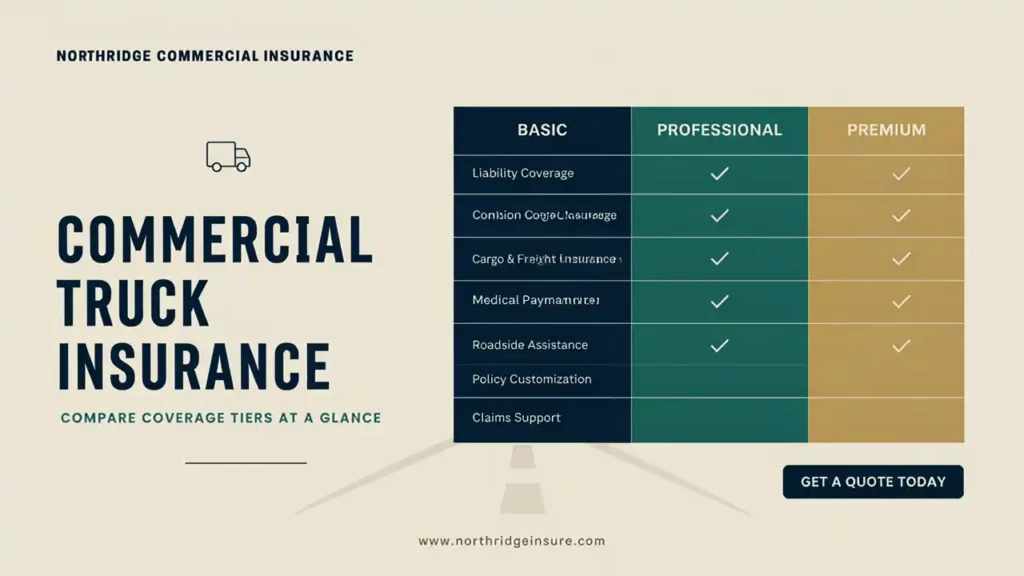
The only fair comparison uses identical coverage. Use this template for all your commercial truck insurance quotes. It’s the same principle as when you compare car insurance quotes side by side, just with trucking-specific lines.
Apples-to-Apples Quote Template
| Line | Quote A | Quote B | Quote C |
| Primary liability limit | |||
| Cargo limit | |||
| Cargo exclusions (commodities) | |||
| Physical damage stated value | |||
| Physical damage deductible | |||
| Cargo deductible | |||
| NTL or bobtail included? | |||
| Trailer interchange included? | |||
| Radius restriction | |||
| FMCSA/state filing included? | |||
| Down payment | |||
| Installment and policy fees | |||
| Total annual cost |
Red Flags in “Too Cheap” Quotes
Here’s an illustrative comparison. These are not real quotes.
| Quote A | Quote B | |
| Monthly premium | $1,050 | $890 |
| Liability | $1,000,000 | $750,000 |
| Cargo | $100,000 | $50,000 |
| Trailer interchange | Included | Not included |
Quote B saves $160 a month. But if your brokers require $1 million liability and $100,000 cargo, Quote B fails the contract test. You’d either lose loads or pay to upgrade mid-term.
Watch for these warning signs:
- The cargo limit is below your freight value
- Liability below your broker’s requirements
- Radius restrictions narrower than your actual lanes
- Commodity exclusions covering what you haul
- Missing filings or vague answers about when they’ll be filed
- Fees that appear only at checkout
- Unlisted drivers or trucks, which can lead to claim problems
- Misstated garaging or radius, which can trigger re-rating or denial
What surprised me when reviewing 2026 trucking cost guides was how often the lowest monthly figure came with a lower cargo limit or a missing coverage line. The headline premium looked better. The policy did less. If a claim is later denied, our Arizona insurance claim lawyer guide explains how disputes work.
Check the Insurer, Not Just the Price
A cheap policy from a financially weak insurer is a risk. Check the insurer’s AM Best rating and NAIC complaint record. Our review of how to evaluate the best car insurance companies explains how to read both.
Box Truck Insurance: Costs and Coverage
Box truck insurance is usually easier to find than semi-truck coverage. Box trucks often run local routes, carry lower-value freight, and cause less severe crashes.
What Does Cheap Commercial Box Truck Insurance Cost?
Insurify puts most box truck premiums at $2,772 to $11,400 a year, or roughly $231 to $950 a month. New ventures pay much more. FreightWaves reports a first-year 26-foot operator with $1 million liability and $100,000 cargo can see $18,000 to $31,000 a year. RV owners see a similar new-owner premium jump, as our guide to RV insurance in Las Vegas shows.
The 26,000-Pound Line
Weight matters. Trucks over 26,000 pounds GVWR generally require a CDL to operate. That threshold can also change state insurance requirements. In Texas, for example, the $500,000 intrastate minimum generally applies to general freight carriers over 26,000 pounds.
So choosing a box truck just under that weight can simplify your licensing and, in some states, your insurance requirements. That’s worth knowing before you buy the truck. RV owners face similar weight rules, as our guide to RV insurance quotes in Florida explains.
Coverages Box Truck Owners Often Need
- Liability at your broker’s or customer’s required level
- Physical damage, especially if financed
- Cargo, if you haul other people’s freight
- General liability for loading and unloading at customer sites
If your box truck is financed, the lender will require physical damage. The concept is similar to full coverage on a personal vehicle, but rated on the truck’s commercial value.
Low-Cost Coverage for Owner-Operators and Small Fleets
Pricing for owner-operators depends heavily on structure. Small fleets get some pricing advantages but face their own rules.
Owner-Operators
Leased-on operators pay far less because the carrier usually provides primary liability. Own-authority operators carry the full stack. Truck Writers estimated the average full package for a one-truck owner-operator at $11,800 a year in 2026. Owners bundling their personal coverage can review home and auto insurance options too.
Small Fleets
Multi-truck operations can earn fleet credits and spread risk. But one bad driver can affect pricing across the whole policy. Driver screening becomes a cost-control tool, not just a safety one. General liability is a separate line, as our guide to general liability insurance cost for an LLC explains.
What Cheap Trucking Insurance Should Never Skip
Some coverages are risky to drop, even when cash is tight:
- Liability at contract-required limits. Without it, you can’t legally or practically haul.
- Cargo matching your freight value. A low limit can leave you paying the difference after a loss.
- NTL or bobtail for leased drivers.
- Physical damage to a financed truck. Skipping it can breach your loan terms.
Decision checkpoint: If dropping a coverage saves money but creates a gap you couldn’t survive financially, it isn’t a saving. Ask: “If this exact loss happened next month, could I keep operating?” If a loss turns into a dispute, our Arkansas insurance claim lawyer guide shows how claims are contested.
Proven Ways to Lower Your Premium
You can lower your premium without stripping coverage to the point of uselessness.
- Hire and keep clean drivers. Driver quality is often the biggest controllable factor.
- Use telematics and ELD data. Progressive reports that new truck customers in its Smart Haul ELD program saved an average of $1,261, and customers without an ELD using Snapshot ProView saved an average of 6%. Those are one insurer’s figures, and results vary.
- Install dashcams. Video can help resolve disputed claims.
- Pay in full if you can. It often avoids installment fees.
- Ask about discounts. Some insurers offer credits for experience, safety programs, or bundling. Our guide to insurance discounts and how they stack explains why discounts rarely add up in a straight line.
- Keep coverage continuous. A lapse makes your next policy more expensive.
- Re-shop at renewal, especially after your first clean year.
Liability Limits: Don’t Cut Too Low
It’s tempting to drop to the legal minimum. But the federal minimum was set decades ago. If you want to understand how liability limits work and why low limits can leave you exposed, our guide on how to get liability insurance and choose limits explains the trade-offs in plain terms.
Real-World Examples
These scenarios are illustrative. They show how different setups lead to different costs and decisions.
Scenario 1: Leased-On Owner-Operator Near Joliet, Illinois
A driver leases to a regional carrier. The carrier provides primary liability and cargo. He buys physical damage on his financed $110,000 tractor, plus NTL. His package lands in the lease-on range of a few hundred dollars a month. Drivers who rent can also look at USAA renters insurance if they’re eligible.
Lesson: Leasing can be the cheapest path into trucking. But NTL isn’t optional in practice. The carrier often requires it, and it closes the off-dispatch gap.
Scenario 2: New Authority Dry Van, Dallas
A driver starts her own authority. Her first quote is about $21,000 a year with $1 million liability and $100,000 cargo. A cheaper quote at $17,500 uses $750,000 liability. Two of her target brokers require $1 million. She takes the higher quote.
She also considers running Texas-only freight under the $500,000 intrastate minimum. But her best-paying lanes cross into Oklahoma. That plan doesn’t fit her business.
Lesson: The cheapest quote failed the contract test. And a state minimum only helps if your lanes match it.
Scenario 3: Local Box Truck in Phoenix
A furniture store owner runs one 24-foot box truck for his own deliveries. He’s a private carrier hauling his own goods, under 26,000 pounds. He carries liability and physical damage but doesn’t need motor truck cargo for freight he owns. His premium lands near the low end of the box truck range. If he also insures a home, our homeowners insurance quote guide covers that side.
Lesson: Your operating model can remove entire coverage lines. Know which ones actually apply.
Scenario 4: Small Fleet With One Problem Driver
A three-truck fleet in Atlanta renews. One driver has had two recent accidents. The renewal price rises sharply across the whole policy. The owner moves that driver to a non-driving role and re-shops. The next quote drops meaningfully. Georgia car insurance quotes show how personal auto prices react to the same kind of record.
Lesson: In small fleets, one driver’s record can raise everyone’s cost.
Common Mistakes to Avoid
These mistakes usually cost more than they save:
- Buying to the federal minimum when brokers require more
- Choosing a cargo limit below your typical freight value
- Misstating your radius or garaging address to lower the quote
- Skipping NTL as a leased driver
- Letting coverage lapse between policies or authorities
- Ignoring commodity exclusions in the cargo form
- Forgetting to list every driver and truck
- Comparing quotes with different limits and deductibles
Before You Sign: A Final Checklist
Use this before you pay any down payment:
- [ ] Liability meets my highest broker requirement
- [ ] Cargo limit covers my typical load value
- [ ] Commodity exclusions don’t include what I haul
- [ ] Radius matches my real lanes
- [ ] Every driver and truck is listed
- [ ] Filing (BMC-91X or state form) is confirmed
- [ ] I can afford every deductible
- [ ] I know the total cost, including all fees
- [ ] I checked the insurer’s financial rating
Finding Coverage That Actually Works
Knowing how to get cheap commercial truck insurance isn’t about finding the lowest number on a quote sheet. It’s about finding the lowest price that passes your filings, satisfies your brokers, and covers losses you couldn’t survive alone.
The biggest levers are usually your operating structure, your drivers, your limits, and how carefully you compare. Insurance costs are rising, according to ATRI’s 2026 data. That makes accurate quoting and annual re-shopping more valuable, not less.
Here’s one feasible next step. Email your top three brokers today and ask for their insurance requirements in writing. Then fill out the quote template above with at least three insurers, using those exact limits. The cheapest quote that passes every line is your real answer.
Frequently Asked Questions
How do I compare truck insurance quotes fairly?
Use the same liability limit, cargo limit, deductibles, and stated truck value on every quote. Then compare the total annual cost, including down payments and fees. A lower price with lower limits isn’t a real saving. Ask your brokers for their insurance requirements in writing before you start.
Why do truck insurance quotes vary so much?
Each insurer weighs risk differently. Authority age, garaging location, cargo type, driver records, and radius all change the price. That’s why the same truck can get quotes thousands of dollars apart. Always check that the cheapest quote still meets your filings and broker limits.
How can a new authority lower its premium?
Expect a new-venture surcharge in year one, often $18,000 to $25,000 for a full package. Strong CDL experience, clean driver records, and complete paperwork can help. Keep coverage continuous with no lapses. Your first renewal is usually your best chance to lower the price.
What documents help me get a better price?
Have your USDOT and MC numbers, every driver’s CDL and MVR, truck VINs, and stated truck values ready. Prior insurance history and loss runs also help. Insurers price uncertainty, so a complete submission often leads to better pricing.
What does cheap commercial box truck insurance cost?
Established box truck operators often pay about $2,772 to $11,400 a year, according to Insurify. A first-year 26-foot truck with $1 million liability and $100,000 cargo can cost $18,000 to $31,000. Local routes and lower-value freight usually keep costs lower.
Does truck weight affect box truck insurance?
Yes. Trucks over 26,000 pounds generally require a CDL and may face higher state requirements. In Texas, for example, intrastate general freight carriers over 26,000 pounds typically need at least $500,000 in liability. Staying under that line can simplify licensing and coverage.
Is a low-cost policy enough to meet federal rules?
It can be if the liability limit meets the federal minimum. Under 49 CFR 387.9, interstate for-hire carriers hauling general freight in trucks over 10,001 pounds need at least $750,000. But many brokers require $1 million. A legal policy may still fail a broker’s contract check.
What should a low-cost trucking policy never skip?
Don’t cut liability below your brokers’ required limits or cargo below your typical freight value. Leased drivers should keep non-trucking liability or bobtail coverage. If your truck is financed, physical damage is usually required by the lender. Skipping these can cost far more than it saves.

Michael Bennett is a U.S. insurance research and consumer education writer at Insurancebasics Hub, an independent resource dedicated to helping consumers understand insurance policies, coverage decisions, claims, and insurance-related consumer protections. His work covers auto, homeowners, renters, life, and other areas of insurance, with a focus on making complex insurance topics easier to understand.
Michael takes a research-focused approach to insurance content, using authoritative government and regulatory resources, state insurance department guidance, applicable insurance rules, policy provisions, and documented industry information. His articles examine important details such as coverage limits, deductibles, exclusions, policy conditions, premiums, claims, denials, cancellations, renewals, and state-specific requirements.
His goal is to provide accurate, transparent, and practical information that helps readers make better-informed insurance decisions. Insurancebasics Hub provides general educational information and does not replace individualized advice from a licensed insurance professional, attorney, financial professional, or other qualified adviser.