
Arizona car insurance quotes depend on your driving record, your city, your credit tier, and the coverage level you choose, but every quote must meet the state minimum liability requirement of 25/50/15 under Arizona law. That number is the legal floor, not a recommendation, and understanding it is the first step before you compare a single quote.
Most drivers searching for quotes here are not trying to become insurance experts. They just want to know what the law actually requires, what a fair price looks like for their situation, and how to avoid paying more than necessary without leaving themselves exposed after a serious accident.
This guide walks through Arizona’s minimum coverage rules, what actually drives rates up or down, how to find affordable options without cutting corners, and how comparative negligence changes what you can recover after a crash. Every figure here is tied to a verifiable Arizona statute or a clearly labeled example, not a guess.
What You Need To Know Before Requesting Arizona Car Insurance Quotes
Before requesting quotes, understand that Arizona is an at-fault state rather than a no-fault state. This affects how accident claims are handled and can influence the coverage and rates insurers offer.
In an at-fault state, the driver responsible for an accident may be financially responsible for the resulting injuries and property damage. Arizona requires drivers to maintain auto liability insurance, so insurers consider this legal framework when preparing car insurance quotes. If you are new to the basics, see how car insurance works.
Because Arizona follows an at-fault system, comparing quotes with the same coverage limits can help you understand the differences between insurers and choose a policy that fits your needs.
Is Arizona a No-Fault or At-Fault State
Arizona is an at-fault state, meaning the driver responsible for an accident is legally required to pay for the other party’s losses through their liability coverage. This determines how claims are filed and how compensation is calculated.
Under this system, an injured driver generally files a claim against the at-fault driver’s insurer rather than their own. That is one reason premiums place so much weight on your driving record, since a history of at-fault accidents signals future claim risk to insurers. Arkansas is also an at-fault state, as covered in our guide to Arkansas car insurance quotes.
Arizona also follows a pure comparative negligence rule, which is covered later in this guide, since it directly affects how much money an injured party can actually recover.
What Is The Minimum Liability Insurance Required In Arizona
Arizona requires every registered vehicle to carry liability coverage of at least 25/50/15 under Arizona Revised Statutes section 28-4009. This split limit format breaks down into three separate numbers that each mean something different.
The first number, 25,000 dollars, is the maximum your policy pays for bodily injury to one person in an accident you cause. The second number, 50,000 dollars, is the total available for bodily injury when two or more people are hurt in the same accident. The third number, 15,000 dollars, covers property damage to someone else’s vehicle or property.
These minimums apply broadly, covering cars, trucks, and motorcycles registered in Arizona. They keep you legal, but a serious accident can easily exceed them, which is worth remembering when you compare quotes side by side. Commercial trucks face separate rules, covered in our guide to commercial truck insurance requirements.
What Happens If You Drive Without Insurance In Arizona
Driving without insurance in Arizona triggers immediate consequences, including fines, license suspension, and registration suspension. A first offense typically starts with a fine of around 500 dollars, and penalties increase for repeat violations.
Beyond the fine, an uninsured driving conviction usually triggers a requirement to file an SR22 with the Arizona Motor Vehicle Division. This certificate proves to the state that you now carry the required minimum coverage.
An SR22 filing typically must stay in place for a set period, often around three years, and any lapse in coverage during that window can restart the clock. This is one of the more expensive mistakes a driver can make, since insurers generally charge more once an SR22 is on file. Our list of the cheapest high-risk car insurance companies can help.
What Do Arizona Auto Insurance Rates Typically Depend On
Arizona auto insurance rates depend on a combination of personal, vehicle, and coverage factors, not a single number set by the state. Age, driving record, credit-based insurance score, coverage level, vehicle type, and where you live can all affect the final premium.
For businesses, commercial auto insurance rates also depend on factors such as the type of vehicles, business use, driving distance, number of drivers, and claims history. A personal auto policy and a commercial policy can therefore have very different premiums, even when the vehicles are similar. Our guide to commercial truck insurance cost covers this in detail.
Insurers also consider how often a vehicle is driven and where it is typically parked overnight, since accident and theft risks can vary by neighborhood and city.
Why Do Rates Vary By City
Rates vary between Phoenix, Tucson, and smaller cities because traffic density, accident frequency, and theft rates differ significantly by location. A busy metro corridor simply produces more claims than a quiet rural stretch of highway.
Phoenix and the surrounding metro area carry heavier daily traffic volume, which statistically increases the odds of a fender bender or a more serious collision. Tucson faces its own pressures, including a documented uninsured driver problem that pushes many residents toward carrying uninsured motorist coverage as a safety net.
Smaller Arizona cities and rural areas often see lower premiums simply because there are fewer vehicles competing for the same roads at the same time. Denver car insurance quotes show the same city-versus-rural pattern.
State Minimum Versus Recommended Coverage
The gap between Arizona’s legal minimum and a genuinely protective policy is larger than most new drivers expect. The table below lays out the practical difference in plain terms.
| Coverage Type | Arizona State Minimum | Commonly Recommended Level |
| Bodily Injury per Person | $25,000 | $100,000 or higher |
| Bodily Injury per Accident | $50,000 | $300,000 or higher |
| Property Damage | $15,000 | $50,000 or higher |
| Uninsured Motorist Coverage | Not required | Matching your liability limits |
This table is meant as a general planning reference, not a personalized recommendation. The right coverage level for you depends on your assets, your vehicle’s value, and how much financial exposure you are comfortable carrying. Colorado auto insurance quotes show how another state compares.
How Can You Find Cheap Car Insurance in Arizona?
Finding affordable coverage starts with comparing multiple quotes rather than accepting the first number you see. Rates for identical coverage can vary by hundreds of dollars a year between companies.
The most reliable way to find cheap car insurance in Arizona is to request quotes from at least three different insurers using the same coverage limits and deductible for each one. Comparing apples to apples is the only way the numbers actually mean anything.
It also helps to review your policy every year instead of letting it automatically renew, as new discounts or lower rates may become available from your current insurer or other best car insurance companies.
What Discounts Lower Your Premium
Several common discounts can meaningfully lower your premium without reducing your actual protection. These are worth asking about directly rather than assuming your insurer applied them automatically. See our full list of car insurance discounts before you shop.
Bundling your auto policy with homeowners or renters coverage often produces a noticeable discount. Good student discounts, defensive driving course completion, and multi-vehicle discounts can also add up quickly for households with more than one driver. Our guide to home and auto insurance explains how bundles work.
Usage-based programs that track driving habits through a mobile app or a small device are becoming more common in Arizona. These can lower premiums for cautious drivers, though they do involve sharing driving data with the insurer, which is worth considering before opting in.
How To Compare Car Insurance Quotes Without Sacrificing Coverage
Comparing car insurance quotes properly means looking at more than the monthly price on the screen. The cheapest number is not always the best value once you look more closely at what it actually covers.
Start by writing down your current coverage limits and deductible, then request new quotes using those exact same numbers from each company. This keeps the comparison fair and prevents a low quote from hiding a much lower coverage limit underneath it.
Once you have several quotes side by side, check each one for uninsured motorist coverage, since it is not automatically included and needs a specific decision on your part.
How Do You Find The Best Car Insurance in Arizona For Your Situation

The best car insurance Arizona option is not the same for every driver, since it depends heavily on your budget, your driving history, and how much risk you want to carry yourself. A young driver with a clean record has very different needs than a family with three vehicles and a mortgage.
Rather than chasing a single ranked list, look at your own situation first. A driver who recently had an accident may value an insurer known for smoother claims handling more than one offering the absolute lowest price.
Financial strength ratings and complaint index data, both published by independent rating agencies and by state regulators, are useful ways to judge the best car insurance in Arizona beyond the sticker price alone.
What To Compare Beyond Price
Price is the easiest thing to compare and often the least informative one on its own. A policy that costs fifty dollars less a year is not a good deal if it settles claims slowly or has a documented pattern of underpaying.
Look at each insurer’s claims process, mobile app functionality, and how easy it is to reach a real person when something actually goes wrong. These details matter far more the day you actually need to file a claim than they do while you are simply shopping.
Ask directly about how each company handles rate increases after a first accident, since this varies significantly and can undo any savings from a lower starting premium.
Who Is Eligible For Military Restricted Coverage
Some Arizona insurers, most notably USAA, restrict eligibility to current military members, veterans, and their immediate family. If you do not have a qualifying military connection, these carriers simply are not an option, regardless of how favorably they are reviewed online.
This restriction surprises many people comparing quotes here for the first time, since USAA frequently appears at the top of national rankings without a clear explanation of who actually qualifies.
If you do not qualify, focus your comparison on carriers that are open to the general public, since spending time chasing a quote you cannot actually purchase wastes effort you could spend comparing real options. Carriers like Direct General Insurance are open to the general public.
Best Car Insurance Arizona Checklist For High-Risk Drivers
Drivers with a recent DUI, an at-fault accident, or an SR22 filing face a narrower set of realistic options. Not every ranking is built with this situation in mind.
Look specifically for insurers that specialize in nonstandard or high-risk policies, since mainstream carriers sometimes decline these applications outright. Ask directly whether the company files SR22 paperwork electronically with the Arizona Motor Vehicle Division, since delays here can create real legal exposure. Our list of the best SR22 insurance companies can help.
Expect premiums to run noticeably higher during the SR22 period. This is a temporary cost tied to your driving record, and it typically decreases once the filing period ends and your record improves.
How Does Comparative Negligence Affect Your Claim
Arizona uses a pure comparative negligence rule under Arizona Revised Statutes section 12-2505, meaning you can recover compensation even if you were mostly at fault in an accident. Your compensation is simply reduced by your percentage of fault rather than eliminated.
For example, if a court finds your total damages at 100,000 dollars and determines you were 30 percent at fault, you would generally be entitled to recover about 70,000 dollars. If you were found 70 percent at fault, you could still recover roughly 30,000 dollars under this rule.
This is more favorable to injured drivers than the modified comparative fault systems used in many other states, which cut off recovery entirely once a driver crosses the halfway mark of fault. If a claim turns into a dispute, our Florida insurance claim lawyer guide explains how another state handles it.
Why Uninsured Motorist Coverage Matters In Arizona
Uninsured motorist coverage matters in Arizona because a meaningful share of drivers on the road carry no insurance at all, despite the legal requirement to do so. Estimates commonly place Arizona’s uninsured driver rate near one in eight vehicles.
Arizona insurers must offer uninsured and underinsured motorist coverage on every policy under Arizona Revised Statutes section 20-259.01, but it is not automatically included. You have to actively reject it in writing if you do not want it, and an oral decline generally is not considered valid.
Given how common uninsured drivers are in metro areas like Phoenix and Tucson, many drivers choose to keep this coverage even though it adds a small amount to the premium, since a hit-and-run or an uninsured at-fault driver can otherwise leave you covering your own medical bills.
What Is SR22 Insurance, and Do You Need It
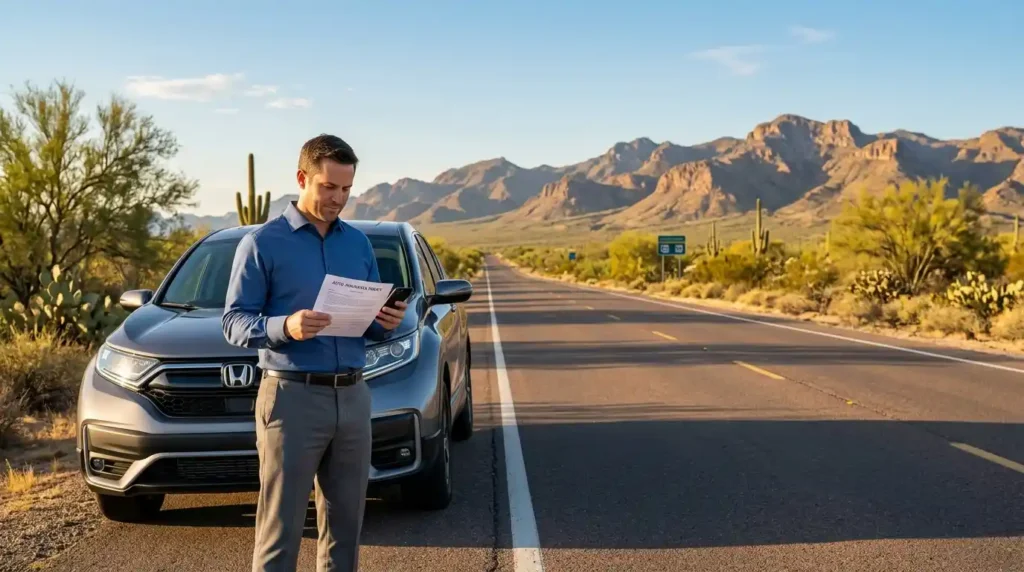
An SR22 is not actually an insurance policy. It is a certificate your insurer files with the Arizona Motor Vehicle Division confirming that you carry at least the state minimum liability coverage.
You typically need an SR22 after a DUI conviction, a conviction for driving without insurance, or certain other serious violations tied to your driving privileges. Not every driver needs one, and most drivers with a clean record never encounter this requirement at all.
If your insurer does not offer SR22 filings, you may need to switch to a carrier that specializes in nonstandard policies specifically because they handle this paperwork regularly.
How Long Does An Arizona SR22 Filing Last
An Arizona SR22 filing generally needs to remain active for a set period, often around three years, depending on the underlying violation. The clock typically starts from the date of the conviction or the reinstatement of your driving privileges.
If your policy lapses at any point during this window, even briefly, your insurer is required to notify the Motor Vehicle Division. That notification can restart the entire filing period from scratch, which is a costly and entirely avoidable mistake.
Setting up automatic payments during an SR22 period is one of the simplest ways to avoid an accidental lapse and the penalties that come with it.
Full Coverage Car Insurance Versus Liability Only
Full coverage car insurance is not a single legal product, but a common industry term that generally refers to a combination of liability, collision, and comprehensive coverage. Arizona law does not mandate it, but a lender or leasing company almost always requires it for a financed vehicle.
Liability-only coverage pays for damage you cause to others, while a fuller policy also pays to repair or replace your own vehicle after a covered accident, theft, or weather event. This distinction matters more than the label itself, since the phrase means slightly different things across different insurers.
Before assuming you need this level of coverage, check whether your vehicle is financed. Once a loan or lease is paid off, the decision to keep collision and comprehensive coverage becomes entirely yours, based on your vehicle’s value and your own financial cushion. Financed work trucks follow similar rules, as our guide to cheap commercial truck insurance explains.
A Real Dollar Example
Numbers make this easier to picture than definitions alone. Consider a driver in Mesa carrying full coverage with a 500 dollar collision deductible and a comprehensive deductible of the same amount.
If a hailstorm causes 4,000 dollars in damage to the vehicle, the insurer would generally pay approximately 3,500 dollars after the deductible is applied, assuming the loss falls under the policy’s coverage limits and no other conditions apply. This is an illustrative example only, not an actual quote or a guaranteed claim outcome.
If that same driver only carried the state minimum liability coverage instead, this hail damage would not be covered at all, since liability-only policies never pay for damage to your own vehicle.
Arizona Climate And Comprehensive Coverage
Arizona’s climate creates specific risks that make comprehensive coverage genuinely useful rather than an optional extra. Extreme summer heat, sudden dust storms, and monsoon season flooding all contribute to vehicle damage that liability coverage simply does not cover.
Arizona also has a distinctive law, sometimes called the Stupid Motorist Law, which allows authorities to bill a driver for rescue costs if they drive around barricades into a flooded roadway. This is a real legal risk unique to the state, and it sits entirely outside of what any insurance policy covers.
Comprehensive coverage generally protects against hail, windshield cracks from road debris, and flood damage, which makes it worth a closer look for anyone weighing fuller protection against a bare-bones liability policy in a state with this kind of weather exposure. Home policies face similar weather risks, as our guide to home insurance quotes in Rhode Island explains.
Common Mistakes When Comparing Quotes
A few mistakes show up again and again when people compare quotes on their own here in Arizona. Recognizing them ahead of time can save real money and real frustration later.
Comparing quotes with different deductibles or different coverage limits is the most common error, since it makes a lower number look better than it actually is. Skipping the uninsured motorist question is another frequent mistake, since silence on this point does not mean the coverage is automatically included.
Letting a policy auto-renew year after year without ever requesting new quotes is a quieter but equally costly habit, since rates and available discounts change more often than most drivers realize.
Assuming Minimum Coverage Is Always Enough
Assuming the state minimum is always enough is a mistake that only becomes visible after a serious accident happens. The 25/50/15 minimum can be exhausted quickly in a crash involving a single serious injury or a newer vehicle.
A single emergency room visit for a significant injury can approach or exceed the 25,000 dollar per person limit on its own. Once your liability limit runs out, you are personally responsible for the remaining balance, which can affect wages, savings, and other personal assets.
This is not a reason to panic, but it is a reason to treat the state minimum as a starting point for comparison rather than a final decision.
State-Required Versus Lender-Required Coverage
State-required coverage and lender-required coverage are two entirely different things, and confusing them leads to unnecessary spending or unexpected gaps. Arizona law only requires the 25/50/15 liability minimum described earlier.
If your vehicle is financed or leased, your lender will almost always require collision and comprehensive coverage as a condition of the loan. This requirement comes from the lender’s contract, not from Arizona law itself.
Once the loan is paid off, you are free to drop collision and comprehensive if you choose, though doing so means you would be personally responsible for repairing or replacing your own vehicle after an accident.
Re-Shopping After A Move Or Life Change
Re-shopping your coverage after a move or a major life change often reveals savings that automatic renewal never surfaces on its own. A change in address, a new vehicle, or even a change in marital status can shift your premium significantly.
Moving between Arizona cities is a common trigger, since rates genuinely differ between a dense metro area and a quieter suburb or rural town. Adding a teen driver, paying off a loan, or improving your credit score are equally good reasons to request fresh quotes rather than assuming your current rate is still competitive. If you buy a home, compare an Allstate homeowners quote as well.
A simple annual habit of requesting new quotes, even if you plan to stay with your current insurer, keeps you honest about whether you are still getting a fair price.
Comparing Quotes The Right Way
Comparing Arizona car insurance quotes properly means starting with the legal minimum, understanding what it actually covers, and deciding honestly whether that minimum matches your real financial exposure. The 25/50/15 requirement keeps you legal, but it rarely reflects what a serious accident actually costs.
Affordable options exist, but the smartest way to find them is through a fair, apples-to-apples comparison rather than chasing the single lowest number on a screen. The right policy looks different for every driver, depending on your record, your vehicle, and how much risk you are willing to carry yourself.
If you found this guide useful, related topics worth exploring include general car insurance quotes and how the comparison process works nationally, how the best car insurance companies are typically rated, and what full coverage car insurance actually includes across different states.
Drivers researching coverage outside Arizona may also find value in guides covering Alabama car insurance quotes, an Alabama insurance claim lawyer for denied claim questions, Alaska car insurance quotes for drivers in a very different climate and regulatory environment, and an Alaska insurance claim lawyer for bad faith and denied claim situations specific to that state.
This article provides general educational information about Arizona car insurance requirements and is not individualized legal, financial, or insurance advice. Coverage requirements, penalties, and filing rules can change, so confirm current details with the Arizona Department of Insurance and Financial Institutions or the Arizona Motor Vehicle Division before making a final decision.
Frequently Asked Questions
What is the minimum car insurance required in Arizona?
Arizona requires liability coverage of at least 25/50/15 under Arizona Revised Statutes section 28-4009, covering bodily injury and property damage up to those specific limits.
Is Arizona a no-fault or at-fault state?
Arizona is an at-fault state, meaning the driver who causes an accident is financially responsible for the resulting damage through their liability coverage.
How much does car insurance cost in Arizona on average?
In Arizona, full coverage car insurance costs about 1,950–2,550 per year, while minimum liability averages 937–1,443 per year. Your actual rate depends on your driving record, location, vehicle, coverage, deductible, and insurer.
What happens if I am caught driving without insurance in Arizona?
Penalties generally include fines starting around 500 dollars for a first offense, along with license and registration suspension and a required SR22 filing.
Do I need an SR22 in Arizona, and for how long?
An SR22 is typically required after a DUI or an uninsured driving conviction, and it generally must stay active for around three years without any lapse in coverage.
Is uninsured motorist coverage required in Arizona?
It is not required, but insurers must offer it on every policy, and you must reject it in writing if you do not want it.
How can I find cheap car insurance quotes in Arizona?
Compare quotes from at least three insurers using identical coverage limits and deductibles, and ask directly about bundling, good student, and defensive driving discounts.
How does comparative negligence affect my claim if I am partly at fault?
Arizona’s pure comparative negligence rule reduces your compensation by your percentage of fault rather than eliminating it entirely, even if you were mostly responsible for the accident.

Michael Bennett is a U.S. insurance research and consumer education writer at Insurancebasics Hub, an independent resource dedicated to helping consumers understand insurance policies, coverage decisions, claims, and insurance-related consumer protections. His work covers auto, homeowners, renters, life, and other areas of insurance, with a focus on making complex insurance topics easier to understand.
Michael takes a research-focused approach to insurance content, using authoritative government and regulatory resources, state insurance department guidance, applicable insurance rules, policy provisions, and documented industry information. His articles examine important details such as coverage limits, deductibles, exclusions, policy conditions, premiums, claims, denials, cancellations, renewals, and state-specific requirements.
His goal is to provide accurate, transparent, and practical information that helps readers make better-informed insurance decisions. Insurancebasics Hub provides general educational information and does not replace individualized advice from a licensed insurance professional, attorney, financial professional, or other qualified adviser.
6 Responses