
You can get an Allstate homeowners quote online, by phone, or through a local Allstate agent. Have your address, year built, roof age, square footage, and claims history ready. Recent studies put Allstate’s average premium around $2,049 to $2,401 a year, depending on the coverage profile. A quote is an estimate. It isn’t a policy until it’s bound.
You probably want two things. A price for your own house. And some way to tell whether that price is fair.
Getting the number is the easy part. Reading it is harder. A quote is a stack of choices: coverage limits, deductibles, add-ons, and discounts. Each one moves the price. Each one also changes what you’d get paid after a fire, a storm, or a burst pipe.
This guide follows the quote the way you’ll actually experience it. It moves through ten stages, from preparation to the day the policy starts. Along the way, you’ll see a line-by-line breakdown of a sample quote, the math behind wind deductibles, and three homes that end up with three very different quotes.
Five Facts Before You Start
- A quote isn’t coverage. Nothing protects your home until the policy is bound and your first payment clears.
- Rebuild cost is what matters. Your dwelling limit should match what it would cost to rebuild the house, not what you could sell it for.
- Floods aren’t included. Allstate lists flood and earth movement among its standard exclusions.
- “Up to 25%” is a ceiling. Bundling home and auto can save up to 25%, according to Allstate’s discount terms as reported by MoneyGeek. The average savings reported by Insurance.com is much smaller.
- California is in flux. Allstate filed on August 31, 2026, to start writing new California home policies again. That filing was still under review when this article was published.
Stage 1: Before You Start Your Allstate Homeowners Quote
The quality of your quote depends on the details you enter. Insurers price uncertainty. Accurate inputs usually lead to a quote that holds up at underwriting.
Gather These Details First
| Detail | Why the Insurer Asks |
| Property address | Location sets storm, fire, and theft risk |
| Year built | Older systems can raise the chance of claims |
| Square footage | Drives the estimated rebuild cost |
| Roof age and material | A major factor in wind and hail pricing |
| Construction type (frame, brick) | Affects fire risk and rebuild cost |
| Updates to wiring, plumbing, heating | Newer systems can lower risk |
| Security and fire alarms | May qualify for a protective device discount |
| Claims in the past five years | Prior claims can affect price and eligibility |
| Current policy declarations page | Lets you compare limits line by line |
If you don’t know your roof’s age, check your closing documents or ask the roofer who last worked on it. Guessing low can backfire. An inspection may correct it later and raise the price.
Market Value vs. Rebuild Cost
This is the most common mistake on any home quote. Market value includes the land, the neighborhood, and buyer demand. Rebuild cost is labor and materials only.
Here’s an illustrative example. These figures are not quotes.
- Home’s market value: $420,000
- Land and location value inside that price: $150,000
- Estimated rebuild cost: $310,000
If you insure for $420,000, you may pay for coverage you can’t use. If you insure for $250,000 because that “feels” right, you could be underinsured by $60,000 after a total loss.
Ask how the insurer estimated rebuild cost. Then compare it with a local contractor’s per-square-foot figure.
Stage 2: Getting an Allstate Home Insurance Quote Online, by Phone, or With an Agent
You can start a quote online, by phone, or with a local agent. Allstate’s homeowners page lists all three. It also lists a quote phone number, 866-702-6500. Check the site for the current number before calling.
| Method | Best For | Trade-Off |
| Online | Speed and a first price | You may miss discounts you didn’t know to select |
| Phone | Questions answered as you go | Less time to compare options carefully |
| Local agent | Unusual homes, older homes, bundling | Takes longer; agents represent only Allstate |
Insurance.com reports that you can complete an Allstate home insurance quote online and, in most cases, buy the policy online too. Some homes may still need an agent. That often happens with older homes, prior claims, or high-risk locations.
Which Route Should You Pick?
Start online if your home is newer and simple. Call or visit an agent if your home is older than about 40 years, has a recent claim, or sits in a high-wind area. Those details often need a person to rate them correctly.
Here’s one honest tip. Do the online quote first, even if you plan to use an agent. You’ll walk into the conversation with a baseline. Then ask the agent why the numbers differ.
Stage 3: Inside the Quote, Line by Line
Most people read one number on a quote: the premium. But the quote is really six coverages stacked together. Here’s what each line means, using a sample quote. These figures are illustrative, not from Allstate.
| Line | Sample Amount | What It Pays For | What to Check |
| Coverage A: Dwelling | $310,000 | Rebuilding the house itself | Does it match rebuild cost? |
| Coverage B: Other Structures | $31,000 | Detached garage, fence, shed | Often 10% of Coverage A |
| Coverage C: Personal Property | $155,000 | Furniture, clothes, electronics | Replacement cost or actual cash value? |
| Coverage D: Loss of Use | $62,000 | Hotel, rent, meals while you’re displaced | How long would repairs take? |
| Coverage E: Personal Liability | $300,000 | Injuries or damage you cause to others | Is it enough to protect your savings? |
| Coverage F: Medical Payments | $5,000 | Small injuries to guests, regardless of fault | Usually low limits |
| Deductible | $1,000 | Your share of each covered claim | Is there a separate wind deductible? |
The Line That Changes Your Payout Most
Look closely at Coverage C. Some policies pay actual cash value, which subtracts depreciation. Others pay replacement cost, which pays what it costs to buy new. Renters face the same choice, as our guide to USAA renters insurance explains.
Here’s an illustrative example. A kitchen fire destroys a five-year-old TV that cost $1,200.
- Replacement cost today: $1,000
- Depreciation after five years: $600
- Actual cash value payout: $1,000 − $600 = $400
Same claim. Very different checks. Before you accept any quote, find out which method applies to your belongings.
Liability: The Line People Set Too Low
Coverage E protects you if a guest is hurt on your property or your dog bites a neighbor. The same idea applies to your car insurance. If you want to see how liability limits work in plain terms, our guide on how to get liability insurance and choose limits walks through the trade-offs. Many umbrella policies also require minimum liability limits on both your home and auto policies.
Stage 4: What Moves the Price
The price on your quote depends on your house, your location, and your choices. Published averages give you a starting point. They don’t predict your own number.
What Recent Studies Report
| Source | Average Annual Premium | Profile Used | Date |
| MoneyGeek | $2,381 | $250,000 dwelling, $200,000 liability | Updated Sept. 2026 |
| Insurify | $2,401 | $300,000 dwelling, $1,000 deductible | Updated Feb. 2025 |
| Insurance.com | $2,049 | Company-wide average | Updated May 2026 |
The numbers differ because each source priced a different home. That’s normal. Use them as a sanity check, not a target. RV owners see the same variation, as our guide to RV insurance in Las Vegas shows.
How Dwelling Coverage Changes the Price
Insurify’s data shows how strongly the dwelling limit drives price. Treat these as older benchmarks, since the page was last updated in February 2025.
| Dwelling Coverage | Average Annual Premium |
| $100,000 | $1,165 |
| $200,000 | $1,804 |
| $300,000 | $2,401 |
| $400,000 | $3,029 |
| $500,000 | $3,630 |
Notice the pattern. Each extra $100,000 of dwelling coverage adds roughly $600 a year in this data. Commercial vehicles follow a similar limit-driven pattern, as our guide to commercial truck insurance cost shows.
What Changes an Allstate Insurance Home Quote the Most?
Here are the five biggest levers.
- Location. Coastal, wildfire, and hail-prone areas cost more.
- Roof. Age, material, and condition matter a lot.
- Claims history. Recent claims can raise the price or limit eligibility.
- Credit. Many states allow credit-based insurance scores. Some states restrict them.
- Deductible. A higher deductible usually lowers the premium.
If you want a broader look at how insurers weigh risk factors, our guide to what drives insurance cost explains the same pricing logic from the auto side.
Stage 5: The Deductible Math Most Quotes Hide
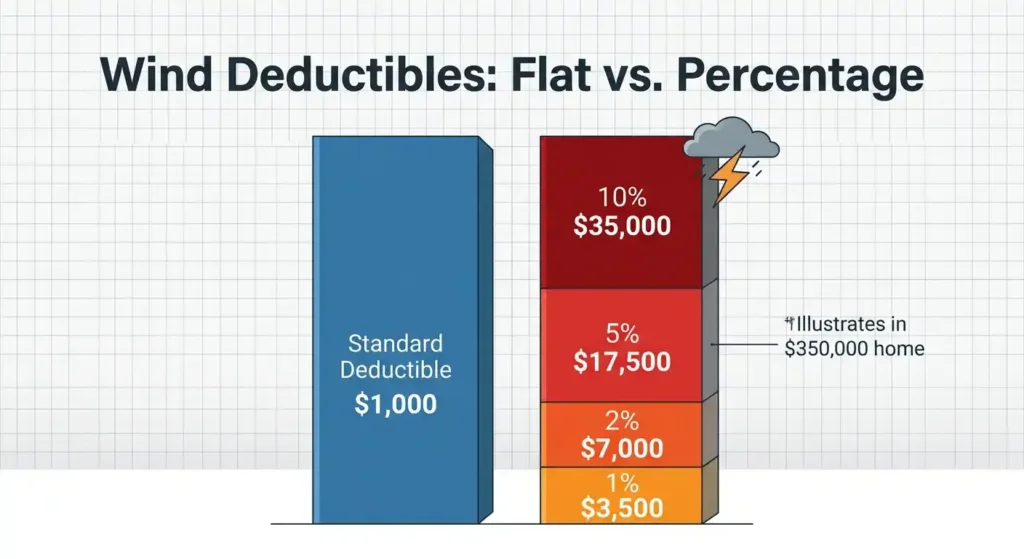
A flat deductible is easy to understand. A percentage deductible isn’t. In storm-prone states, an Allstate insurance home quote may include a separate wind, hail, or hurricane deductible set as a percentage of your dwelling limit.
How a Percentage Deductible Works
The percentage applies to Coverage A, not to the size of the claim. Here’s the math on three dwelling limits. These figures are illustrative.
| Dwelling Limit | 1% Deductible | 2% Deductible | 5% Deductible |
| $250,000 | $2,500 | $5,000 | $12,500 |
| $350,000 | $3,500 | $7,000 | $17,500 |
| $500,000 | $5,000 | $10,000 | $25,000 |
Now picture a hailstorm that causes $14,000 in roof damage to a $350,000 home.
- With a $1,000 flat deductible, the insurer pays about $13,000
- With a 2% wind deductible ($7,000): the insurer pays about $7,000
- With a 5% wind deductible ($17,500): the insurer pays nothing, because the damage is below the deductible
That last line surprises people. A 5% deductible can turn a five-figure storm into a fully out-of-pocket repair.
Deductibles work the same way across most insurance types. If you’d like a plain-English refresher on how deductibles and limits interact, our guide on how insurance claims and deductibles work covers the mechanics step by step.
Decision checkpoint: Before accepting a quote, find the wind or hurricane deductible line. Multiply the percentage by your dwelling limit. Ask yourself one question: could I pay that amount tomorrow?
Florida’s Extra Rules
Florida homeowners face specific hurricane deductible rules under state law. Florida also requires insurers to offer discounts for qualifying windstorm mitigation features, such as roof straps or impact-rated openings. A wind mitigation inspection can document those features. Confirm current rules with the Florida Office of Insurance Regulation. Florida RV owners face similar hurricane rules, as our guide to RV insurance quotes in Florida explains.
Stage 6: What the Quote Won’t Cover
A quote shows what you’re buying. It rarely highlights what you aren’t. Allstate’s homeowners page lists the standard exclusions below. Home-based business owners should also check whether an LLC needs commercial insurance.
- Flood
- Earth movement, such as earthquakes
- Business pursuits
- Water backup
- Wear and tear
- Damage during vacancy or construction
Flood Is the Big One
Standard homeowners policies, including Allstate’s, exclude flood. Flood coverage usually comes from the National Flood Insurance Program (NFIP) or a private flood insurer.
According to FEMA’s FloodSmart site, NFIP coverage usually starts 30 days after purchase. Building coverage goes up to $250,000. Contents coverage goes up to $100,000 for a single-family home.
That waiting period matters. If a storm is already forecast, it’s usually too late to buy flood coverage for it.
Water Damage vs. Flood
People confuse these constantly. Allstate’s page says its policies can help with water damage from plumbing, water heaters, appliances, and HVAC systems. Water coming from outside, like rising water, is flood. Water backing up through a drain is “water backup,” which needs an add-on. Car damage follows its own rules, as our guide on whether car insurance covers pothole damage explains.
Home Businesses Aren’t Automatically Covered
If you run a business from home, the “business pursuits” exclusion may limit coverage. That also applies to vehicles. A truck or van used for paid work may need its own policy. Our guide on how commercial auto insurance covers business vehicles explains when a personal policy stops applying.
Stage 7: Discounts and the Home-and-Auto Bundle
Discounts can lower your premium. But advertised maximums and typical savings aren’t the same thing.
Discounts Allstate Lists
MoneyGeek’s September 2026 review lists nine Allstate homeowners discounts:
| Discount | How You Typically Qualify |
| Multi-policy | Bundle home and auto (up to 25%) |
| Responsible payer | Strong payment history |
| Claim-free | No recent claims when you switch |
| Welcome and loyalty | New and returning customers |
| Home buyer | Recently purchased or newly built home |
| Easy Pay Plan | Automatic payments |
| Protective device | Fire or theft alarms, security systems |
| Early signing | Sign at least 7 days before your current policy expires |
| Windstorm mitigation | Florida homes with wind-resistant features |
Allstate itself notes that discounts and availability vary by state.
The Gap Between “Up To” and Typical
What stood out to me when comparing these sources was the bundle number. Allstate’s terms say “up to 25%.” But Insurance.com’s May 2026 data puts Allstate’s average bundle discount at about 7%. The same data shows a much bigger average for new homes, at about 46%.
Here’s what that gap means in dollars. These are illustrative figures.
- Home premium: $2,381 (MoneyGeek’s average)
- Auto premium: $2,922 (a national full-coverage average reported by Experian in 2026)
- Combined: $5,303
- At a 7% bundle discount: about $371 saved
- At the 25% maximum: about $1,326 saved
Both are possible. Most people should plan for the smaller number and treat the larger one as a best case.
Discounts rarely stack in a straight line, either. Our guide to how insurance discounts stack explains why three 10% discounts usually don’t equal 30%.
Price the Bundle Both Ways
Always get three prices: the bundle, the home policy alone, and the auto policy alone. Sometimes two insurers beat one bundle. Our guide to home and auto insurance explains how bundles are priced.
When you compare car insurance quotes side by side, use identical auto limits and deductibles. Otherwise, the bundle math won’t be fair.
The auto coverage level matters too. A bundle built on liability-only auto coverage will price very differently from one built on full coverage car insurance. Match coverage levels before you compare.
If you’re buying a car and a home around the same time, timing helps. Our guide on how to get car insurance step by step covers what to have ready so both quotes can be priced together.
When a Driver’s Record Breaks the Bundle
A household driver with a DUI or several tickets can raise the auto side sharply. That can wipe out the bundle savings. In that case, quoting the auto policy separately may cost less. Our guide to the cheapest high-risk car insurance companies shows how much prices vary after a violation.
Some drivers also need an SR-22 filing. Not every insurer files them in every state. If yours doesn’t, a bundle may not be possible. Our review of the best SR22 insurance companies explains how those filings work.
Claim RateGuard
Allstate offers an add-on called Claim RateGuard. Insurance.com describes it this way: your rate won’t go up just because you file a claim, for one claim every five years. A second claim may still lead to an increase. It can make sense if you’re claim-free and worried about one surprise loss. It’s less useful if you rarely file claims at all. Business owners weighing similar trade-offs can review general liability insurance cost for an LLC.
Stage 8: Comparing an All State Home Insurance Quote With Other Insurers

Many people search “all state home insurance quote” with a space in the name. Whatever you typed, the next step is the same. Compare it fairly with at least two other insurers.
Build an Apples-to-Apples Comparison
Line up these items on every quote:
- Dwelling limit (Coverage A)
- Personal property limit and settlement method
- Liability limit
- Standard deductible
- Wind or hurricane deductible
- Add-ons, such as water backup
- Total annual cost, including fees
If one quote has a $2,500 deductible and a competitor’s has $1,000, the prices aren’t comparable. Change one to match the other first.
Check the Insurer, Not Just the Price
Price is only half the decision. The other half is how the insurer handles claims. Sources disagree on Allstate’s numbers, so check them yourself. If a claim is ever denied, our Arizona insurance claim lawyer guide shows how disputes work.
- AM Best financial strength. Insurance.com lists A+. Insurify’s older page shows conflicting figures. Confirm on AM Best’s site.
- NAIC complaint index. Insurance.com reports 1.26. Insurify shows other figures. A score above 1.00 means more complaints than expected for the insurer’s size. Pull the current number from the NAIC’s Consumer Insurance Search.
Our review of how to evaluate the best insurance companies explains how to read both ratings.
Stage 9: Is Allstate Writing Policies in Your State?
Availability is the first gate. If Allstate isn’t writing new policies where you live, you can’t buy one there.
California
Older reviews say Allstate isn’t writing new California home policies. That was accurate. But it’s changing.
The California Department of Insurance says Allstate filed under the state’s Sustainable Insurance Strategy on August 31, 2026. The filing signals Allstate’s intent to write new residential policies in California for the first time since 2022. The department said it would review the filing “with a goal of Allstate more aggressively reopening across California.”
So a California resident searching for an Allstate home quote today may not get one yet. Check Allstate’s site or a local agent for current status. If Allstate can’t quote you, the California FAIR Plan exists as a last-resort option for some properties.
Other States
Availability can also vary by region within a state. Coastal areas often face tighter rules. Allstate’s own site notes that product availability varies by state. Ask before you spend time on a full application. Businesses with remote workers face similar state-by-state rules, as our guide to employer of record insurance coverage explains.
Stage 10: Before You Sign, and the First 30 Days After
This is where a good quote becomes a good policy, or a problem.
The Red-Pen Review
Read the final quote with a pen in hand. Circle anything you can’t explain.
- Is the dwelling limit close to your rebuild estimate?
- Is personal property paid at replacement cost?
- Is there a separate wind or hurricane deductible?
- Are the discounts you qualified for actually listed?
- Did any discount require proof you haven’t sent yet?
- Is your mortgage lender listed correctly?
Missing proof is a common snag. A protective device or home buyer discount may disappear at underwriting if documents don’t arrive. Business owners insuring work trucks should also review commercial truck insurance requirements.
Avoid a Coverage Gap
Don’t cancel your old policy until the new one is active. Then send your lender the new declarations page. Lenders require continuous coverage. A gap can trigger force-placed insurance, which is often expensive. Business owners with work trucks can also compare cheap commercial truck insurance.
In the First 30 Days
- Confirm the effective date on your declarations page.
- Check whether an inspection is scheduled.
- Save digital copies of the policy and your home inventory.
- Take dated photos of each room. They help if you ever file a claim.
Three Homes, Three Quotes
These scenarios are illustrative. They show how the same insurer can produce very different results.
The Ohio Ranch House
A 1998 ranch home in Columbus, Ohio, has a five-year-old roof and no claims. The owner quotes online in 15 minutes. She bundles with her auto policy. The bundle saves less than she expected, closer to the typical average than the 25% maximum. She still bundles because the combined price beats separate policies. Budget auto carriers like Direct General Insurance can also change the bundle math.
Lesson: Price the bundle both ways. The “up to” number is rarely the real number.
The Florida Coastal Home
A home near Sarasota, Florida, gets a quote with a 5% hurricane deductible on a $400,000 dwelling limit. That’s $20,000 out of pocket per hurricane claim. The owner gets a wind mitigation inspection. The report documents roof straps and impact windows. The quote improves, and he asks about a lower hurricane deductible option. If a storm claim is ever disputed, our Florida insurance claim lawyer guide explains the options.
Lesson: In wind states, the deductible line can matter more than the premium.
The Older Home With a Recent Claim
A 1950s home in Atlanta had a water damage claim two years ago. The online tool can’t finish the quote. An agent completes it after asking about the plumbing updates. The final price is higher than the first estimate, but it reflects the home’s real history. Georgia homeowners bundling auto can also compare Georgia car insurance quotes.
Lesson: An online estimate is a starting point. Underwriting has the final word.
Bottom Line: Making Your Quote Work for You
An Allstate homeowners quote is only as useful as the details behind it. Insure for rebuild cost, not market value. Read every deductible line, especially wind. Price the bundle both ways. And confirm availability before you spend time on a full application.
The biggest surprises usually come from three places: percentage wind deductibles, actual cash value on belongings, and flood exclusions. Check all three before you sign.
Here’s one practical next step. Before you start, find your roof’s age and your current declarations page. Then get the online quote and use it as your baseline when you compare at least two other insurers.
Frequently Asked Questions
Can I get an Allstate home quote online and buy without an agent?
Often, yes. Insurance.com reports that you can complete a quote online and, in most cases, buy the policy online. Older homes, prior claims, or high-risk locations may still need an agent.
Is an Allstate quote final?
No. It’s an estimate based on the details you entered. The final price can change after underwriting, a property inspection, or a check of your claims history.
Why is my Allstate quote higher than a competitor’s?
Each insurer weighs risk differently. Location, roof age, claims history, and credit can all be rated differently. Make sure both quotes use the same limits and deductibles before comparing.
How should I compare my Allstate quote with other insurers?
Match the dwelling limit, personal property settlement method, liability limit, and every deductible. Then compare total annual cost and each insurer’s complaint record.
Does an Allstate home policy include flood coverage?
No. Allstate lists flood as a standard exclusion. Flood coverage usually comes from the NFIP or a private flood insurer, and NFIP coverage typically starts 30 days after purchase.
What discounts can lower an Allstate quote?
MoneyGeek lists nine, including multi-policy (up to 25%), early signing (at least seven days before your current policy expires), protective devices, and Easy Pay Plan. Availability varies by state.
Does Allstate write home insurance in California?
Not for most new customers yet. Allstate filed on August 31, 2026, to start writing new California policies again. The California Department of Insurance was reviewing that filing when this article was published.
How much is an Allstate home policy likely to cost?
It depends on your home and location. Recent averages range from about $2,049 (Insurance.com) to $2,401 (Insurify) a year. Your own quote may be far higher or lower.

Michael Bennett is a U.S. insurance research and consumer education writer at Insurancebasics Hub, an independent resource dedicated to helping consumers understand insurance policies, coverage decisions, claims, and insurance-related consumer protections. His work covers auto, homeowners, renters, life, and other areas of insurance, with a focus on making complex insurance topics easier to understand.
Michael takes a research-focused approach to insurance content, using authoritative government and regulatory resources, state insurance department guidance, applicable insurance rules, policy provisions, and documented industry information. His articles examine important details such as coverage limits, deductibles, exclusions, policy conditions, premiums, claims, denials, cancellations, renewals, and state-specific requirements.
His goal is to provide accurate, transparent, and practical information that helps readers make better-informed insurance decisions. Insurancebasics Hub provides general educational information and does not replace individualized advice from a licensed insurance professional, attorney, financial professional, or other qualified adviser.