
Full coverage car insurance is not an official policy type. It is a common name for a bundle of liability, collision, and comprehensive coverage. Liability pays for damage you cause to others. Collision pays for damage to your own car after an accident. Comprehensive pays for theft, fire, and other non-collision losses. The name does not mean that every possible loss is covered.
You have probably heard this phrase from a lender, an agent, or a friend, and assumed it meant one fixed thing. It does not.
This guide walks through exactly what full-coverage car insurance includes, how it compares to liability-only car insurance, what it typically costs, and when dropping down to minimum liability insurance actually makes financial sense.
What Is Full Coverage Car Insurance?
It is an informal industry term for a policy that combines liability, collision, and comprehensive coverage in one package. No state law or insurer contract defines it as a single, standardized product, which is exactly why two “full coverage” quotes can differ so much.
Because the term has no fixed legal meaning, one insurer’s full coverage might include a $500 deductible and another’s might default to $1,000. Reading the actual coverage list matters more than trusting the label.
Is Full Coverage for car insurance a Real, Legally Defined Policy?
No. Full car insurance coverage is not a legally defined policy type in any U.S. state. It is consumer and industry shorthand for a specific combination of coverages, not a regulated product with a fixed definition.
This is worth pausing on, since it explains a lot of consumer confusion. When a driver assumes that full coverage means total protection, they are reacting to the name, not to the actual policy contract in front of them.
What Does Full Car Insurance Actually Include?
Full-coverage car insurance typically includes three types of coverage working together. Each one protects against a different kind of loss.
- Liability coverage: pays for injuries and property damage you cause to other people
- Collision coverage: pays to repair or replace your own vehicle after a covered accident, regardless of fault
- Comprehensive coverage: pays for non-collision losses like theft, vandalism, fire, or a cracked windshield
What Does Car Insurance Cover That “Full Coverage” Might Miss?
Full coverage often does not automatically include your own medical bills, a rental car, or the gap between your loan balance and your car’s value. These require separate coverage types or specific add-ons, even though the word full suggests otherwise.
Here is the distinction many drivers miss. Personal injury protection or medical payments coverage handles your own medical bills, not liability or collision. Gap insurance closes the loan balance gap, and it is sold separately from standard full coverage in most cases.
Full Coverage vs. Liability Insurance for Car: What’s the Difference?
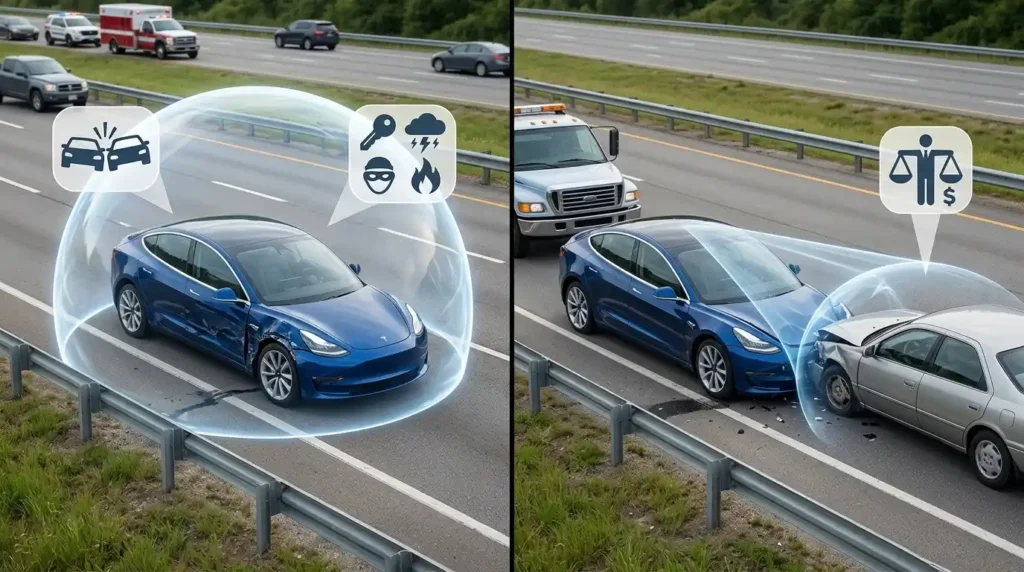
Liability car insurance only pays for damage you cause to someone else. Full coverage adds protection for your own vehicle on top of that same liability protection. If you carry liability only and you cause an accident, your own repair bill is entirely your responsibility.
What Does Liability Car Insurance Cover?
It covers bodily injury and property damage you cause to other people in an accident for which you are found responsible. It does not pay one cent toward repairing or replacing your own vehicle, no matter who caused the crash.
Liability limits are usually written in a split format, such as 25/50/25. That means $25,000 per injured person, $50,000 total per accident, and $25,000 for property damage.
What Is the Minimum Liability Required by Your State?
Minimum liability for insurance requirements vary by state, and most states set a baseline near 25/50/25, though the exact numbers differ. New Hampshire is the only state that does not require liability insurance by law, though drivers there must still show financial responsibility after an accident.
A few states sit well outside the common pattern. Florida requires personal injury protection and property damage liability but no bodily injury minimum at all, while states like Alaska require limits as high as 50/100/25. Confirm your own state’s current minimum liability requirement directly with your state Department of Insurance before assuming a general number applies to you. Our About Us page explains how Insurancebasics Hub approaches this kind of state-specific detail across every article on the site.
When Does Full Coverage Make More Sense Than Liability Only?
Full coverage makes more financial sense when your vehicle still has meaningful resale value and you could not comfortably replace it out of pocket after a total loss. Liability only tends to make more sense once a car is older, paid off, and worth relatively little.
Decision checkpoint: if your car’s value is less than roughly ten times your annual full coverage premium, dropping to liability only may be a reasonable financial choice, since you would spend more on premiums over time than the car itself is worth.
What Does Car Insurance Cover Under Each Part of Full Coverage?
Each piece of full coverage answers a different question about who pays for what. Understanding the three parts separately makes it much easier to spot gaps in your own policy.
What Does Liability Coverage Pay For?
Liability coverage pays for the other driver’s medical bills, lost wages, and vehicle repairs when you are at fault, up to your policy’s limits. It also covers legal defense costs if you are sued over the accident, subject to those same limits.
What Does Collision Coverage Pay For?
Collision coverage pays to repair or replace your own vehicle after a crash, whether you hit another car, a fence, or a pothole, regardless of who is at fault. This is the coverage that specifically closes the gap that liability alone leaves open.
A deductible applies before collision coverage pays. If your deductible is $500 and repairs cost $3,000, your insurer generally pays $2,500 after you cover the first $500 yourself.
What Does Comprehensive Coverage Pay For?
Comprehensive coverage pays for damage from causes other than a collision, including theft, fire, vandalism, falling objects, and hitting an animal. It also typically covers a cracked or shattered windshield, sometimes with a separate, lower glass deductible.
How Does Actual Cash Value Affect a Full Coverage Payout?
Both collision and comprehensive coverage pay based on your vehicle’s actual cash value, not what you originally paid or what it would cost to buy new. Actual cash value means your car’s pre-loss market value after depreciation, which is why a five-year-old car often pays out far less than its original sticker price.
Here is the part that surprises a lot of drivers after a total loss. A car bought for $30,000 three years ago might have an actual cash value closer to $18,000 by the time it is totaled, even though the remaining loan balance could still be higher than that payout. This exact gap is what gap insurance is designed to close, which is why financed vehicles and actual cash value payouts are so closely connected.
What Optional Add-Ons Go Beyond Basic Full Coverage?
- Gap insurance: covers the difference between your loan balance and your car’s actual cash value after a total loss
- Rental reimbursement: pays for a rental car while yours is being repaired after a covered claim
- Roadside assistance: covers towing, jump starts, and flat tire changes, separate from any collision claim
- New car replacement: replaces a totaled newer vehicle with a new one instead of paying only its depreciated value
- Accident forgiveness: prevents your first at-fault accident from raising your premium at renewal
Full Coverage and Gap Insurance: How the Two Work Together
Full coverage and gap insurance solve two different financial problems, and a financed vehicle often needs both to avoid a real gap in protection. Full coverage pays your car’s actual cash value after a total loss. Gap insurance pays the remaining difference between that payout and what you still owe your lender.
Consider a driver who owes $22,000 on a car loan when the vehicle is totaled. If the car’s actual cash value comes out to $17,000, full coverage pays that $17,000 to the lender. Without gap insurance, the driver is still personally responsible for the remaining $5,000, even though the car no longer exists. This is the exact scenario gap insurance exists to prevent, and it is a genuinely different product from full coverage, not a feature bundled inside it.
Does Your State’s No-Fault or At-Fault Rule Change What Full Coverage Pays?
Yes. Whether you live in a no-fault or at-fault state changes which policy pays first after an accident, even though full coverage itself works the same way in both. In an at-fault state, the driver who caused the accident is responsible, and claims generally route through that driver’s liability coverage.
In a no-fault state, each driver’s own personal injury protection typically pays their medical bills first, regardless of who caused the accident, up to that coverage’s limit. Personal injury protection and medical payments coverage are not automatically part of full coverage in every state, so a driver in a no-fault state should confirm this coverage is actually included rather than assuming it comes standard.
How Much Does Full Coverage Car Insurance Cost?
Its typically costs more than double a comparable liability only policy, since it adds two more coverage types on top of the same liability protection. There is no single accurate national number, since your actual price depends on your state, vehicle, driving record, and deductible.
| Common Assumption | Real World Consideration |
| “Full coverage means everything is covered” | The name refers to a bundle of three coverage types, not a guarantee against every possible loss |
| “Liability insurance is always the cheap option” | It is usually cheaper month to month, but pays nothing toward your own vehicle after an at-fault accident |
| “One national average applies to everyone” | Published national averages vary widely, since they depend on the data source, driver profile, and coverage level assumed |
What Factors Affect Full Coverage Insurance for Car Quotes?
Quotes change based on your deductible, your vehicle’s value, your driving record, your ZIP code, and your credit-based insurance score in most states. Raising your deductible from $500 to $1,000 typically lowers the quote, but it also raises what you owe out of pocket if you file a claim.
- Deductible amount: a higher deductible lowers the premium but raises your claim time cost
- Vehicle value: a more expensive car costs more to insure for collision and comprehensive
- Driving record: a recent at-fault accident or ticket raises the price for several years
- Credit-based insurance score: used in most states, though a handful, including California, Hawaii, and Massachusetts, prohibit it
- Location: ZIP code affects theft rates, accident frequency, and local repair costs
- Usage-based or telematics programs: apps or devices that track actual driving behavior can lower a quote for drivers with safe habits, independent of the standard rating factors above
What Is an SR22 or FR44 Filing, and Does It Require Full Coverage?
An SR22 or FR44 is a certificate your insurer files with the state confirming you carry at least the state’s minimum liability insurance, and it does not by itself require full coverage. A judge or state agency typically orders this filing after a serious violation, such as a DUI or driving without insurance, not because of a coverage level choice you made voluntarily.
Drivers sometimes assume an SR22 requirement forces them into a full-coverage policy, but the filing only confirms your liability limits meet the state minimum. You can technically carry an SR22 with liability-only coverage, though a lender’s separate contract requirement would still apply if the vehicle is financed.
How Can You Get Cheap Full Coverage Insurance for your Car Without Losing Needed Protection?
Cheap full-coverage car insurance is realistic when you compare multiple insurers with the same deductible and limits, ask about every available discount, and avoid quietly lowering your liability limits just to see a smaller number. The word cheap only means something once the coverage on both sides of the comparison actually matches. Checking an insurer’s financial strength and complaint history matters here too, since our comparison of top-rated auto insurers explains how to look at that track record before committing to a company.
Illustrative calculation, not a real quote: a driver paying $65 a month for liability only might pay $145 a month for full coverage on the same vehicle, a difference of $80 a month, or $960 a year. If that driver later has a $6,000 covered collision claim with a $500 deductible, the full coverage policy nets $5,500 from the insurer. The liability-only policy would have paid nothing toward that same repair. For a deeper walkthrough of how insurers actually build a quote before you compare prices, see our car insurance quotes guide.
Do You Need Full Coverage Insurance?
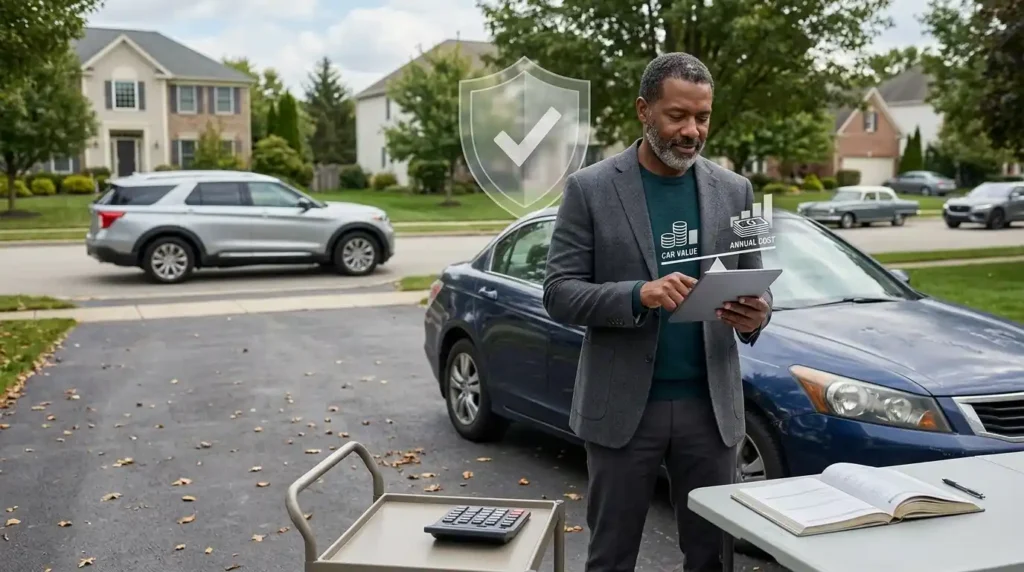
You generally need if your car is financed or leased, and minimum liability may be enough once your car is paid off and worth relatively little. The right answer depends on what you would actually lose if your car were totaled tomorrow, not on a fixed rule that applies to every driver.
When Is Full Coverage Required by a Lender or Lessor?
Lenders and leasing companies almost always require full-coverage car insurance for the entire length of the loan or lease, since the vehicle serves as collateral for money you still owe. This is a contract requirement from the lender, not a state law, and it usually specifies a maximum allowed deductible too.
Is Full Coverage Different for a Financed Car Versus a Leased Car?
The full coverage requirement itself is similar for financed and leased vehicles, but leasing companies typically set stricter minimum liability limits and lower maximum deductibles than a typical auto loan lender. A lease contract may also require gap insurance outright, while a financed purchase usually leaves that choice up to the buyer.
Read your specific loan or lease agreement rather than assuming one set of rules applies to both. The exact liability limits, deductible cap, and any required add-ons are spelled out in that contract, not in general advice like this.
When Might You Consider Dropping Full Coverage?
You might reasonably consider dropping full coverage once your car is paid off and its resale value has fallen low enough that the annual premium no longer makes financial sense compared to the payout you would receive. There is no fixed dollar cutoff, since it depends on your own comfort with financial risk.
One honest limitation worth stating plainly. Dropping to minimum liability means a single at-fault accident could leave you without a working car and without any insurance payout to replace it. That tradeoff is often reasonable for an older vehicle, but it is a real risk, not a free option.
What Happens If You Drop Required Coverage on a Financed Car?
If you drop required full coverage on a financed vehicle without telling your lender, the lender can add its own coverage to your loan automatically, called force-placed insurance. This coverage is usually far more expensive than a policy you would buy yourself, and it often protects only the lender’s financial interest, not you personally.
This is one of the more expensive mistakes a driver can make, and it is rarely explained clearly anywhere else. If cost is the reason you are considering dropping coverage, call your lender first and ask about your actual options before canceling anything.
Common Mistakes People Make
Most mistakes with full-coverage car insurance come from trusting the name instead of reading the actual policy. The three below are the ones that cause the most expensive surprises.
Assuming Full Coverage Covers Every Possible Situation
Full coverage does not cover mechanical breakdowns, normal wear and tear, intentional damage, or commercial use like rideshare driving without a specific endorsement. The name suggests completeness, but the policy contract lists exactly what is and is not included.
Not Checking State Minimum Liability Requirements Before Buying
Skipping your state’s minimum insurance regarding liability requirement before buying a policy can leave you either underinsured or unknowingly paying for more than your state actually mandates. Checking this number first gives you an accurate baseline before you decide how much additional protection makes sense.
Ignoring How Deductibles Affect Full Coverage Car Insurance Quotes
Ignoring the deductible when comparing full-coverage car insurance quotes is one of the easiest ways to misjudge which quote is actually cheaper. A lower monthly price with a much higher deductible can end up costing you more the moment you actually file a claim.
Choosing Best One
Full coverage car insurance earns its extra cost when your vehicle still has real financial value worth protecting, and it becomes the harder choice to justify once that value has dropped significantly. There is no single right answer for every driver, since the decision comes down to what you would genuinely lose if your car were gone tomorrow, not a rule that applies equally to a new lease and a fifteen-year-old sedan.
Before you renew or switch, put your full insurance premium next to your car’s actual value and ask if the math still makes sense. If it does, full-coverage car insurance remains the more responsible choice. If it does not, liability insurance for car alone may finally be the more honest reflection of what your vehicle is actually worth protecting.
FAQs
Is full-coverage car insurance required by law?
No state requires by law. States require some form of liability insurance, and full coverage only becomes mandatory when a lender or lease contract adds that condition.
What’s the difference between full coverage and liability insurance for cars?
Liability insurance only pays for damage you cause to others, while full coverage adds collision and comprehensive protection for your own vehicle. The choice mainly comes down to whether your own car is worth protecting financially.
Does full-coverage car insurance cover a rental car?
Many full coverage policies extend some protection to a rental car used temporarily, but the details vary by insurer and by whether you added rental-specific coverage. Check your policy or call your insurer directly before assuming a rental is automatically covered.
Is cheap full-coverage car insurance worth it on an older vehicle?
It depends on the car’s actual value compared to what you are paying in premiums each year. If the annual premium approaches or exceeds a meaningful share of the car’s resale value, liability only may be the more practical choice.
Does full coverage include gap insurance?
Not automatically. Gap insurance is usually a separate add-on that covers the difference between your loan balance and your car’s actual cash value, and it is worth asking about specifically if your vehicle is financed.
Does full-coverage car insurance cover my own medical bills?
Only if your policy includes personal injury protection or medical payments coverage, since liability, collision, and comprehensive do not pay for your own injuries. Whether this coverage is required or optional depends on whether your state is a no-fault or at-fault state.
Can I drop full coverage after paying off my car?
Yes, once the loan is paid off and there is no lender requirement left, dropping to liability only becomes your own financial decision entirely. Weigh your car’s current value against your annual full coverage premium before deciding, since the right answer depends on that comparison, not a fixed rule.
What happens if I do not have full coverage and my financed car is totaled?
Without full coverage on a financed car, you are personally responsible for the entire remaining loan balance, since there is no collision or comprehensive payout to cover the vehicle at all. This is also the scenario force placed insurance is meant to prevent, though that lender-added coverage is usually far more expensive than a policy you choose yourself.

Michael Bennett is a U.S. insurance research and consumer education writer at Insurancebasics Hub, an independent resource dedicated to helping consumers understand insurance policies, coverage decisions, claims, and insurance-related consumer protections. His work covers auto, homeowners, renters, life, and other areas of insurance, with a focus on making complex insurance topics easier to understand.
Michael takes a research-focused approach to insurance content, using authoritative government and regulatory resources, state insurance department guidance, applicable insurance rules, policy provisions, and documented industry information. His articles examine important details such as coverage limits, deductibles, exclusions, policy conditions, premiums, claims, denials, cancellations, renewals, and state-specific requirements.
His goal is to provide accurate, transparent, and practical information that helps readers make better-informed insurance decisions. Insurancebasics Hub provides general educational information and does not replace individualized advice from a licensed insurance professional, attorney, financial professional, or other qualified adviser.
6 Responses