A car insurance quote is a free, estimated price for a policy, based on the personal and vehicle details you provide. It is not a bill or a binding contract. Comparing three to five car insurance quotes with matching coverage limits is the most reliable way to lower your cost, since identical coverage can vary by hundreds of dollars between carriers.
Your quote looks off. Maybe it’s higher than expected. Maybe two sites show two different numbers for the “same” policy. You are not imagining this.
Car insurance pricing is one of the least transparent parts of personal finance. This guide breaks down how car insurance quotes actually work, what moves them, and where consumers get misled.
What Are Car Insurance Quotes and How Do They Actually Work?
A car insurance quote is a ballpark price. An insurer calculates it from the information you give them, then runs it through a statistical risk model before issuing a policy.
A quote is not a contract. It breaks down itemized costs so you can compare prices, coverage types, and limits across companies. Insurers verify your driving record, your insurance score based on credit, and your vehicle details before the number becomes a real, binding rate. You can browse more consumer-focused breakdowns like this one on the Insurancebasics Hub.
Here is the process in order. You share your information. The insurer scores your risk. You choose your coverage types, limits, and deductibles. Eligible discounts get applied. Then formal underwriting checks everything you reported. If your file matches what you said, the quote becomes your active premium. If it doesn’t, an unstated ticket or a VIN mismatch can change the price before you actually buy.
What Information Do You Need Before Requesting Car Insurance Quotes?
Have this ready before you start a car insurance quote.
Personal information
- Full legal name, date of birth, and how long you’ve lived at your current address
- Driver’s license number
- Social Security number. Many insurers use this to pull your insurance score and motor vehicle record, so it’s commonly requested up front, not just at final purchase
- Names and driving details for other household members or regular drivers on the vehicle
Vehicle details
- Vehicle Identification Number (VIN), or the year, make, and model if you don’t have it handy
- Current odometer reading and estimated annual mileage
- Where the car is parked or garaged overnight. This can differ from your home address, for example if a car is garaged at a college address
- Loan or lease information, if the vehicle is financed
History and coverage
- Accidents, tickets, or claims from the past three to five years
- Your current insurer and policy expiration date, if you have one
- Desired coverage types, limits, and deductibles
Are Online Car Insurance Quotes Accurate or Just Estimates?
Online quotes are directional estimates, not locked-in prices. The number on a web form reflects self-reported information; the number on your declarations page reflects verified information.
Not all online car insurance quotes update in real time. If your online quote assumed a clean record and the insurer’s file shows a forgotten ticket, the final price will move, usually up.
Does Getting a Car Insurance Quote Hurt Your Credit Score?
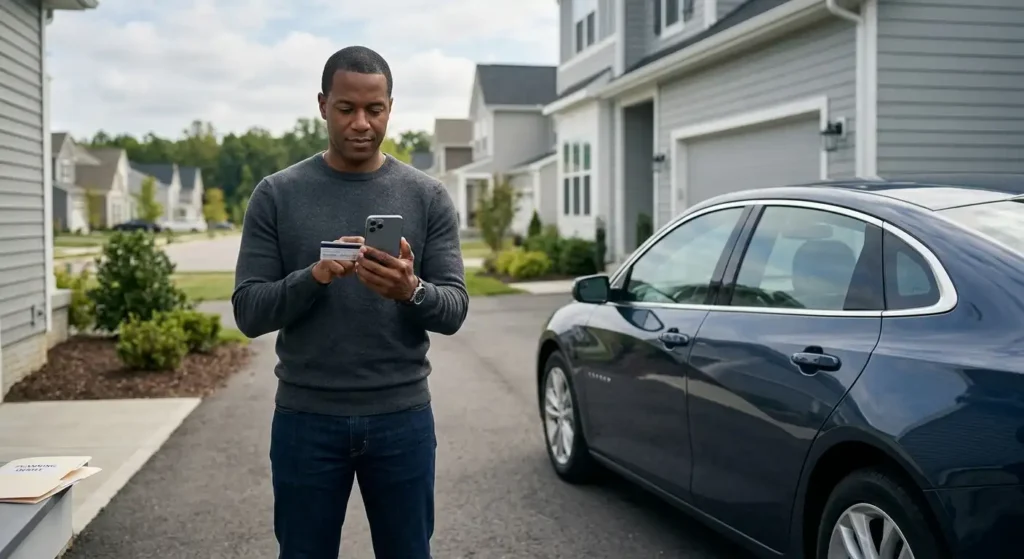
Requesting a quote generally does not hurt your credit score. Most insurers use a “soft pull,” visible only on your own credit report, which does not lower your score the way a hard inquiry would.
A handful of states restrict or prohibit the use of credit for insurance scoring. California, Hawaii, and Massachusetts are the most commonly cited examples. If you live there, a national comparison tool’s default assumptions may not match your real quote.
What’s the Difference Between a Quote and a Rate?
A quote is the estimate you see before you buy. A rate, or premium, is the price you actually agree to pay once underwriting confirms your information. The quote is a draft; the rate is the final version.
How to Compare Car Insurance Quotes the Smart Way
Comparing car insurance quotes only works if the quotes are actually comparable. That single fact causes most of the confusion in this market.
A fair car insurance quote comparison means every policy has the same deductible and the same limits. A $95 a month quote and a $140 a month quote are not “cheap” versus “expensive” if they carry different liability limits. They are two different products.
What Should You Look for When You Compare Car Insurance Quotes?
Match three things before you compare car insurance quotes side by side: the coverage limits, the deductible, and any add-ons.
| What to Check | Why It Changes the Comparison |
| Liability limits (25/50/25 vs. 100/300/100) | Higher limits cost more but leave less of a gap if you cause a serious accident |
| Deductible amount | A lower deductible raises the premium; a higher one lowers it but raises your out-of-pocket cost at claim time |
| Collision and comprehensive coverage | Often optional once a car is paid off; dropping it removes protection for your own vehicle |
| Uninsured/underinsured motorist coverage | Protects you if the other driver has too little insurance; required in some states, optional in others |
| Add-ons (rental reimbursement, roadside assistance, accident forgiveness) | Small line items that quietly change the total when bundled into a package price |
A quote that drops your liability limits to the state minimum is not a better deal. It’s a thinner policy with a lower price tag.
Cheap Car Insurance Quotes vs. Full Coverage: What’s the Real Tradeoff?
“Full coverage” is not an official term. It’s shorthand for a policy with liability, collision, and comprehensive coverage, usually required by a lender.
The search for cheap car insurance quotes often leads people to drop coverage they actually need. Policies with only the state minimum liability cost less, but they pay nothing toward repairing your own car. If you’re still financing your vehicle, that gap can be expensive.
How Many Car Insurance Quotes Should You Get Before Deciding?
Get at least three quotes from different companies before deciding. That’s usually enough to spot a competitive price and gauge each insurer’s reputation for service, without spending disproportionate time chasing a fourth or fifth number.
Decision checkpoint: if your cheapest quote is 40% or more below the others, check what coverage was quietly reduced before assuming it’s a bargain.
Does My Policy Actually Meet My State’s Requirements?
Confirm your chosen policy meets your state’s, and sometimes your city’s, minimum insurance requirements before you buy. Minimum liability limits, and whether uninsured motorist or personal injury protection is required, vary by state. A policy priced to look cheap can sometimes fall short of what your state actually requires. Our About Us page explains how Insurancebasics Hub approaches this kind of state-level accuracy across every article.
Where to Find the Best Auto Insurance Quotes Online
Finding strong auto insurance quotes starts with knowing where to look, and each channel has a different tradeoff.
Direct Insurer vs. Comparison Marketplace: Which Gives Better Results?
Going straight to an insurer’s website gives you one quote, with no data shared elsewhere, and often lets you adjust coverage in real time to see the price change instantly. A comparison marketplace lets you enter your information once and view side-by-side rates from many companies at once, which saves time but usually shares your contact information with several insurers.
| Factor | Direct Insurer | Comparison Marketplace |
| Speed | One quote at a time | Several estimates in one session |
| Data sharing | Limited to that insurer | Shared with multiple insurers or partners |
| Accuracy | Often more precise | Often a rough estimate pending verification |
| Follow-up contact | From one company | Potentially from several |
A reasonable approach: use a comparison marketplace to build a shortlist, then go direct for a final, verified number. It helps to know that these marketplaces typically earn referral fees from insurers, not from you. That’s why the service is free.
How Do You Find Car Insurance Quotes Near Me?
People searching for car insurance quotes near me are usually looking for a local agent who can quote several carriers at once. This works well for complicated situations, like a lapse in coverage or a recent DUI, where a single online form may not capture the full picture.
Is It Safe to Enter Personal Information for a Car Insurance Quote Comparison?
Reputable sites encrypt their forms and disclose how your information is shared. Be cautious of any site asking for a Social Security number before showing any estimate at all. Most legitimate tools can give a rough range first and confirm identity-sensitive details later.
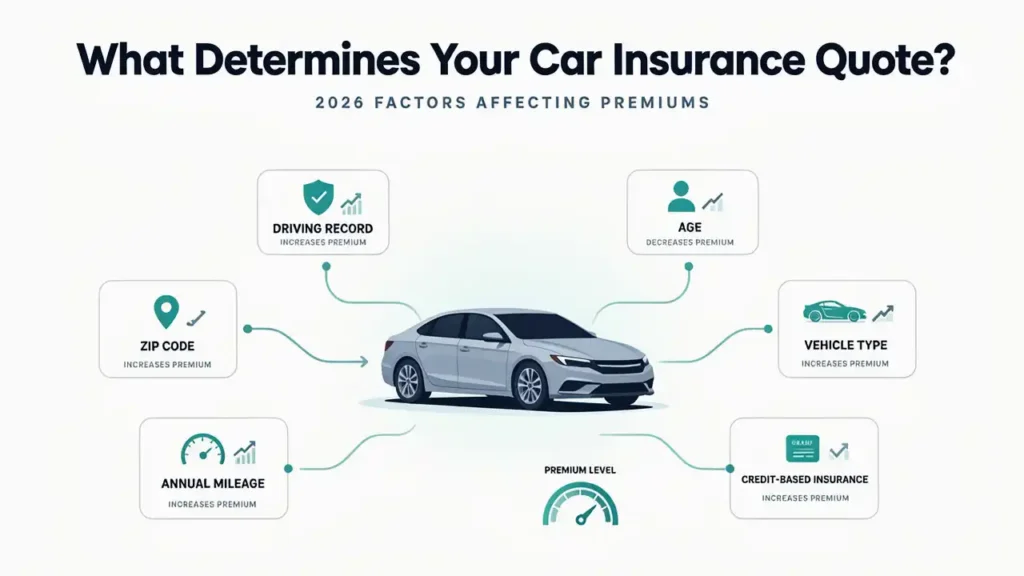
What Factors Affect Your Car Insurance Quotes?
How Does Your Driving Record Affect Your Quote?
Your driving record is one of the heavily weighted rating factors. Insurers run your history through a statistical model to predict how likely you are to file a claim, and a single accident you caused, or a moving violation, can raise your premium for several years.
How Does Credit History Impact Cheap Car Insurance Quotes?
In most states, insurers can use a credit-based insurance score, a calculation that differs from your everyday credit score. California, Hawaii, and Massachusetts prohibit this practice; most other states allow it.
Does Your ZIP Code Really Change Your Car Insurance Quote Comparison?
Yes. ZIP code, and specifically where your car is garaged overnight, feeds an insurer’s read on local accident frequency, theft rates, and the cost of repairs and medical care. Two drivers with identical records, twenty miles apart, can see different base premiums for this reason alone.
Age, Vehicle Type, and Mileage: The Hidden Rating Factors
Younger drivers, typically under 25, and drivers over roughly 70, tend to see higher premiums, reflecting statistically higher claims rates in both groups. Vehicle repair cost, safety ratings, and theft rates all move the number too, and so does your reported annual mileage.
How Does Insurance Score Underwriting Actually Work?
An insurance score is not the same as your everyday credit score. It weighs different inputs, and insurers are not required to disclose the exact formula.
Payment history, length of credit history, and outstanding debt generally factor in. Two drivers with identical clean driving records can still get different quotes because of this score alone.
How Much Do Car Insurance Quotes Typically Cost?
There is no single national number that fits every driver. Any site presenting one flat average is oversimplifying a market that varies by state, ZIP code, age, and record.
| Common Assumption | Real World Consideration |
| “The advertised rate is what I’ll pay” | Advertised rates usually reflect the lowest risk profile in the cheapest available territory |
| “$X a month quoted online” | Actual price depends on state, ZIP code, coverage limits, deductible, and verified information |
| “Minimum coverage is the cheap option” | It costs less up front, but pays nothing toward your own vehicle after an accident you caused |
| “A ticket won’t move my rate much” | A single moving violation can raise premiums for several renewal cycles |
Illustrative calculation, not a real quote: a driver quoted $110 a month with a $500 deductible pays $92 a month with a $1,000 deductible. That’s an $18 monthly difference, or $216 a year. After a $4,000 covered claim, the $500 deductible policy nets $3,500 from the insurer; the $1,000 deductible policy nets $3,000. The cheaper premium only pays off if the driver can absorb that extra $500 at claim time.
Cheapest Car Insurance Quotes for High Risk Drivers
Drivers with a DUI, an accident they caused, or a lapse in coverage usually land in a high-risk tier, sometimes requiring an SR22 filing. Companies that specialize in this market can sometimes beat a standard insurer’s high-risk surcharge for the same driver.
How to Get Cheap Car Insurance Quotes Without Sacrificing Coverage
Top Discounts That Lower Auto Insurance Quotes
These discounts can meaningfully lower auto insurance quotes without cutting your coverage.
- Multiple vehicle and multiple policy discounts: insuring more than one vehicle, or bundling auto with home or renters coverage
- Good student discounts: usually tied to a documented GPA threshold for drivers under 25
- Telematics or usage-based programs: apps or devices, such as Drive Safe and Save, SafePilot, or the Root app model, that price you on actual driving behavior
- Low mileage discounts: for people who work from home or drive infrequently
- Safety feature discounts: for vehicles with anti-lock brakes, airbags, or driver assistance systems
Should You Raise Your Deductible to Get Cheaper Quotes?
Raising your deductible from $500 to $1,000 typically lowers your premium. The real question is whether you have $1,000 available if you need to file a claim, not just the monthly savings.
Does Bundling Home and Auto Insurance Really Save Money?
Bundling often produces a discount, but not always. For some drivers, two separate, specialized insurers beat one company’s bundled rate. Compare the bundled total against separate best-in-class quotes before assuming the bundle wins.
What About Policies for Non-Owners or Gig Economy Drivers?
Non-owner car insurance exists for people who drive occasionally without owning a vehicle. Rideshare and delivery drivers face a different gap: a personal auto policy often excludes commercial use, including the period when a driver’s app is on but no passenger is in the car.
Are Electric and Hybrid Vehicles More Expensive to Insure?
Often, yes. EVs and hybrids can carry higher comprehensive and collision premiums, driven by battery replacement costs and specialized repair parts, not the electric powertrain being inherently riskier.
Common Mistakes to Avoid When Comparing Car Insurance Quotes
This mismatch is the top reason car insurance quotes seem to contradict each other: comparing different coverage as if it were the same product.
Assuming the first year price holds at renewal. Insurers often price new customers competitively, then adjust at the first renewal based on claims history.
Switching mid-policy without checking for a gap. Confirm the new policy’s effective date before canceling the old one, to avoid a coverage lapse.
Treating “starting at” prices as a real estimate. Advertised low rates usually apply to the lowest risk profile an insurer covers.
Choosing on price alone. A rate is only half the decision. A carrier’s reputation for handling claims well, and its financial strength, matter once you actually need to use the policy, not just when you’re buying it.
Assuming USAA is an option. USAA is competitive, but eligibility is restricted to military members, veterans, and their families.
Making Your Car Insurance Quote Comparison Work for You
Comparing car insurance quotes only works when every number reflects identical coverage. A cheaper number by itself tells you almost nothing, since two car insurance quotes with different limits or deductibles are really two different products wearing the same label. The real value of getting several car insurance quotes comes from lining up the coverage first, then letting the price differences speak for themselves.
Treat every comparison of car insurance quotes as incomplete until you have checked the liability limits, the deductible, the add ons, and your state’s minimum requirements line by line. Once those match across every option, the lowest car insurance quotes on your list are finally telling you something real, and you can choose with confidence instead of guesswork.
Frequently Asked Questions About Car Insurance Quotes
How long is a car insurance quote valid?
Most quotes stay valid for about 30 days. The exact window varies by insurer, and it can shorten if your reported information changes before you buy. It’s worth confirming the expiration date if you’re taking time to compare multiple offers.
Can I get car insurance quotes without owning a car?
Yes. Non-owner policies exist for people who drive occasionally without owning a vehicle. They can also help maintain continuous coverage history between vehicles, which insurers often reward at your next renewal.
Why did my quote go up after I entered more details?
Initial estimates rely on self-reported information, which is naturally incomplete. Verified details, like your VIN, driving record, or exact garaging address, adjust the quote to reflect your actual risk. This is a normal part of underwriting, not a sign that something went wrong.
Is the cheapest quote always the best option?
No. The cheapest quote may reflect lower coverage limits or a higher deductible, not a genuinely better price for identical coverage. Always check what was reduced before assuming you found the best deal.
Are online car insurance quotes always lower than agent quotes?
Not necessarily. Online car insurance quotes and agent quotes both start as estimates, and the final premium depends on verified underwriting rather than which channel you used. An agent may still be useful for unusual driving histories that a simple web form can’t capture well.
Are car insurance quotes near me cheaper than online quotes?
Not automatically. A local agent may find a competitive rate for complicated situations, but a straightforward driver profile often prices similarly whether you go online or through an agent. The channel matters less than making sure the coverage being compared is identical.
Do I need my Social Security number to get a quote?
Often, yes. Many insurers and comparison tools request it early on, since it’s used to check your insurance score and motor vehicle record. A legitimate site should still be able to explain, in its privacy disclosure, exactly how that information will be used.
How do I cancel my old policy after accepting a new quote?
Confirm the new policy’s effective date first, then contact your current insurer to cancel effective that same date. This sequence avoids a coverage lapse, which can otherwise affect your future pricing.