
RV insurance Colorado owners need depends on the vehicle. A motorhome must carry at least 25/50/15 liability under Colorado’s financial responsibility law, which the Division of Insurance says is a floor, not a recommendation. A towable has no standalone state mandate, but lenders often require physical damage coverage, and hail, mountain driving, and wildfire shape what makes sense.
Most Colorado owners arrive here with a quiet worry: “Is my RV actually covered for the things that happen in this state?” Hail on the Front Range and steep grades on I-70 are not rare events, and a policy written for a flat, dry state can feel thin here.
This guide starts with the rules, then moves to the risks, then to what the quotes mean. One caution up front: the only Colorado cost figures I could source come from a single insurer’s 2024 data, so I label them that way and don’t call them state averages.
Start Here: Which RV Do You Own?
Your RV type sets the legal question, and your loan or usage sets the practical one. A motorhome is a motor vehicle, so liability rules apply directly. A towable follows the vehicle pulling it.
| Your situation | Required by Colorado law | Often required by someone else | Worth checking |
| Motorhome | Liability, at least 25/50/15 | Lender: comprehensive and collision | Limits above the minimum |
| Towable (trailer, fifth wheel) | Tow vehicle must be insured; no standalone trailer policy | Lender, if financed | Who pays for trailer damage |
| Financed unit | Same as above | Lender sets physical damage terms | Loss payee and deductible caps |
| Full-time or long stays | Same as above | Insurer may require full-timer form | Usage definition in the policy |
The “law” column is short. Almost everything that costs people money sits in the other two.
Colorado RV Insurance Requirements: What the Law Sets
Colorado requires motorhome liability limits of at least $25,000 for one person’s injuries, $50,000 for all injuries in one accident, and $15,000 for property damage. The Colorado Division of Insurance, part of DORA, lists this split in its auto guide and says it does not recommend buying only the statutory minimums.
One source I found lists the property-damage figure as $10,000. That looks like an outlier, so cite the Division directly and re-check before you rely on any number, including mine.
Why minimums fall short on a large vehicle
A motorhome is heavy, and the minimums were written with ordinary cars in mind. Take an illustrative crash near Georgetown on I-70: two people injured with medical bills of $70,000 and $20,000, and a vehicle with $32,000 in damage.
At 25/50/15:
- Person one: capped at $25,000, leaving $45,000 unpaid
- Person two: $20,000, within the cap
- Vehicle damage: capped at $15,000, leaving $17,000 unpaid
That is $62,000 of exposure that lands on the driver. Colorado is an at-fault state, so the injured parties can pursue the at-fault driver for what insurance doesn’t pay.
Decision checkpoint: If the state minimum is the number on your declarations page, the question is whether you could personally absorb a gap like that. If not, higher limits or an umbrella policy are the usual conversation to have.
UM/UIM and proof of insurance
Uninsured and underinsured motorist coverage pays for your injuries when the at-fault driver has none or too little. From what I reviewed, Colorado insurers must offer it at limits matching your liability, and you can decline in writing, but sources disagree on details, so confirm with the Division. For how disputes over this coverage play out, see our guide to uninsured motorist lawsuits.
For comparison, the Washington Department of Licensing lists a $10,000 property-damage minimum, which makes the two neighboring western states differ on exactly the number that matters in a crash with a high-value vehicle. Our Washington RV insurance guide covers that side.
Towables: The Gap Between Your Truck and Your Trailer
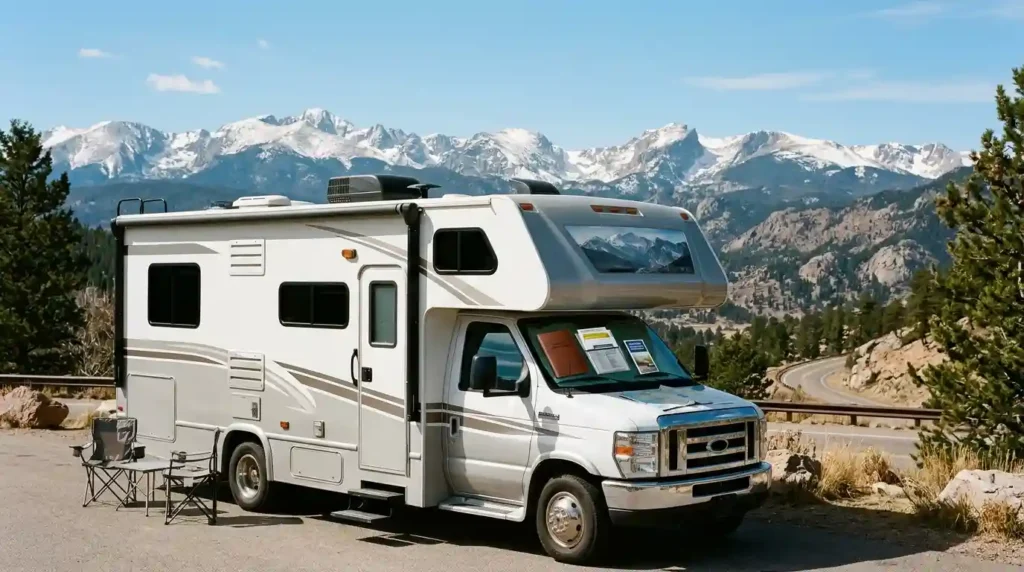
Your tow vehicle’s liability generally covers harm the trailer causes while hitched, but not damage to the trailer itself. For towables, Colorado RV insurance requirements stop at the tow vehicle, which is why owners are often surprised by what a truck policy leaves out.
Here is the part many readers don’t hear until a claim: once you unhitch at a campsite, the tow vehicle’s liability may no longer respond, so a guest injury or a runaway trailer becomes a different kind of claim. Whether any liability continues depends on the policy.
The smallest towables raise the same questions at a lower price point, as our guide to pop-up camper insurance requirements explains.
Camper Insurance Coverage in Colorado: What Each Part Pays
A full recreational policy is a bundle of separate coverages, and each one answers a different question. Knowing which is which matters more than the headline premium.
| Coverage | What it pays for | Colorado example |
| Liability | Injury or damage you cause to others | Collision on a mountain grade |
| Collision | Impact damage to your RV | Sliding into a guardrail on ice |
| Comprehensive | Hail, theft, fire, animals, falling objects | Front Range hailstorm |
| UM/UIM | Your injuries from an uninsured driver | Hit by a driver with no coverage |
| Personal effects | Belongings inside, up to a limit | Gear stolen from a campsite |
| Vacation liability | Guest injury at your campsite | A visitor trips on a stabilizer jack |
| Emergency expense | Lodging and travel after a covered loss | Stranded after a covered accident |
Some policies add glass or roof coverage, but those are insurer-specific, not Colorado rules. I’d treat any competitor page that presents them as standard with caution.
Hail, Mountains and Wildlife: Colorado’s Real Risks
Colorado’s risk profile is unusual: hail on the eastern side, steep descents in the mountains, and wildfire and wildlife in between. Camper insurance coverage in Colorado usually lives or dies on the comprehensive terms, because hail, fire, and animal damage all land there.
Hail
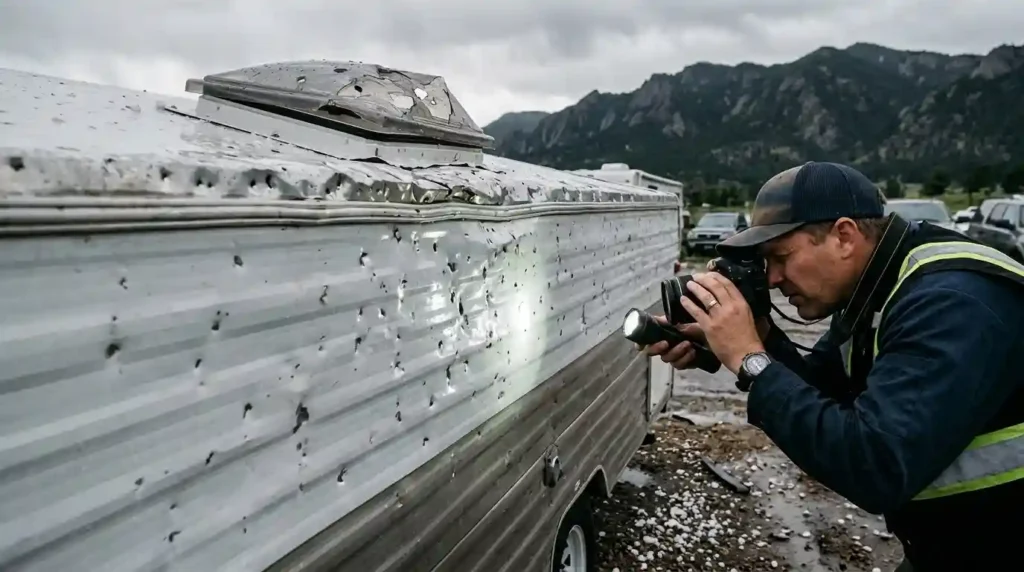
Hail is the claim most owners underestimate. Suppose a hailstorm in Denver leaves $7,400 in damage to the roof, vents, and solar panel of a trailer worth $18,000 (illustrative). With a $500 comprehensive deductible, the insurer-paid amount would be about $6,900. With a $2,500 deductible, about $4,900.
Premium savings from a higher deductible can look attractive. Say a $1,150 premium with the $500 deductible drops to $980 with the $2,500 one. That saves $170 a year but adds $2,000 of exposure. Divided out, it takes about 11.8 claim-free years to break even, which is a long bet in hail country.
The friction point is the claims process: hail damage often involves an inspection, a repair estimate, and sometimes a dispute over what counts as damage versus cosmetic wear. Ask whether cosmetic damage is paid or limited.
Mountain driving and glass
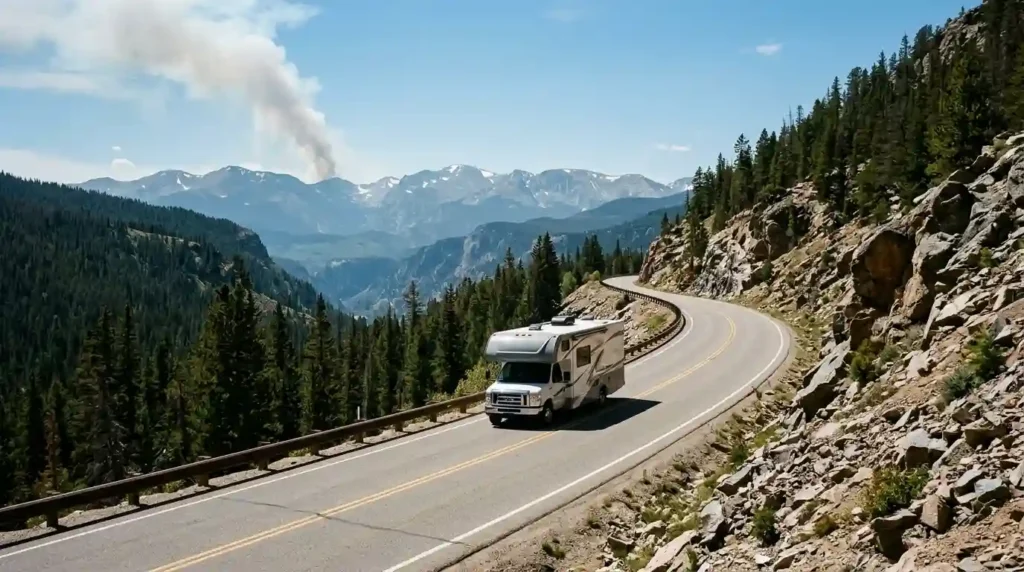
Steep grades, brake wear, and rock chips are routine on I-70 and mountain passes. Windshield claims are usually handled under comprehensive coverage, and our explainer on how a rock-chip windshield claim works shows how the deductible logic plays out on a smaller loss.
Wildfire, wildlife, and winter storage
Wildfire is a comprehensive loss. Animal damage, such as rodents chewing wiring, is also typically comprehensive, though you should confirm how your policy treats it.
Winter storage helps by reducing exposure, but freeze damage from poor winterization can be excluded as neglect. The practical lesson: document your winterization steps with dated photos.
What RV Insurance Colorado Buyers Should Compare
Three details usually matter more than the premium: valuation, deductible, and limits. Each can change what you receive after a loss by thousands of dollars.
Valuation, from first principles
Actual cash value (ACV) is what a comparable RV is worth today, after depreciation. Agreed value is a figure you and the insurer set in advance. Stated value typically caps the payout at that amount or market value, whichever is lower.
Here is an illustrative total loss on a motorhome with an ACV of $48,000 and an agreed value of $60,000, with a $1,000 deductible:
- ACV payout: $48,000 − $1,000 = $47,000
- Agreed value payout: $60,000 − $1,000 = $59,000
That is a $12,000 difference from the valuation method alone, and agreed value policies may cost more and require documentation of condition.
Limits and deductibles
The state minimum is the legal floor. The Division’s own advice against buying only minimums is the clearest regulator signal you will find. Choosing a deductible is a question of what you can pay in a bad week, not what saves the most in a quiet year.
Colorado RV Insurance Cost: What the Numbers Show
The only Colorado figures I could source are one insurer’s 2024 averages: $1,175.90 a year for a motorhome and $760.84 for a travel trailer. That works out to about $97.99 and $63.40 a month. They are one carrier’s data, not a statewide average.
Progressive’s 2024 national averages were $594 for a travel trailer and $1,052 for a motorhome. Because I can’t confirm both Colorado figures come from the same insurer, treat the comparison as directional.
| Factor | One insurer, Colorado 2024 | National 2024 (Progressive) | Direction |
| Motorhome | $1,175.90 / yr | $1,052 / yr | $123.90 higher (about 11.8%) |
| Travel trailer | $760.84 / yr | $594 / yr | $166.84 higher (about 28.1%) |
Third-party “typical range” tables that run from $200 to over $3,000 aren’t Colorado data, and I didn’t use them.
What moves your premium
Premiums respond to RV class, value, age, usage days, storage location, ZIP code, driving record, deductible, limits, and claims history. Hail-prone ZIP codes and storage type can matter more than people expect, because storage determines theft and weather exposure.
Decision checkpoint: If two quotes differ by a few hundred dollars, compare the deductible, valuation method, and personal-effects limit before treating the cheaper one as the better deal.
Colorado Motorhome Insurance Rates by Class and Use
Motorhome premiums run higher than towable premiums because of value, size, and driving exposure. Colorado motorhome insurance rates also reflect the driver, so a clean record can matter as much as the class of vehicle.
Class A, B, and C each price differently, but I’d be cautious with any ranking such as “Class A costs the most, then C, then B” because that is a generalization, not a Colorado finding. Value and usage often explain more than class.
Full-time versus recreational use
If you live in the RV, a standard recreational policy may not fit. Full-timer coverage is a different form with higher liability and contents limits, and the threshold varies by insurer, with about six months of residence use common. The risk of the wrong form is a problem at claim time.
Saving Without Cutting the Wrong Corner
Colorado RV insurance cost falls most reliably where the premium buys the least exposure: a deductible you can actually pay, bundling, secure or covered storage, and accurate usage reporting. Discounts vary by insurer. For how bundling works across policies, see our overview of home and auto insurance bundling.
The savings that backfire are dropping comprehensive in hail country, trimming liability to the minimum on a heavy vehicle, and accepting a personal-effects limit too small for your gear.
Consider a $6,500 teardrop trailer. At $760.84 a year, coverage equals about 11.7 percent of its value, and payouts shrink as it depreciates. For that owner, liability through the tow vehicle and a savings cushion may be more practical than full physical damage coverage, unless a lender requires it.
How an RV Claim Works
A claim moves through a predictable sequence, and the paperwork is where delays happen:
- Document the damage with photos and keep receipts.
- Report the loss to your insurer promptly.
- Get an estimate or inspection.
- The insurer decides between repair and total loss.
- Settlement follows policy terms, valuation, and deductible.
What stood out to me while comparing the Division’s guidance with typical RV policy wording is how much depends on definitions, not on the word “covered.” A denial doesn’t tell you whether the loss was excluded, undocumented, or over a limit; the explanation and the policy provision do.
Common Mistakes
Assuming the truck’s policy covers the trailer tops the list. Others: buying only the state minimums for a motorhome, skipping hail-deductible questions, understating usage days, forgetting to tell the insurer about solar panels or awnings, and letting coverage lapse during storage.
Rental use is another trap: personal policies often exclude it. A lapse can also raise future rates and create legal exposure.
I’ll add one labeled opinion: I expect hail and wildfire exposure to keep shaping how Colorado policies handle deductibles and storage terms. That is my read of the market, not a confirmed regulatory change.
Who Regulates Colorado Insurers?
The Colorado Division of Insurance, part of DORA, regulates insurers and handles consumer complaints. The Colorado DMV handles registration and titling. If a claim or cancellation seems wrong, the Division is the official place to ask, and its auto guide is the best source for the liability limits.
Final Thoughts: Read the Policy Before Hail Season
So what does RV insurance Colorado owners need come down to? The law sets a floor for motorhomes and points to the tow vehicle for trailers, and Colorado’s hail, mountain driving, and wildfire exposure make the optional coverages worth reading closely.
The most useful next step is concrete: pull your declarations page, check your liability limits and comprehensive deductible, and confirm the current minimums with the Colorado Division of Insurance.
FAQs
Is RV insurance required in Colorado?
Motorhomes must carry liability of at least 25/50/15 because they are registered motor vehicles. Towables have no standalone state requirement, but the tow vehicle must be insured. A lender may still require more coverage on a financed unit, so check your loan agreement.
What are Colorado’s minimum liability limits?
The Division of Insurance lists $25,000 per person, $50,000 per accident, and $15,000 for property damage. These are legal minimums, and the Division does not recommend buying only the minimums. On a heavy motorhome, a serious crash can exceed them quickly.
Does my truck’s policy cover my trailer?
Your truck’s liability generally covers harm the trailer causes to others while hitched. It does not pay to repair the trailer itself after hail, theft, or a crash. Once you unhitch at a campsite, liability may not respond either, so ask your insurer how it treats that situation.
Does RV insurance cover hail in Colorado?
Hail is typically a comprehensive loss, so you need that coverage on the policy. The deductible matters a lot here, because a higher one can cut your payout by thousands after a storm. Ask whether cosmetic damage is paid or limited, and how the insurer handles roof and vent repairs.
Do lenders require full coverage?
Lenders typically require comprehensive and collision on a financed or leased RV and name themselves as loss payee. That is a loan condition, not a Colorado law. If coverage lapses, the lender may buy a policy and bill you for it, so send proof of any new policy right away.
Can I insure my RV for part of the year?
Many insurers offer seasonal or storage coverage that keeps comprehensive active while suspending driving-related coverage. Terms vary by insurer, and driving a stored RV could leave you without liability protection. Confirm what is suspended and how to reactivate before your first trip of the season.
Does homeowners insurance cover an RV?
Usually not the RV itself, because homeowners policies are built around the house. Belongings kept in the RV may be covered, but often with a lower off-premises limit. Check your policy’s personal property section and its list of property not covered before you assume anything.
How do I file a complaint in Colorado?
Start by asking your insurer for a written explanation of its decision, then contact the Colorado Division of Insurance, part of DORA. The Division regulates insurers and handles consumer complaints. Keep your policy, claim notes, photos, and correspondence ready, since it will want documentation.