
Do pop-up campers need insurance? Usually not by law when you own one outright, but lenders require coverage on financed or leased units. Your tow vehicle’s liability coverage generally handles harm the trailer causes while hitched, yet it does not repair the camper or cover theft, hail, or storm damage.
That one paragraph hides three separate questions, and most online answers blur them together. Is insurance legally required? Does a lender or campground require it? Is it financially wise for your particular camper? The answers can differ, and mixing them up is how people end up either overpaying or discovering a gap after a loss.
This guide separates the three. It also explains what your car insurance actually does while you tow, where homeowners insurance stops, and what pop-up coverage tends to cost. A note on sourcing: much of the web on this topic is scraped, contradictory material. Where I cite a figure below, I name where it came from and flag what you should confirm yourself.
Who Needs What? A Quick Answer by Situation
The question “do pop-up campers need insurance” really has three tests behind it: a legal requirement, a lender requirement, and financial prudence. Your ownership situation decides which test applies, and a camper can pass one while failing another.
| Your situation | Legally required? | Required by someone else? | Worth considering |
| Owned outright, used a few weekends a year | Generally no standalone mandate for the trailer itself (confirm for your state) | Possibly a campground, if its reservation terms say so | Depends on camper value and what you could afford to replace |
| Financed or leased | No separate law, but the contract applies | Lender typically requires physical damage coverage | Read the loan agreement for exact terms |
| Newly bought used from a private seller | Same as above | Insurer will want title or bill of sale and VIN | Insure before the first tow, not after |
| Stored at home or off-site | Not by law | Storage facility may ask for proof | Theft and weather exposure matter most here |
| Lived in full time | Standard recreational coverage usually does not fit | Varies | A different policy type (full-timer) is usually involved |
Does a Pop-Up Camper Need Insurance by Law?
For a towed pop-up, the legal picture is mostly indirect. Mandatory liability laws in the U.S. are written around motor vehicles and the people who drive them, and a pop-up is an unpowered trailer. Progressive’s pop-up camper guidance says insurance generally isn’t required unless the trailer is financed or leased.
The practical effect is that your tow vehicle’s insurance is what the law cares about while you drive. Progressive also states that your vehicle’s policy should cover damage or injuries a pop-up causes while being towed. Insurance.com makes a related point: auto liability extends to a travel trailer when towing, but damage to the trailer itself needs separate coverage.
Where state rules differ
This is the part I can’t flatten into one answer. States set their own financial responsibility laws, their own trailer registration and title rules, and their own wording about whether a trailer counts as part of the towing vehicle for insurance purposes. I have not verified a rule for every state, and I’m not going to pretend otherwise.
Pricing varies by market too. For a look at how one specific market handles RV coverage, see RV insurance in Las Vegas, which shows how local conditions can shape what coverage looks like.
For your own state, check two official places. Your state insurance department publishes consumer guidance, and your DMV explains registration and any trailer-specific proof requirements. The NAIC maintains links to every state regulator if you need a starting point.
The reality check: “not required” is not “not exposed”
People hear “no law requires it” and conclude “I’m fine.” But the law sets a floor for harming others. It says nothing about your own loss. If hail shreds the roof of your camper, no statute pays for it.
Decision checkpoint: If no law or lender requires coverage on your camper, the real question becomes: could you comfortably pay to replace it out of pocket tomorrow? If yes, going without physical damage coverage is a defensible choice. If no, the lack of a mandate doesn’t help you.
What Your Auto Policy Covers While You Tow
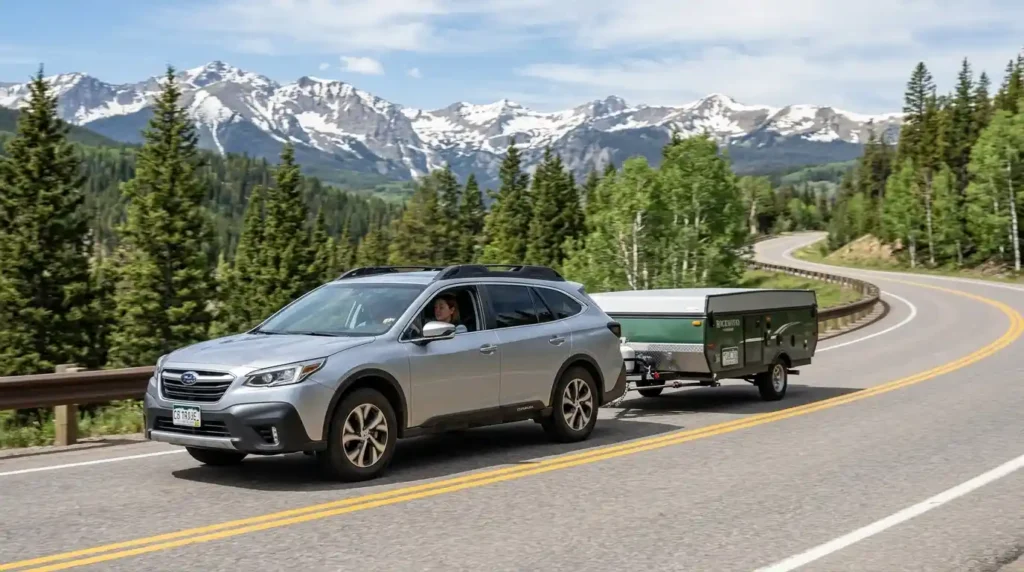
Your auto policy generally covers the liability side of towing, meaning injuries or property damage the trailer causes to other people. It generally does not cover the camper itself as property you own. Most people assume the opposite, and the assumption tends to surface only at claim time.
Liability while hitched
Imagine the trailer sways and clips a guardrail, or a hitch failure sends it into another car. Your tow vehicle’s bodily injury and property damage liability is what typically responds for the other party’s losses. The key limit is whatever appears on your declarations page. If a serious accident exceeds those limits, the shortfall can land on you personally, which is why some owners review their liability limits and an umbrella policy together.
What it won’t pay
Here is what falls outside typical auto liability coverage:
- Repair or replacement of the camper after theft, fire, hail, or vandalism
- The camper’s damage in a collision (that requires physical damage coverage tied to the trailer)
- Camping gear, bedding, stoves, and other contents inside the camper
- Injuries to a guest at your campsite while the camper is parked and set up
“Parked” is the operative word. The auto policy’s trailer liability is built around the towing relationship. Once you unhitch and set up camp, that relationship ends, and the auto policy has little reason to respond.
Deductible and rate impact
If you cause an accident and the camper is damaged too, which policy pays for the camper? It depends on how your auto policy treats trailers. Some provide limited coverage for trailers under the tow vehicle’s collision coverage, with its deductible, while others exclude or cap it. Verify this in your policy wording or with your insurer, since I can’t tell you what your policy says.
A claim can also affect your auto premium at renewal, depending on fault and insurer practice. A trailer-related claim sits on your auto record, not on a separate camper record, unless you carry a separate policy.
Do You Need Insurance for a Pop-Up Camper With a Loan?
Yes, in practice. Once there is a loan or lease, the lender’s contract typically requires physical damage coverage, and the law isn’t the reason. The lender has a financial stake in the camper and wants it protected until the balance is paid.
Lender requirements
Loan agreements commonly require comprehensive and collision coverage, often with a maximum deductible, and name the lender as loss payee or lienholder on the policy. That means any physical damage payout can go to the lender first. The exact language sits in your loan or lease agreement, so read that document rather than relying on a general rule.
Force-placed insurance risk
If your coverage lapses or the lender can’t confirm it, the lender can buy a policy on your behalf and bill you for it. This is called force-placed insurance. It generally protects the lender’s interest, not yours, and it can cost more than a policy you’d shop for yourself. Procedures differ by lender and loan type, so confirm the specifics in your agreement.
The reality check: the friction here is mostly paperwork. A lender can flag a lapse because a renewal notice went to an old address or a payment bounced, even if you believed you were covered. If you change insurers, make sure the new declarations page reaches the lender before the old policy ends.
Do You Have to Insure a Pop-Up in Storage?
No law requires it, but a stored camper faces a different mix of risks: theft, weather, and rodents. Whether your existing policies cover those risks depends on how and where it’s stored.
Driveway and home storage
A camper in your driveway isn’t “in use,” so auto liability doesn’t apply, and auto insurance doesn’t cover physical damage either. Homeowners insurance is the next place people look, and this is where assumptions break down.
Homeowners policies are built around the house and its contents. Many either exclude trailers or cover them minimally, and personal property kept away from the home is often subject to a lower limit than property inside it. Some policies let you add the camper by endorsement. The sections to read are your Coverage C (personal property) definition and the “property not covered” list. If you want to understand how those policies are priced and structured before you call your carrier, our homeowners insurance quote guide walks through it.
Off-site and seasonal storage
Off-site storage adds a second layer: the facility’s own rules. Some require proof of insurance, and a facility’s own liability policy typically covers the facility’s negligence, not your camper’s contents. Seasonal use can lower a premium with some insurers, and lay-up or storage-only coverage exists, though I haven’t verified specific terms, and they vary by carrier.
Do You Need Insurance on a Pop-Up Camper at a Campground?
No law requires it, but a campground can set its own conditions. Most public campgrounds don’t ask for proof of coverage on a simple pop-up, though some private parks, rental-lot arrangements, and long-stay sites do. The place to check is your reservation confirmation and the park’s posted rules.
Vacation liability
Suppose a visiting friend trips over a tent stake and breaks a wrist. Your auto policy isn’t designed for that, because the trailer isn’t being towed. Vacation liability is the coverage built for it: it typically applies while the camper is parked and used as a temporary residence, and it is commonly part of a recreational vehicle policy rather than an auto policy. Whether your homeowners liability extends to a camper at a campsite depends on the policy wording, so don’t assume.
Campground rules
Some campgrounds ask guests to sign a waiver acknowledging that the park isn’t responsible for guest-caused injuries. That shifts attention back to you. A campground’s insurance protects the campground, not your campsite.

Can Homeowners Insurance Cover a Pop-Up Camper?
It can cover some things, but rarely the camper in full. Homeowners policies tend to treat belongings away from home as limited coverage, and trailers are commonly carved out unless you add an endorsement. Reading the policy matters more here than any general rule.
Belongings vs. the trailer
Your sleeping bags, lanterns, and cookware might be covered as personal property, subject to the off-premises limit and a deductible. The trailer itself, as a trailer, is frequently not. This is a coverage-versus-exclusion question, and the exclusions section is where the answer lives.
Limits to check
Three items are worth confirming with your carrier: whether trailers are excluded or covered by endorsement, how off-premises personal property is limited, and whether the camper’s liability is covered when it’s parked. I can’t tell you the typical numbers because they vary, and I’d rather say that than give you a figure I can’t support.
Coverage Options Explained
A standalone recreational policy is typically built from a handful of coverages, and knowing what each one pays helps you read a quote without being swayed by the headline premium.
Comprehensive pays for non-collision losses such as theft, fire, hail, and falling objects, subject to a deductible. If the concept feels abstract, our breakdown of how comprehensive coverage handles a rock-chip claim shows the same deductible logic on a car, and it works the same way on a camper.
Collision pays for accident damage to the camper whether or not you were at fault. Personal effects coverage replaces camping gear and contents up to a stated limit, and that limit is usually the number people never check. Roadside and emergency expense coverage can help with towing and trip-related costs. And the way the policy values your camper decides how much you actually get back.
ACV vs. agreed value, from first principles
This is the concept I would spend ten minutes on before choosing a policy, because it changes the payout more than almost any other setting.
Actual cash value (ACV) is replacement cost minus depreciation. The insurer asks what a comparable camper is worth today, in its current condition, not what you paid. Agreed value is a number you and the insurer set in advance, which then becomes the starting point for a total loss payment.
Here is an illustrative example, not a quote. Assume a camper’s current ACV is $7,200, your comprehensive deductible is $500, and it’s a total loss from a fire:
- ACV policy: $7,200 − $500 deductible = $6,700
- Agreed value of $9,000: $9,000 − $500 deductible = $8,500
That $1,800 gap is not free; agreed value policies usually cost more and may require documentation of condition. But it shows why the valuation method matters as much as the premium.
What Does Pop-Up Camper Insurance Cost?
Published figures conflict, so a single “average” would be misleading. The honest answer is a range that depends on the camper’s value, your deductible, your state, and your driving record.
Typical ranges, with sources
Here is what I could trace:
- Per Progressive’s 2024 data, as reported by an agency blog (secondary, so verify with the carrier), the average annual travel trailer policy was $594, and motorhomes averaged $1,052, with liability-only policies starting around $125 a year.
- Insured Better reports pop-up campers averaging roughly $200 to $550 per year.
- Other agency pages I reviewed give $200 to $350 and $240 to $552, which shows how far these figures can drift depending on method and date.
Treat these as orientation, not quotes. The travel trailer average is a different product category than a pop-up, which is typically lighter and lower-valued.
What changes your premium
Camper value, age, and condition lead the list, followed by your deductible, liability and personal-effects limits, state, storage location, and claims or driving history. Bundling with an auto or home policy and seasonal use can reduce cost with some insurers, depending on the carrier. The same camper can price differently across two quotes.
Deductible example (hypothetical)
Say Quote A costs $520 a year with a $250 deductible, and Quote B costs $430 a year with a $1,000 deductible. Quote B saves $90 a year but adds $750 of out-of-pocket exposure per claim. Divide $750 by $90, and you get about 8.3 years of claim-free ownership before the cheaper premium has paid back one claim’s extra deductible.
Decision checkpoint: If a higher deductible lowers your premium, the relevant question is whether you could comfortably absorb that deductible after a covered loss. A deductible you can’t pay is a coverage you can’t use.
Real-World Examples (Illustrative, Not Actual Claims)
These scenarios are constructed to show how coverage mechanics work. They are not case studies of real policyholders.
A stolen camper. A pop-up with an ACV of $7,200 is taken from a storage lot. With comprehensive coverage and a $500 deductible, the claim is evaluated under the policy terms, and the insurer will want the title or bill of sale, VIN, and photos. Without comprehensive, the loss is entirely the owner’s. The friction point is documentation: someone who bought privately and never kept the bill of sale may spend weeks reconstructing ownership.
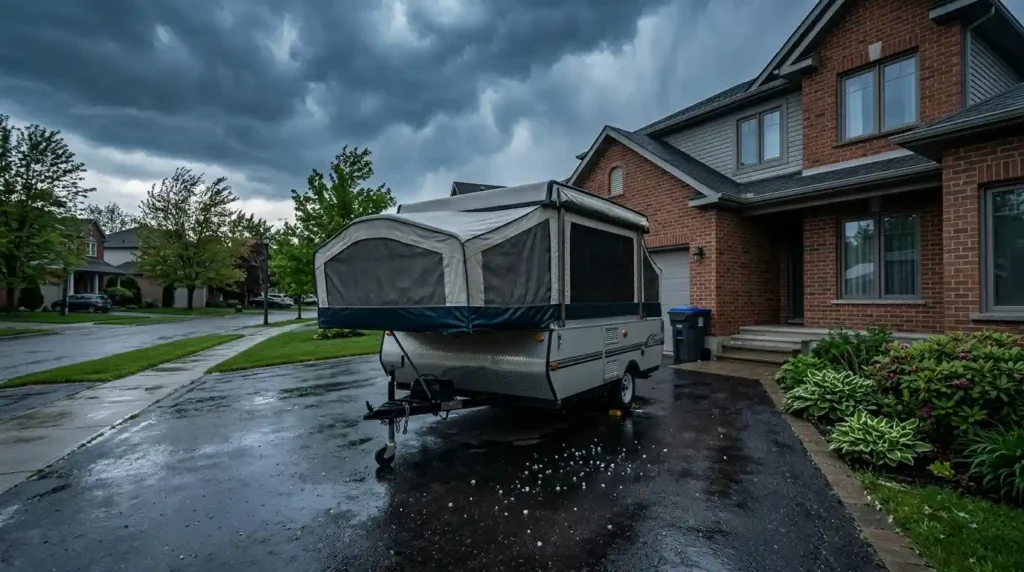
Hail damage. A storm leaves $2,400 of damage to the roof and vinyl panels of that same camper. With comprehensive and a $500 deductible, the payable amount would be about $1,900, assuming the loss is covered and no other limits apply. Without it, the owner pays $2,400. Soft-sided and canvas components can also raise a wear-and-tear question, since many policies exclude gradual deterioration, so condition photos taken before a loss are useful.
A guest injury. A visitor trips on a stabilizer jack, and medical bills reach $18,000. The auto policy has little reason to respond, because the camper is parked. Vacation liability, if carried, may apply. Homeowners liability might extend to it or might not, depending on the wording. This is the scenario where “I assumed my car insurance covered it” does the most damage.
The scenario where the sensible-sounding option isn’t practical
Consider a $3,000 camper owned outright, with a quote around $350 a year (illustrative). Five years of premiums come to $1,750, which is more than half the camper’s original price, and the camper’s value is falling the whole time. Meanwhile, comprehensive and collision payouts are capped by ACV, which on an older camper may be lower than the premiums add up to. For this owner, liability-only coverage, or relying on the tow vehicle’s liability and self-insuring the camper, can be more rational. Insurance that costs more than the loss it protects against isn’t automatically a bad deal, but it deserves a hard look.
Do You Need Insurance on a Pop Up Camper if It’s Old or Cheap?
Does a pop-up camper need insurance when it’s worth only a few thousand dollars? Value drives the physical damage math more than any rule does. A cheap camper changes that question, but it does not change the liability question, which concerns other people’s injuries and property, not your camper’s price tag.
Cheap or older camper: The physical damage case is weak because payouts shrink with depreciation. The liability exposure is the same as for a new one, though, so check your tow vehicle’s limits.
Newer or financed camper: The camper’s value and the lender’s terms both push toward physical damage coverage. Agreed value becomes more attractive when depreciation would otherwise eat a large part of the payout.
I’ll offer an opinion here, labeled as one: many owners focus on the camper’s repair cost and underweight the liability side. A guest injury or a towing accident can dwarf a $3,000 trailer’s value.
A decision checklist
Work through these questions with your own documents in front of you:
- Is there a loan or lease? If so, what does the agreement require?
- Could I replace this camper out of pocket without hardship?
- Do my auto liability limits seem adequate if the trailer causes a serious accident?
- Where is it stored, and who else has access?
- Do I host guests at campsites?
- Do I lend the camper to others or rent it out? Rental use may void a personal-use policy, so verify carrier language. If rental income runs through a business entity, our explainer on whether an LLC needs commercial insurance covers the separate commercial question.
- Does my homeowners policy mention trailers in the exclusions?
How to Get Coverage, Step by Step
Once you’ve decided the answer to “do you need insurance for a pop-up camper” is yes for your situation, preparation makes the process smoother. Gather the VIN, title or bill of sale, purchase price, year, make, model, and a list of accessories such as awnings or aftermarket equipment. Photograph the camper’s condition.
Then ask your auto insurer whether it can add the camper by endorsement, and compare that to a standalone recreational policy. An independent agent can compare several carriers, while a captive agent represents one. Ask for the quote in writing, with the deductible, limits, valuation method, and personal-effects cap listed. Insurers can ask for proof of ownership before binding coverage, and buying a camper privately without a clean title is a common stall point.
Insure before the first tow, not after. Coverage generally starts when the policy is bound, not when you remember to call.
Questions worth asking an agent
- Is the camper covered as ACV or agreed value?
- What is the personal-effects limit, and does it include gear I add later?
- Is vacation liability included, and when does it apply?
- Does the policy cover accessories, awnings, and attached equipment?
- How does storage or seasonal use affect the rate?
- What happens to the premium if I file a claim?
Common Mistakes
Assuming auto insurance covers the camper tops the list, followed by dropping coverage after payoff without checking whether anything else would pay for theft or hail. Other frequent ones: not reading the personal-effects cap, skipping documentation when buying privately, lending the camper without asking whether the policy covers other drivers, and treating the cheapest quote as the best without comparing deductibles and limits.
One more worth flagging: a changed address, new tow vehicle, or added accessories can alter coverage. Tell your insurer when something material changes.
What stood out to me while comparing carrier guidance with typical policy structures is how rarely the tow and parked states are explained side by side. Most people learn the boundary between them after a loss, not before.
Saving Money Without Cutting the Wrong Corner
Bundling the camper with an auto or home policy, raising a deductible you can afford, storing it securely, and asking about seasonal or lay-up pricing are the usual levers. Wheel locks and hitch locks may reduce theft risk, and some insurers recognize them in rating, though that varies. What I’d avoid is dropping liability-related coverage purely to shave the price, since that’s the part that protects your other assets.
Looking ahead, I’d expect weather-related losses to keep shaping how insurers price lightweight, soft-sided units. That is my read of the market, not a confirmed rule change, so check what your insurer’s current guidelines say.
Final Thoughts: What to Check Before Your First Trip
So, do pop-up campers need insurance? Not by law in most owned-outright situations, but your lender, your campground, and your own balance sheet can each change the answer. The most useful next step is concrete: pull your auto policy’s declarations page and read what it says about trailers, then compare that to your loan agreement if you have one.
If a gap shows up, you’ll know exactly what to ask about. Your state insurance department can confirm any state-specific rule.
FAQs
Does law require pop-up camper insurance?
Most states don’t require separate insurance for a pop-up camper. However, your tow vehicle must have required liability coverage. Check your state’s insurance rules for specific requirements.
Do I need it if I own the camper outright?
No, insurance is generally not legally required if you own it outright. However, coverage can protect you from costly repairs, theft, or loss. Consider whether you could afford to replace the camper yourself.
Does a lender require it?
Yes, lenders typically require physical damage coverage on financed campers. This often includes comprehensive and collision insurance. Check your loan agreement for the exact requirements.
Does my car insurance cover the camper?
Your auto policy may cover liability for damage or injuries caused while towing. It generally does not cover repairs to the camper itself. Separate camper insurance can help protect against damage and theft.
Does homeowners insurance help?
Homeowners insurance may cover some personal belongings inside your camper. Coverage is often limited and may exclude the camper itself. Check your policy or ask about adding an endorsement.
Is it covered while parked or stored?
Auto liability generally doesn’t cover damage to a parked or stored camper. Comprehensive coverage may protect against theft, fire, and certain weather damage. Check your camper policy for covered events and exclusions.
Do campgrounds require proof of insurance?
Some private campgrounds require proof of insurance or liability coverage. Requirements vary by campground and reservation terms. Check with the campground before your visit.
Can I add it to my auto policy?
Some insurers allow camper coverage through an auto policy endorsement. Others offer a separate camper or RV insurance policy. Compare both options to find suitable coverage.