
Under Missouri Department of Revenue guidance, motor vehicles need liability limits of at least 25/50/25 plus uninsured motorist coverage of 25/50, which applies to a motorhome. A towed trailer generally relies on the tow vehicle’s liability, though lenders often require physical-damage coverage. Missouri RV insurance pricing varies by RV class, value, driver record, and usage.
Maybe you can’t tell whether your trailer needs its own policy. Maybe two quotes came back hundreds of dollars apart. Both problems usually trace back to one split.
A motorhome has an engine and gets driven. A travel trailer, fifth wheel, or pop-up gets pulled. The legal rule, the price, and the claim outcome all follow from that difference.
This guide separates what the state requires, what lenders require, and what neither guarantees. It draws on the Missouri Department of Revenue’s insurance page, one dated insurer figure, and labeled illustrative math.
One method note. I found no statewide average for RV premiums, so I don’t publish one. Nothing here is a quote or personal advice.
Is RV Coverage Required in Missouri?
A motorhome must carry Missouri’s mandatory motor vehicle coverage. For towed trailers, I found no separate state mandate in the DOR guidance I reviewed. Confirm that point with the DOR directly.
The DOR says all motor vehicle owners and drivers must maintain liability insurance. A motorhome is a self-propelled vehicle on public roads. It falls under the same rule as your car.
The DOR can ask for proof at any time. Insurers report coverage through the Missouri Insurance Verification System. A conviction for failing to show proof can lead to supervision or suspension orders, so check current penalties with the DOR.
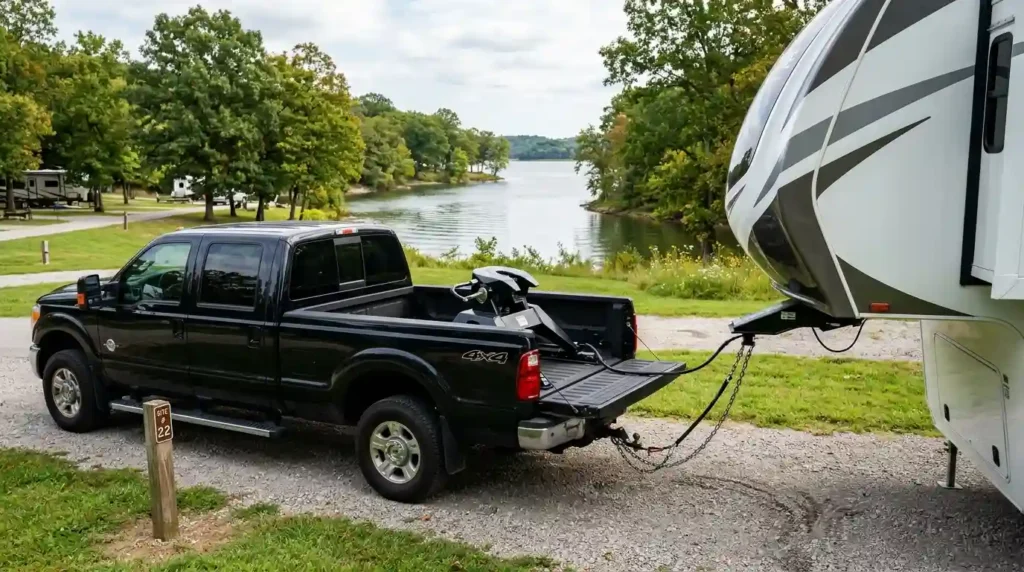
A trailer has no engine and no driver. Its liability exposure, such as a hitch failure while towing, usually flows through the tow vehicle’s policy. So “Do I need to insure my trailer?” has two answers. The law may not require it. Your finances probably do.
| RV type | State requirement (per DOR guidance) | Who often requires more |
| Class A, B or C motorhome | Liability 25/50/25 plus uninsured motorist 25/50 | Lenders: collision and comprehensive |
| Travel trailer, fifth wheel, toy hauler | No separate mandate found; verify with DOR | Lenders, some campgrounds |
| Truck camper | Depends on classification; verify | Lenders |
Does your truck policy cover the trailer? Partly. Its liability usually follows the trailer while hitched. It generally does not pay to repair or replace the trailer itself.
A $35,000 fifth wheel can be fully exposed even when your truck policy is current. Do lenders require coverage? Typically yes. They usually require collision and comprehensive until the loan is paid, so check your loan agreement.
Missouri Motorhome Insurance Requirements
Missouri motorhome insurance requirements start at 25/50/25 liability. That means $25,000 per person and $50,000 per accident for bodily injury, plus $25,000 for property damage. Uninsured motorist bodily injury coverage of 25/50 is also required.
These are split limits. The first number caps what the policy pays for one injured person. The second caps total injury payments in one accident. The third caps property damage.
Liability pays other people. It never repairs your own RV.
Uninsured motorist coverage works the other way. It protects you and your passengers when the at-fault driver has no insurance. Property damage and underinsured motorist coverage aren’t mandated for auto policies, so ask how your RV insurer handles them.
Missouri is an at-fault state. The driver who causes a crash is responsible for the damage. Missouri also applies a pure comparative fault rule, which reduces your recovery by your share of blame. Verify the current statute with a licensed professional.
Here’s the number that matters. This is an illustrative scenario, not a quote. A motorhome driver near Lake of the Ozarks misjudges a turn. The other driver has $45,000 in injuries, and a pickup and fence add $38,000 in damage.
| Item | Loss | Limit | Insurer pays | Left for you |
| Bodily injury (one person) | $45,000 | $25,000 | $25,000 | $20,000 |
| Property damage | $38,000 | $25,000 | $25,000 | $13,000 |
| Total | $83,000 | $50,000 | $33,000 |
The math is simple: $20,000 plus $13,000 leaves $33,000. That shortfall may be pursued against your personal assets.
Decision checkpoint: A state minimum is the legal floor, not protection. If your limits sit at the minimum, ask whether you could absorb a gap like this one. Higher limits and an umbrella policy are the usual ways people address it. Here is what 25/50/25 liability limits mean in more depth.
What Does RV Coverage Include?
A typical camper policy bundles liability, physical damage, and optional add-ons. Wording varies by insurer. Your declarations page and policy form decide what you actually have.
Collision pays for impact damage to your RV, like clipping a low bridge. Comprehensive pays for non-collision losses such as theft, fire, hail, and falling trees. Whether flood fits under comprehensive depends on the wording. Glass damage can also land here: if a rock chips your windshield on I-44, see how a cracked windshield from a rock is handled by insurance before assuming it’s covered.
Personal effects coverage is usually capped at a dollar amount. Awnings, solar panels, and satellite dishes may need to be listed. Custom equipment often needs an endorsement.
Vacation liability covers campsite incidents, like a guest tripping over your power cord. Roadside coverage handles towing and breakdown help, usually with limits.
I think the most underrated item here is the personal effects cap. People insure a $70,000 coach and forget that bikes, tools, and electronics inside may be limited to a few thousand dollars. Check that number on your declarations page.
Missouri RV Insurance Cost
RV insurance cost depends on the driver and the coverage chosen. The one dated insurer figure I found is Progressive’s Missouri page. It reported 2024 averages of $1,098.82 per year for a motorhome and $599.97 for a travel trailer.
That’s one insurer’s mix of policies, not a statewide average. Divide the figures, and you get about $91.57 per month for the motorhome and $50.00 for the trailer. Your quote could land far above or below.
Is a motorhome more expensive than a trailer? Usually, yes. Motorhomes cost more to buy, and the insurer rates you as a driver too.
What else moves the price? RV value is the biggest driver, since physical-damage coverage costs more as the unit costs more. Driving record, usage days, storage type, deductible, ZIP code, and payment plan all play a part.
Covered storage may reduce theft and weather risk, which some insurers reflect in price. A lapse in coverage can raise future quotes.
Here’s an illustrative walk-through, not a quote. Assume a hypothetical $60,000 Class C with a $1,000 deductible. Say liability prices at $400, physical damage at $900, and extras at $150 per year. That totals $1,450, or about $120.83 monthly.
The numbers are invented to show structure. The point is that most of the price sits in physical damage. The RV’s value moves the premium more than the liability limit does.
Best RV Insurance Rates in Missouri
The best RV insurance rates in Missouri are the ones that match your coverage needs at a price you can sustain. No credible ranking exists without your RV, record, and ZIP code. Judge a rate by what it pays, not only by the number.
What’s the cheapest way to insure an RV? Usually a higher deductible, covered storage, a clean record, and bundling where available. If you already carry home and auto insurance with one company, ask whether that carrier offers an RV discount. Discounts vary by insurer, so ask which apply.
A very low quote is often liability-only. That costs less because it pays nothing toward your own RV. It can make sense for an old, paid-off trailer. It’s a poor fit for a financed motorhome.
Now the deductible trade-off. Suppose raising the deductible from $500 to $1,500 saves $90 per year. You take on $1,000 more risk per claim. Break-even is $1,000 divided by $90, about 11.1 claim-free years.
If hail hits in year three, you lose that bet. If you never claim, you win it. That’s how a deductible works.
Decision checkpoint: If a premium is lower because the deductible is higher, ask whether you could comfortably pay that deductible after a covered loss. Review how deductibles work on a claim before choosing.
Trailer and Camper Coverage
A standalone trailer policy covers the unit itself, which the tow vehicle’s policy generally does not. It matters most when the trailer is financed, expensive, or stored away from home.
Picture a weekender at Table Rock Lake with a $28,000 travel trailer on a seasonal site. A limb falls during an ice storm and tears the roof. The truck policy pays nothing toward the trailer.
A comprehensive camper policy would address that loss, subject to its deductible and exclusions. Without one, the owner pays for the roof.
Toy haulers add a wrinkle. The garage may hold motorcycles or ATVs, and those may not count as personal effects. Ask whether they need separate coverage.
Campsite liability is another gap. If a guest is hurt at your site, the tow vehicle’s liability may not respond the way you expect. Vacation liability exists to address that.
ACV, Agreed or Replacement Value?
Valuation decides your payout after a total loss. Actual cash value subtracts depreciation. Stated value is a cap, not a promise. Agreed value fixes the amount in advance. Replacement cost pays for a comparable newer unit, often only for newer RVs.
“Stated value” sounds like a guarantee, but it usually isn’t. Many policies pay the lesser of the stated value or actual cash value at the time of loss. Read the policy language, because the label alone doesn’t settle it.
What happens if your RV is totaled? The insurer values the unit under the policy’s method, subtracts the deductible, and pays the lender first if there’s a loan. Here’s an illustrative case. A Springfield owner owes $58,000 and has a $1,000 deductible. Hail and fire total the motorhome.
| ACV settlement | Agreed value ($60,000) | |
| Payout before deductible | $52,000 | $60,000 |
| After $1,000 deductible | $51,000 | $59,000 |
| Loan balance | $58,000 | $58,000 |
| Result | $7,000 shortfall | $1,000 surplus |
The shortfall is $58,000 minus $51,000. That’s where gap coverage, where available, enters the picture. Availability varies by insurer.
Replacement cost often carries age limits, so confirm the cutoff. See actual cash value versus replacement cost to compare the methods.
Missouri Camper Insurance Quotes
Missouri camper insurance quotes are estimates based on what you report. The final price can move once the insurer verifies your driving record, the RV’s value, and your storage and usage details.
How do you get one? Gather what insurers typically ask for:
- Year, make, model, and VIN of the RV
- Purchase price and any loan details
- Mileage and how many days a year you use it
- Where and how it’s stored
- Driving records for everyone who will drive
- Your current declarations page, if you’re switching
To compare fairly, use one worksheet. Match limits, deductibles, valuation, and add-ons across every quote. A $300 gap means little if one quote uses actual cash value and the other uses agreed value.
An independent agent can quote several carriers. A captive agent sells one company’s products. A direct carrier quotes its own policies, often quickly, but you won’t get a side-by-side. None is automatically better.
Why does the final price move? The insurer may pull your motor vehicle record, re-rate the RV’s value, or add a payment-plan surcharge. A quote is an estimate, not a contract.
There’s friction here too. Quote forms can lead to follow-up calls and emails. Decide in advance how much contact information you’re comfortable sharing.
Missouri Weather and Storage Risk
Missouri’s weather raises comprehensive claim exposure. Hail, tornadoes, river flooding, and ice storms all hit RVs. Standard policies treat each differently, which is why RV insurance of Missouri wording matters more than the price.
When I compared Missouri’s risks against standard policy language, earthquakes stood out. The New Madrid Seismic Zone, mapped by the USGS, lies in southeastern Missouri. Earthquake damage is excluded from standard policies.
Missouri isn’t one risk market. The Ozarks lakes, including Table Rock and Lake of the Ozarks, combine seasonal storage with falling limbs. Springfield and Branson see hail exposure. St. Louis and Kansas City storage lots add theft concerns.
The 2011 Joplin tornado and the 2019 Missouri River flooding show how severe regional weather can be. Flood is usually not covered under standard property policies, and RV treatment depends on the comprehensive wording. See why flood damage needs separate coverage.
Winterization is another trap. A pipe that bursts because the RV wasn’t winterized may be treated as neglect. Some policies list winterization as a condition.
Can you cancel in winter? Cancellation rules and refunds vary by insurer and state. Ask about storage-only options before you cancel, because a lapse can raise future quotes.
Honest limitation: Missouri’s severe weather can make comprehensive coverage more valuable and may push premiums and deductibles up in some areas. I found no verified data to put a number on that, so I won’t guess one.

Living in Your RV
Full-time coverage is designed for an RV that serves as your residence. Recreational policies usually assume occasional use. Each insurer sets its own full-time threshold, so read the definition.
A snowbird who spends five months in Florida may be rated differently from someone who lives in the RV year-round. If that’s your plan, our Florida RV insurance guide covers how the state’s rules and pricing differ. Ask how the insurer counts usage days and whether seasonal rating exists.
Does homeowners insurance cover an RV? Generally not as a vehicle. Some homeowners policies cover contents in limited ways while the unit is parked at your house. Check yours, and if you’re shopping both policies at once, comparing homeowners and car insurance quotes can show whether bundling actually saves money.
Insurance rules change at the state line, so if your route takes you beyond Missouri, here are our guides to Washington RV insurance.
What Is Not Covered?
Camper policies vary, but these exclusions appear often enough to check for in yours:
- Wear and tear, and mechanical breakdown
- Damage from neglect, including skipped winterization
- Roof leaks caused by deferred maintenance
- Rental use, unless endorsed
- Earthquake damage
Roof leaks cause the most confusion. A branch punctures the roof, and water pours in. That’s typically a covered cause of loss, subject to the policy. Caulk that dries out over several seasons and leaks is typically a maintenance issue.
Can you rent your RV out or take it abroad? Rental use may void coverage unless endorsed. Territory terms may limit Mexico and Canada travel. Can you insure an older RV? Some insurers limit eligibility by age or condition, so ask early. Read what standard policies exclude for the general pattern.
How an RV Claim Works
A claim moves from report to inspection, valuation, and payment. Documentation drives the pace. Photos, receipts, your declarations page, and repair estimates help the adjuster evaluate a covered loss.
Start by making the RV safe and preventing further damage. Take photos and video before cleanup. Report the loss and keep receipts for temporary repairs.
How long does a claim take? I found no official timeline for RV claims. It depends on the insurer, the damage, and how well you document it.
What if a claim is denied? A denial letter should state the reason. It may mean the cause was excluded, documentation was missing, or a limit applied. It doesn’t tell you which one by itself. Ask for the specific policy provision. See how the insurance claims process works.
Claim deadlines apply. I believe Missouri allows several years for property damage and injury suits. Verify the exact statutes with a licensed attorney.
Common Mistakes
The most frequent error is assuming the tow vehicle’s policy covers the trailer itself. It usually doesn’t.
Others include choosing a stated value without learning it caps payment, forgetting to list solar panels or awnings, skipping gap coverage on a fast-depreciating financed RV, and letting coverage lapse during storage.
The biggest myth is that “full coverage” covers everything. It doesn’t. Exclusions and limits still apply.
Who Regulates Missouri Insurers?
The Missouri Department of Commerce and Insurance (DCI) regulates insurers and takes consumer complaints. The DOR enforces proof of insurance. Start at the DCI consumer page to check an agent’s license or file a complaint.
If you receive a cancellation or nonrenewal notice, DCI can explain the notice rules that apply. Ask in writing and keep copies.
What to Check Before You Decide
The core point holds in Missouri: a motorhome has legal requirements, while a trailer mostly has practical ones. Missouri RV insurance works best when you compare identical coverage, not just identical prices.
Your next step is concrete. Pull your declarations page and read the liability limits, valuation method, and deductible. Then verify any legal question with the DOR or DCI.
FAQs
Is RV insurance required in Missouri?
Motorhomes must meet the state’s motor vehicle liability and uninsured motorist rules, the same as your car. For towed trailers, I found no separate state mandate in the DOR guidance I reviewed. Confirm that point with the DOR directly.
Does my truck cover my trailer?
Its liability usually follows the trailer while hitched. It generally does not pay to repair or replace the trailer itself. A fire, hail, or fallen limb at the campsite would typically fall on you without a separate policy.
What are Missouri’s minimum limits?
The DOR requires 25/50/25 liability: $25,000 per person and $50,000 per accident for bodily injury, plus $25,000 for property damage. Uninsured motorist bodily injury coverage of 25/50 is also required. These are the legal floor, not full protection.
How much does it cost?
One insurer, Progressive, reported 2024 Missouri averages of $1,098.82 per year for a motorhome and $599.97 for a travel trailer. That is one insurer’s mix of policies, not a statewide average. Your quote will depend on RV value, driving record, usage, and deductible.
Can I insure for part of the year?
Some insurers offer seasonal or storage-only options. Availability varies, so ask before you cancel for winter. A lapse in coverage can raise future quotes.
Does homeowners insurance cover my RV in Missouri?
Typically not as a vehicle. Some homeowners policies cover contents in limited ways while the RV is parked at your house. Check your own policy for the details.
Do lenders require full coverage?
Lenders typically require collision and comprehensive until the loan is paid. This applies to financed motorhomes and trailers alike. Confirm the exact requirements in your loan agreement.
How do I file a complaint with the DCI?
Contact your insurer first and try to resolve the issue directly. If that fails, use the complaint process on the Missouri Department of Commerce and Insurance website. Keep copies of all notices and correspondence.