
SkiSafe insurance reviews are mixed and thin: a retrieved Trustpilot profile showed 3.8 out of 5 from nine reviews, and a small, self-selected sample cannot prove how your claim will go. Legitimacy, coverage quality, and claims experience are separate questions, so verify the underwriting insurer, state authorization, and policy wording before you buy.
You found a boat insurance brand, you want to know whether to trust it with a vessel that may be worth tens of thousands of dollars, and the internet has handed you star ratings. Stars are a start. They are not an answer.
This guide pulls the available evidence apart on purpose. It covers SkiSafe’s own published materials, a Trustpilot profile, a BBB business profile, a consumer-review publication, and the National Association of Insurance Commissioners’ guidance on researching insurers. It also lists what I could not verify, because an honest gap is more useful than a confident guess.
Is SkiSafe Insurance Legit?
Nothing in the sources I reviewed suggests SkiSafe is not a real business: it publishes coverage explanations and claims guidance, and it has a BBB profile. But “real business” and “verified insurer for my state and my boat” are different standards, and only the second one protects you after a loss.
Legitimacy gets confirmed by identifying the company that actually underwrites your policy and checking that it is authorized where you live. I did not have a current SkiSafe policy in hand, so I can’t confirm that entity myself.
Company and underwriting identity
Start with what role SkiSafe plays. It could be an insurer, an agency, a program administrator, or another structure, and your policy documents are where that gets disclosed. The declarations page and policy form name the entity with contractual responsibility.
Some sources point to AXIS Insurance Company as the underwriting insurer, and AXIS Capital is the related group name. Treat that as a lead to verify against your own declarations page, not a fact to repeat. The NAIC cautions that insurer names can differ across subsidiaries, so a search for the wrong legal name can return the wrong record.
Why does this matter so much? Because complaint records, state licensing, and financial strength ratings attach to the legal entity, not to the brand on the quote page.
State licensing and financial strength
Once you have the exact entity, check it with your state insurance department and the NAIC’s Consumer Insurance Search, which lets you research insurers by state, company, and insurance type. The New York State Department of Financial Services also runs a company search, though a listing there does not by itself prove a company currently writes a particular product.
For financial strength, use AM Best’s current rating for the specific underwriting entity, not a related company. These ratings are opinions about financial capacity, not promises about how any single claim will be handled. If a third-party page quotes an older rating, check the date before you trust it.
One more safeguard sits in the background: many states run guaranty associations that may protect eligible policyholders if a member insurer becomes insolvent, subject to state law and limits.
BBB status and business records
The BBB profile I retrieved identifies SkiSafe as not BBB accredited while displaying an A+ rating. Those two facts can both be true, because accreditation and a letter grade are different measures. Neither one tells you whether the insurer is licensed or how it handles claims.
| Source | What it can tell you | What it cannot tell you |
| SkiSafe’s own pages | The coverage and claims process the company describes | Whether every claim is paid quickly or favorably |
| Policy and declarations page | The contract, limits, deductibles, and underwriting entity | How the insurer behaves in a dispute |
| NAIC and state insurance department | Licensing and official complaint information for the exact insurer | Individual satisfaction |
| AM Best rating | Financial capacity of the rated entity | Claims-handling quality |
| BBB profile | Business information and complaint activity | Insurance licensing or financial strength |
| Trustpilot | Individual customer experiences | A representative picture of all policyholders |
Decision checkpoint: If you can’t find the underwriting insurer’s name on your quote or declarations page, treat that as the first thing to resolve. Everything else, from complaints to ratings, depends on knowing the right legal entity.
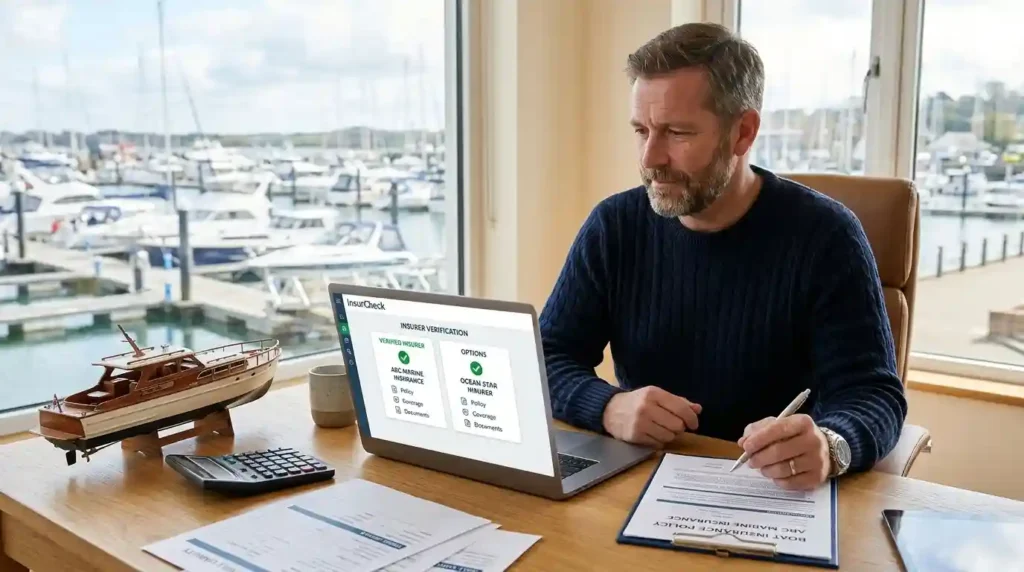
SkiSafe Boat Insurance Reviews: Coverage and Exclusions
SkiSafe’s own materials describe options including agreed value, liability, medical payments, towing, and physical damage coverage. Those are the company’s stated offerings, so read them as a menu and confirm the actual terms in the policy you are offered, because coverage varies by boat, state, and endorsement.
Main coverage types
| Coverage | What it generally does | What to confirm in the policy |
| Physical damage | Pays for covered damage to your boat | Covered causes, deductible, valuation method |
| Liability | Covers specified legal responsibility to others | Limit amounts and excluded uses |
| Medical payments | Helps with qualifying medical expenses | Limit and who is covered |
| Towing | Eligible emergency assistance | Dollar cap and conditions |
| Trailer and personal property | Protection for the trailer and belongings | Whether included, limits, sublimits |
Homeowners policies tend to give boats limited protection, so don’t assume your home policy fills a gap. Our homeowners insurance quote guide explains how those policies treat belongings and where they stop.
Agreed value, ACV, and replacement cost
This is the concept to understand before you compare anything else. Agreed value means the policy states an insured amount and settlement is based on it, subject to the terms. Actual cash value (ACV) generally accounts for depreciation. Replacement cost may pay eligible repair or replacement without certain depreciation deductions, depending on the endorsement.
A total loss means the boat meets the policy’s total-loss criteria. A partial loss is damage short of that. The two are often settled differently, and many disputes start in that gap.
Here is an illustrative partial loss, not SkiSafe’s actual formula. A covered repair costs $4,500, and the deductible is $1,000. If the deductible applies once and nothing else is adjusted, the payment is $3,500.
Now suppose $2,000 of that repair is parts, and the policy depreciates parts by 25 percent. Depreciation would be $500, so the payment becomes $4,500 − $500 − $1,000 = $3,000. Same repair, $500 less in your pocket, purely because of settlement wording.
Exclusions to check
Four policy provisions deserve a line-by-line read:
- Wear and tear: gradual deterioration is commonly excluded.
- Maintenance and neglect: damage tied to poor upkeep can be excluded.
- Navigational limits: coverage may apply only within stated operating areas.
- Storm and hurricane terms: wording and endorsements vary, so don’t assume all storm damage is covered.
The premium alone does not tell the whole story. SkiSafe’s FAQ describes premiums as depending on vessel value and condition, navigation area, claim history, selected coverage, and deductibles, which means two quotes can differ because of coverage choices, not just risk.
What Do SkiSafe Insurance Reviews Show?
The evidence I could retrieve is small and mixed. Here is the ledger, with the caveat that ratings and review counts change, so recheck each source before you rely on it.
| Source | What was displayed | Limitation |
| Trustpilot | 3.8/5 from nine reviews, mixed experiences | Small, self-selected sample |
| BBB | Not accredited; A+ rating | Grade and accreditation differ; neither measures claims quality |
| ConsumersAdvocate | 4/5 overall assessment | Underlying data includes older information |
| SkiSafe’s pages | Coverage and claims descriptions | Company’s own statements, not independent proof |
How small a sample is too small?
Nine reviews can move a lot. Suppose they total 34 stars, which averages about 3.78 and rounds to 3.8 (an assumption for illustration). One new 1-star review would drop the average to 3.5, and one new 5-star review would lift it to 3.9. A single person can swing the headline number by a quarter point or more.
That is why I won’t blend these sources into one overall score. Each measures something different.
Sales experiences versus claims
Many reviews of any insurer describe quoting, billing, or customer service, not a claim. Only some speak to SkiSafe boat insurance claims experience, and I’m not going to invent themes the data doesn’t support. When you read reviews yourself, sort them: sales and service, billing, and claims. Then check dates, and ask whether the reviewer’s boat and situation resemble yours.
Searching for SkiSafe insurance complaints is a sensible step, but a complaint is one person’s account. It is not a regulator’s finding, and it isn’t proof of company-wide conduct.
What reviews cannot prove
Reviews can’t tell you your claim will be paid, denied, or how fast. They can’t establish a complaint ratio, an average settlement time, or a denial rate, and I have not verified any of those for SkiSafe. If you see one published without a traceable source, treat it with suspicion.
SkiSafe Insurance Complaints: What Should You Check?
Official complaint records are stronger evidence than customer reviews, because they are tied to a regulated legal entity and tracked by a regulator. The catch is that you need the right entity name, and I have not verified a current SkiSafe-specific NAIC complaint index.
Reviews versus official complaints
A review is a customer’s opinion posted to a platform. A BBB complaint is a record on a business profile. A state complaint is a formal dispute channel with the insurance regulator. Each carries different weight, and none replaces the others.
How to search
- Identify the exact underwriting insurer from your policy documents.
- Search it in the NAIC Consumer Insurance Search.
- Check your state insurance department’s records for that insurer.
- Compare complaint information alongside financial strength and premium, not as the only factor.
The same method works for any company. If you want to see it applied to another insurer, our look at Direct General Insurance follows a similar review-and-record approach.
How to interpret what you find
Look at complaint types, time period, and company size. A handful of complaints against a large insurer reads very differently from the same number against a small one. And a single complaint, or an unverified count, should never be the basis for a conclusion.
What stood out to me while organizing these sources is how often “reputation” gets built from the cheapest evidence, a star rating, while the strongest evidence, the regulator’s record for the exact legal entity, sits one search away and goes unchecked.
Decision checkpoint: If the complaint record for the underwriting insurer looks reasonable but the reviews are thin, the question becomes whether you’re comfortable with the policy terms, because terms, not stars, decide your outcome.
SkiSafe Boat Insurance Claims Experience: What to Expect
Claims is where insurance becomes real, and where the evidence is weakest. I found no verified approval rate, average payout, or settlement timeline for SkiSafe, so I won’t offer one. What I can do is explain how a boat claim generally works and where it tends to snag.
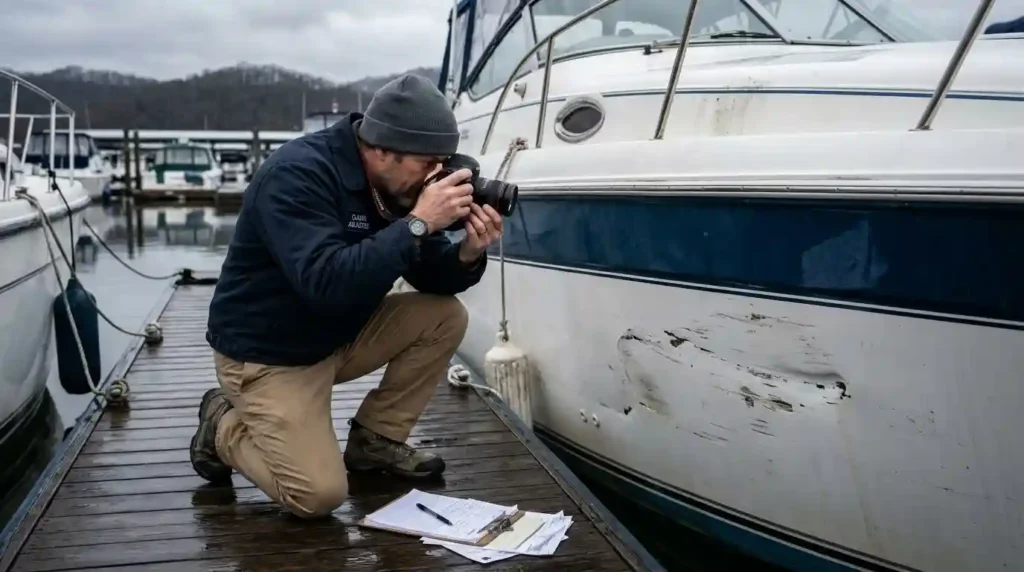
How boat claims are evaluated
A typical claim moves through these steps:
- Report the incident and document it with photos and receipts.
- The insurer reviews coverage and may assign a claims adjuster.
- An estimate or inspection determines repair cost.
- The deductible, limits, exclusions, and valuation method are applied.
- The insurer issues a settlement or explains a denial.
SkiSafe describes its claims procedures on its website. Treat that as the company’s stated process, not independent proof of how quickly or favorably claims are paid.
Where claims get stuck
The friction points are predictable: a repair estimate that differs from the adjuster’s, depreciation on parts, an exclusion for wear or neglect, and a navigation limit that didn’t match where the incident happened. None is unique to one insurer, but all are worth understanding before you buy.
Picture a storm that damages a boat on a trailer in storage. Whether that loss is covered depends on the storm wording and any endorsement, which is exactly the clause to read before the season begins. Or picture a collision outside the policy’s stated operating area. The loss could be excluded no matter how good the insurer’s reviews look.
If you disagree with a decision
A denial doesn’t tell you why by itself, so ask for a written explanation and compare it with the policy language. Then:
- Gather your own repair estimates and photos.
- Keep a written record of every communication.
- Use the insurer’s internal appeal or review process.
- Contact your state insurance department if the dispute isn’t resolved.
The appropriate regulator depends on the underwriting insurer and your state, which is one more reason to know the exact legal entity.
How Much Does SkiSafe Boat Insurance Cost?
I have no reliable current average premium for SkiSafe, so I won’t publish one. What I can say, based on SkiSafe’s own FAQ, is that price depends on vessel value and condition, navigation area, claim history, selected coverage, and deductibles. Verified quotes come only from requesting one.
Compare quotes on equal terms
A cheaper quote may simply carry a higher deductible or narrower coverage. Take two hypothetical quotes: Quote A at $890 a year with a $500 deductible, and Quote B at $740 a year with a $2,000 deductible. Quote B saves $150 a year but adds $1,500 of exposure per claim, so it takes about 10 claim-free years to break even.
Decision checkpoint: If a lower premium comes from a higher deductible, ask whether you could comfortably pay that deductible after a covered loss.
Ask about discounts, such as safety training or multi-policy savings, and confirm them in writing, since availability varies. For how multi-policy pricing works, see our overview of home and auto insurance bundles.
How Does SkiSafe Compare With Other Boat Insurers?
You can’t judge SkiSafe fairly without comparing identical coverage, and I have not researched specific competitor policies, so I’m not going to fill a table with guesses. Use this framework with real quotes:
| Comparison point | SkiSafe | Insurer A | Insurer B |
| Underwriting insurer | Verify from your policy | Verify | Verify |
| Valuation method | Confirm available option | Confirm | Confirm |
| Deductible | Compare actual quote | Compare | Compare |
| Navigational limits | Read wording | Read | Read |
| Trailer, towing, belongings | Confirm limits | Confirm | Confirm |
| Complaint record | Research exact insurer | Research | Research |
| Review sample and date | Date-stamp | Date-stamp | Date-stamp |
Reading SkiSafe boat insurance reviews next to quotes from others only helps if the coverage matches. Our broader piece on the best car insurance companies shows the criteria approach in another line, and the quote-gathering basics in how to get car insurance transfer well.
A forward-looking opinion, labeled as one: I expect review counts and ratings on all these platforms to keep shifting, so any snapshot, including mine, should be rechecked before you commit.
Who Should Consider SkiSafe?
I won’t call SkiSafe the best or worst insurer, because no comparable evidence supports either label. A more useful question is whether its policy fits your boat and your use. Ask:
- Does the policy cover my vessel type and how I use it?
- Are the navigational limits suitable?
- Is the valuation method acceptable?
- Can I manage the deductible and premium?
If coverage isn’t available, an exclusion doesn’t fit, or the terms fall short, compare alternatives. If the underwriting insurer checks out, the policy terms suit you, and the complaint record is reasonable, the case for SkiSafe rests on documents, not stars.
Final Thoughts: Verify the Insurer, Then Read the Policy
So what do SkiSafe insurance reviews actually tell you? A small, mixed picture that can’t predict your claim. What protects you is the underwriting insurer, its state authorization and complaint record, and the policy wording on valuation, depreciation, exclusions, and navigation limits.
The most useful next step is concrete: get the quote’s declarations page, identify the exact underwriting company, and look it up with the NAIC and your state insurance department before you decide.
FAQs
Is SkiSafe insurance legit?
Nothing I reviewed suggests it isn’t a real business, but legitimacy means confirming the underwriting insurer and state authorization. Check your declarations page, the NAIC, and your state insurance department.
Who underwrites SkiSafe boat insurance?
Some sources point to AXIS Insurance Company, but confirm the exact entity on your current policy. Insurer names can differ across subsidiaries, and records attach to the legal entity.
What do SkiSafe reviews say?
A Trustpilot profile showed 3.8/5 from nine mixed reviews when I checked. That is a small, self-selected sample and can change.
What complaints have customers raised?
I did not verify a SkiSafe-specific NAIC complaint index, and individual complaints are accounts, not regulator findings. Check official records for the exact insurer.
Does SkiSafe offer agreed value coverage?
Its materials describe agreed value as an option, but terms depend on the policy you are offered. Read the settlement wording before relying on it.
Can depreciation affect a claim?
It can, depending on the valuation method and wording for partial losses. Ask how depreciation applies to repair parts.
How can I check an insurer’s complaint record?
Use the NAIC Consumer Insurance Search and your state insurance department, using the exact legal entity name. Consider complaints alongside financial strength and premium.
What should I do if I disagree with a settlement?
Request a written explanation, compare it with your policy, gather estimates, and use the insurer’s appeal process. If unresolved, contact your state insurance department.