
USAA renters insurance may cover certain injuries or property damage your pet causes to other people under its personal liability coverage, subject to policy limits, exclusions, and conditions. It generally does not cover your pet’s veterinary bills or damage your pet does to your own belongings. Your declarations page and policy form decide the actual answer.
If you’re asking, Does USAA renters insurance cover pets?, the answer depends on what happened and whose injury or property damage is involved. You probably have a dog or cat, a lease, and a vague worry that “pet coverage” means something different on every website. That worry is fair. The phrase covers three separate problems, and a renters policy handles only one of them well.
Here are the three. First, liability: your pet hurts someone or damages their property. Second, damage to things you or your landlord own. Third, your pet’s own medical costs. USAA’s renters policy is built around the first. Separate pet health insurance, sold through USAA’s agency, is aimed at the third. The second is where most renters get caught off guard.
This guide sticks to USAA’s published renters policy language and documented industry data. When an answer depends on your form, your state, or the facts of an incident, I’ll say so instead of guessing.
Does USAA renters insurance cover pets?
USAA renters insurance does not insure the pet itself. It may respond when your pet causes covered injury or property damage to someone else, because that falls under personal liability. Vet care and chewed belongings are generally outside what a renters policy is built to pay.
The simplest way to hold this in your head: renters insurance protects you from what your pet does to other people, not from what happens to your pet or what your pet does to your stuff.
What May Be Covered
Coverage may apply when you’re legally responsible for someone else’s injury or property damage, and the loss fits the policy’s terms. That’s the heart of personal liability. Depending on your form, it can also include a defense if you’re sued, plus limited medical payments for people hurt on your premises.
- Injury to a visitor, neighbor, or delivery worker caused by your pet, if you are legally responsible and no exclusion applies.
- Damage your pet causes to another person’s property, such as a neighbor’s belongings.
- Legal defense costs for a covered liability claim or suit, as the contract defines them.
- Medical payments to others, if your declarations page shows that coverage and the injury qualifies.
What Usually Is Not Covered
A renters policy isn’t veterinary insurance, and it isn’t a pet-damage warranty. Three things typically fall outside it: your pet’s illness or accident bills, damage your pet does to your own property, and anything the policy language or an endorsement specifically excludes.
That third category deserves attention. A general statement that liability “covers pets” never overrides an exclusion in your actual form.
Quick Coverage Table
This table shows which part of the policy to investigate for each common scenario. It is a map for reading your documents, not a coverage decision.
| Scenario | Coverage to investigate | Important qualification |
| Dog bites a visitor | Personal liability; medical payments to others | Must satisfy policy terms and exclusions |
| Dog damages a neighbor’s belongings | Property damage liability | Legal responsibility and the definition of covered property damage matter |
| Dog chews your sofa | Personal property coverage | Pet-caused damage is generally not an ordinary covered renters loss |
| Dog damages the rental unit | Rented-property provisions and exclusions | Do not assume landlord damage is covered |
| Dog needs veterinary treatment | Separate pet health insurance | Renter’s liability is not veterinary coverage |
| Dog injures a household member | Bodily injury and insured-person exclusions | Household status can materially affect coverage |
The Policy Detail Most People Miss: the word “insured.” USAA’s policy defines who counts as an insured person. Liability coverage protects insureds from claims by others. That’s why people who live in your household are treated differently from guests. Read the definitions before the coverage grant.
Does USAA renters insurance cover pet damage?
It depends on whose property gets damaged. Your own belongings generally aren’t covered. Your landlord’s unit raises a separate, often unfavorable question. A third party’s property may fall under liability. Three situations, three different answers.

Damage to Your Own Belongings
A chewed sofa, scratched table, or stained rug generally isn’t paid for under renters’ personal property coverage. That coverage protects your belongings from named perils like fire or theft. A pet chewing, scratching, or soiling is wear and tear or animal damage, not a typical insured peril.
In practice, this surprise is common. Many renters assume “personal property coverage” means “anything that happens to my stuff.” It doesn’t. If you’re wondering, Does USAA renters insurance cover pet damage?, first identify whether the damaged property belongs to you, your landlord, or someone else. Our guide to USAA renters insurance coverage shows what that protection does include.
Illustrative example (not an actual claim): a $1,200 sofa is chewed beyond repair. The loss generally falls outside the policy, so the realistic out-of-pocket cost is the full $1,200. The exception would be a specific endorsement you bought that says otherwise.
Damage to a Rental Unit
Don’t assume USAA will pay your landlord for flooring, doors, or carpets your pet damaged. Liability policies commonly exclude property rented to, occupied by, or in the care of an insured. Some forms have limited exceptions, so read the exact wording in yours.
Most renters ask the same thing here: is the deposit my only exposure? Not necessarily. A security deposit is a lease and state-law mechanism, not insurance. If repairs cost more than the deposit, your lease may let the landlord pursue the difference.
Illustrative example: a $900 door replaced after scratching, against a $1,500 deposit, may just reduce your refund. A $4,800 flooring replacement against the same deposit could leave $3,300 for you to deal with directly. Lease terms, flooring depreciation, and your state’s deposit rules all affect the result.
Damage to Someone Else’s Property
When your pet damages a neighbor’s belongings, personal liability is the section to check. This is where the policy is designed to respond, as long as you’re legally responsible and the damage fits the policy’s definition of property damage.
It is a useful contrast: the same pet behavior can be an uncovered first-party loss in your apartment and a potentially covered third-party loss in the apartment next door.
Where Expectations Can Differ: “damage to others” doesn’t reach the landlord the way many people assume. The landlord is a third party in everyday terms. But the rented-property exclusion can still apply to the unit you live in.
Does USAA renters insurance cover dog bites?
If you’re asking, Does USAA renters insurance cover dog bites?, a dog bite may be covered under personal liability if you’re legally responsible and no exclusion applies. The Insurance Information Institute (Triple-I) notes that homeowners and renters policies typically cover dog-bite liability, subject to limits and exclusions.
That is general industry guidance, not a guarantee for your policy.
When Liability May Apply
Liability usually turns on whether you’re legally responsible under the law where the injury happened. A friend bitten in your living room, a delivery worker hurt at your door, a neighbor bitten in the hallway: these are the situations liability coverage exists for.
Legal responsibility isn’t the same everywhere. California has a statute (Civil Code section 3342) that makes dog owners liable for most bites to people in public places or lawfully on private property. Florida’s statute (Florida Statutes section 767.04) also places liability on owners, with allowances when the victim was negligent. Other states use versions of the “one-bite” rule or negligence standards. I’m citing these two only to show the range, so check the current statute for your own state. Readers in those states can also see our California insurance claim lawyer guide and Florida insurance claim lawyer guide for how claim disputes are generally handled.
This is where the state rule changes the practical answer. In a strict-liability state, it may be easier to establish that you’re legally responsible. That makes your liability limit and defense provision matter more.
Decision checkpoint: the useful question is not “is my dog the kind that bites?” It is “if someone is hurt on my premises or by my dog elsewhere, do I know my liability limit and what my policy says about animals?”
Household Members and Prior Incidents
Injuries to people who live in your household are typically excluded from liability and medical payments coverage, because those people are generally insureds themselves. Prior bite history is a different issue. It can affect underwriting or how an animal is treated. Still, I wouldn’t assume a blanket USAA breed or bite-history rule without checking current guidance.
I haven’t found reliable public evidence of a single USAA-wide breed ban. Online, you’ll see conflicting breed information, much of it about other insurers. Rules can also differ by state and policy form. The safer move is to ask USAA directly and get the answer in writing.
Medical Payments vs. Liability
Medical payments to others and liability are different tools. Medical payments may cover limited, eligible medical bills for someone hurt on your premises, usually without deciding who was at fault. Liability responds when you’re legally responsible, and it handles larger claims, settlements, and defense.
| Feature | Medical payments to others | Personal liability |
| Typical purpose | Smaller medical bills for injured guests | Legal responsibility, settlements, lawsuits |
| Fault required? | Often no | Generally yes, legal responsibility |
| Size | Usually a much lower limit | Selected limit on the declarations page |
| Household members | Typically excluded | Typically excluded from the claim |
Check whether your declarations page actually shows both coverages. Some renters assume the second exists because the first does.

USAA renters insurance dog liability coverage
Dog liability coverage is the personal liability portion of your renters policy, with a maximum amount shown on your declarations page. A covered claim is paid up to that limit, and anything above it may remain your responsibility. The limit is a ceiling, not a promise that every claim reaches it.
Personal Liability Limits
USAA renters insurance dog liability coverage is governed by the limit and terms shown in your policy, so review the declarations page before you need it. Your declarations page lists the liability limit you selected. Find it before you need it. The limit applies per covered claim as the policy defines it, and prior payments may affect what remains.
Here is how limits work from first principles, using two hypothetical claims against a $100,000 limit:
- Claim totals $80,000. The amount sits below the limit. That does not make it automatic. The insurer still evaluates legal responsibility, exclusions, conditions, and the covered amount.
- Claim totals $150,000. The 50,000abovethelimit(150,000 minus $100,000) could remain the insured’s responsibility, depending on the facts and any other applicable insurance.
These are illustrative numbers, not a prediction of any USAA decision or settlement.
Industry data helps with scale. Triple-I, using data attributed to Triple-I and State Farm, reported 28,450 dog-bite and other dog-related injury claims in 2025, with a total value of about $1.862 billion and an average of $65,450 per claim. (Check: 28,450 × $65,450 is roughly $1.862 billion.) Those are industry-wide figures, not USAA statistics.
Here is the unexpected part. An average of $65,450 sits comfortably under a $100,000 limit, which makes $100,000 look generous. But an average blends minor bites with severe facial injuries, so a single serious claim can exceed the average by a wide margin. The average describes the middle of the distribution, not the risk you are buying protection against.
Decision checkpoint: if a claim at the industry average would use about 65% of a 100,000limit(65,450 divided by $100,000), the question worth asking is how comfortable you are with the remaining margin, and whether other insurance sits above it. That is a question about your finances and risk tolerance, so it is yours to weigh, not something this article can answer for you.
Legal Defense and Settlements
Liability coverage usually includes a duty to defend a covered suit, and defense costs may be handled separately from, or inside, the limit depending on the form. Do not assume which; check the wording on defense expenses.
In a settlement, the insurer typically negotiates and pays covered damages up to the limit. Settlement offers reflect covered damages and applicable limits, not necessarily what the injured person demands.
When to Consider Umbrella Insurance
Umbrella insurance may add liability limits above your underlying policy, but it comes with its own exclusions and underwriting rules. Some umbrella policies restrict or exclude certain animals or breeds, so an umbrella is not automatic extra protection for a dog bite.
If you already face an animal exclusion in your renters policy, buying more limits on top does not erase it. Confirm how the umbrella treats the specific animal before relying on it.
What Changes the Real-World Outcome: A higher limit raises the ceiling on a covered loss. It does not turn an excluded loss into a covered one. People often raise limits when the real problem is a coverage gap.
USAA renters insurance pet liability exclusions
USAA renters insurance pet liability exclusions can change the answer even when an incident would otherwise appear to fit personal liability. Exclusions are where a general “yes” turns into a specific “no.” USAA’s published renters policy contains personal liability provisions and exclusions, and those exact words control. The most relevant ones for pet owners concern animals, rented property, household members, and intentional acts.
Animal-Related Restrictions
Start with the liability section and any endorsements added to your policy. Look for wording about animals, prior incidents, and categories of animals the insurer treats differently. Underwriting rules about breeds, exotic animals, or prior bite history may sit outside the policy form, so ask.
A pet that must be disclosed but was not can create trouble. Misrepresentation on an application may affect eligibility or how a claim is handled, so accuracy at the application stage matters.
Other Important Exclusions
Pet owners most often run into these exclusions:
- Damage to your own belongings. Property coverage is not built for pet chewing or scratching.
- Property rented to or in the care of an insured. This is the landlord-unit issue.
- Injuries to household members. Typically excluded because they are insureds.
- Intentional or criminal acts. Liability coverage is designed for accidents, not deliberate harm.
A helpful distinction: accidental and foreseeable are not the same. A policy exclusion for intentional acts generally concerns what the insured intended, not whether an incident could have been predicted. How an insurer applies that to a specific bite is a claim-facts question.
How to Read the Policy
Read in this order: declarations page first, then definitions, then the liability insuring agreement, then exclusions, then endorsements. Endorsements are last on the page but often first in priority, because they modify the standard terms.
I went through the layout of the published policy structure while preparing this, and what stood out is how many answers depend on a definition rather than the coverage grant. People hunt for the word “dog” and miss that “insured” and “property damage” do the real work.
USAA renters insurance coverage for pet injuries
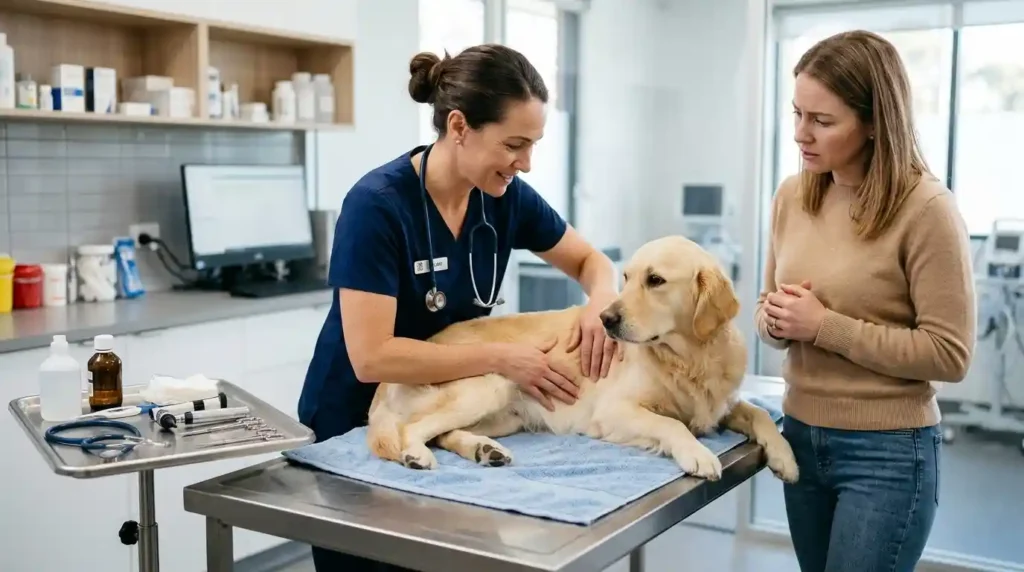
USAA renters insurance coverage for pet injuries depends on who is injured: another person may have a liability claim, while your own pet’s veterinary costs generally require separate pet health insurance. The phrase “pet injuries” has two directions. When your pet injures another person, liability may apply. When your pet itself is hurt or sick, renters insurance does not pay, and separate pet health insurance is the product designed for veterinary expenses.
When Another Person Is Injured
Third-party bodily injury is the covered-category core of the policy: physical injury to someone else for which you are legally responsible. A cat scratch that becomes infected can be as much a bodily injury claim as a dog bite, depending on facts, though severity and legal responsibility vary.
If your pet injures someone else’s pet, that is typically analyzed as property damage because pets are generally treated as property under the law, which is a legal classification, not a statement about their value to you. Coverage then turns on the policy’s definition of property damage and any animal-related wording.
When Your Own Pet Gets Hurt
Renters insurance does not pay for your pet’s illness, accident, or routine care. A $3,500 emergency surgery is an out-of-pocket cost unless you have separate pet health insurance or other funds set aside. It is a first-party health expense, not a liability claim.
Pet Insurance vs. Renters Insurance
Pet health insurance and renters liability protect against different things, so one does not substitute for the other. USAA’s agency offers pet health insurance as a separate product; confirm the issuing insurer and terms in that policy’s own documents.
| Question | Renters insurance (liability) | Pet health insurance |
| Who gets protected? | You, from claims by others | Your pet’s veterinary expenses |
| Typical trigger | Pet injures someone or damages their property | Your pet is sick or injured |
| Paid to | The injured third party (via the insurer) | Generally reimbursed to you |
| Common limits | Per-claim liability limit | Annual limits, deductibles, reimbursement percentage |
| Common conditions | Exclusions, insured definitions | Waiting periods, pre-existing condition exclusions |
| Fixes a liability exclusion? | n/a | No |
Buying pet health insurance does not close a liability gap. And a strong liability limit does not pay a vet.
A realistic case where the “obvious” option is not practical: a renter with a dog that has a documented prior bite might assume a higher liability limit solves the problem. If the policy or underwriting treats that history as a restriction, the extra limit may protect very little. The practical step is to learn how the insurer treats the animal before paying for more limits.
How to Verify Your Coverage
Verification takes three documents and one phone call or message. Your declarations page, the full policy form with endorsements, and written answers from USAA together tell you more than any article, including this one.
Find Your Declarations Page
Your declarations page shows the policy period, the insureds, the selected liability limit, whether medical payments to others are included, and any deductible. It is usually available in your online account or the policy packet. Confirm the issuing insurer named on the page, since the underwriting company matters for complaints. Belongings kept off-site raise their own questions, which we cover in USAA renters insurance and storage units.
Ask USAA These Questions
Put these in writing so the answer is documented:
- Does my policy cover this specific pet and this type of incident?
- Are there animal-related exclusions, endorsements, or underwriting restrictions on my animal?
- Does liability coverage apply away from my residence?
- How are defense costs and medical payments handled, and do defense costs reduce the limit?
- Does pet ownership or a prior incident affect my eligibility or premium?
What to Do After an Incident
Safety and medical care come first. After that, a few ordinary steps preserve your position:
- Get medical help for the injured person and separate the animals.
- Write down what happened while memory is fresh: date, location, people present, and the pet’s vaccination status.
- Keep photos, medical records you are given, and any messages about the incident.
- Report the incident to your insurer promptly and follow its instructions, including requests for statements or records.
- Avoid speculation about fault in writing or conversation; stick to facts.
Here is the part many policyholders discover only afterward: claims take time and paperwork. The insurer may request recorded statements, medical records, or incident reports, and the process can run weeks or longer. Delay in reporting can create complications, so reporting early is worth the small effort.
If a claim is denied, you can ask for the written reason and the specific policy provision relied on. If you disagree, the state insurance department handles consumer complaints; the NAIC publishes a directory of state insurance departments to find yours. Outcomes depend on policy wording, state law, and facts, and a qualified professional can advise on your individual situation.
Final Takeaway: Check the Policy Before the Incident
Whether USAA renters insurance covers pets depends on which of three things you mean. Liability for injuries or damage to others may be covered. Damage to your own belongings or the rental unit generally is not. Your pet’s vet bills belong to separate pet health insurance.
So, Does USAA renters insurance cover pets? It may cover certain claims involving harm to other people, but it generally won’t pay your pet’s vet bills or repair your own pet-damaged belongings. The single most useful next step is to pull up your declarations page today, note your liability limit, and ask USAA in writing how your specific pet is treated. Doing it before an incident means you learn the answer on your schedule.
FAQ’s
Does USAA cover dog bites?
Possibly. A dog bite to someone else may fall under personal liability if you are legally responsible and no exclusion applies. Confirm against your policy and limit.
Does USAA cover damage pets cause to furniture?
Generally no. Damage by your own pet to your own belongings is not typically a covered renters loss.
Does USAA pay veterinary bills?
Renters insurance does not. Veterinary expenses are what separate pet health insurance is designed for, subject to its own exclusions and waiting periods.
Does USAA exclude certain dog breeds?
I would not assume so without confirmation. Breed and bite-history rules can vary by insurer, state, and form, so ask USAA and keep the response in writing.
Can umbrella insurance cover a dog bite?
It may add liability limits, but umbrella policies can have their own animal exclusions. Read the umbrella wording separately.
What if USAA denies a pet-related claim?
Ask for the written explanation and the policy provision cited. You can then review it, ask for reconsideration, or contact your state insurance department.